
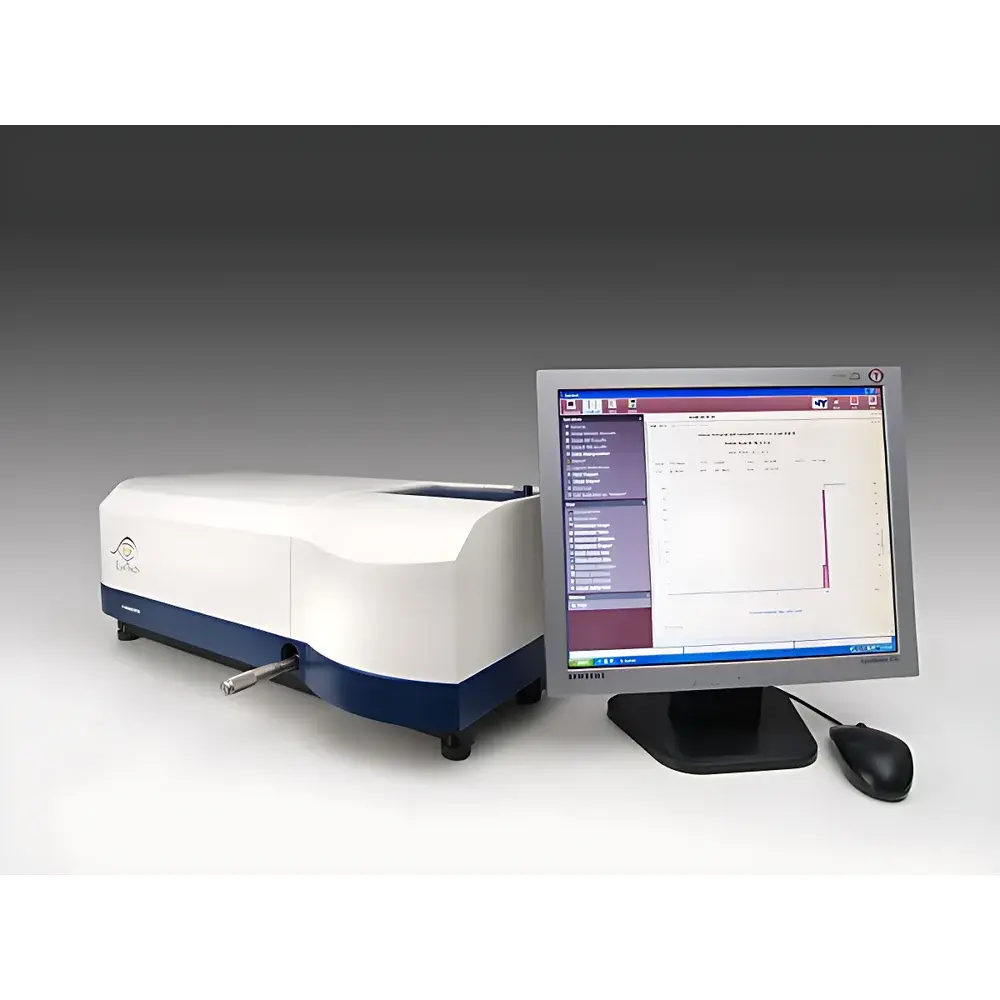
EyeTech Laser Particle Size and Shape Analyzer by Ankersmid
| Brand | Ankersmid |
|---|---|
| Origin | Netherlands |
| Model | EyeTech Laser Particle Size and Shape Analyzer |
| Dispersion Method | Dry & Wet |
| Instrument Type | Laboratory Laser Particle Analyzer |
| Measurement Range | 0.1–3600 µm |
| Repeatability | <1% |
| Measurement Time | 30–60 s |
| Principle | Combined Laser Obscuration (LO) and Dynamic Image Analysis (DIA) |
Overview
The EyeTech Laser Particle Size and Shape Analyzer, engineered by Ankersmid (Netherlands), is a dual-channel laboratory instrument designed for simultaneous, direct measurement of particle size distribution, morphological parameters, and number concentration in dispersed systems. Unlike conventional laser diffraction analyzers that infer size from angular scattering patterns—requiring assumptions about particle shape, refractive index, and density—the EyeTech employs two orthogonal, physically independent optical principles: Laser Obscuration (LO) and high-speed Dynamic Image Analysis (DIA). The LO channel quantifies equivalent spherical diameter (ESD) based on the absolute reduction in light intensity as particles traverse a collimated laser beam—a first-principle measurement directly proportional to projected area. The DIA channel captures >10,000 high-resolution silhouette images per second under controlled flow conditions, enabling robust quantification of shape descriptors (e.g., aspect ratio, circularity, convexity, solidity, elongation) for both spherical and highly irregular particles—including fibers, platelets, agglomerates, and fractal structures. This dual-sensor architecture eliminates reliance on optical models or material-specific calibration, making it uniquely suited for transparent, low-contrast, or optically heterogeneous samples where traditional methods fail.
Key Features
- Dual optical measurement principle: Integrated Laser Obscuration (LO) and real-time Dynamic Image Analysis (DIA) in a single platform
- True primary measurement: Particle size derived directly from light blockage (not inverse scattering solutions); shape derived from pixel-accurate silhouette geometry
- No refractive index dependency: Valid for transparent, translucent, and opaque particles without prior optical property input
- Wide dynamic range: Covers 0.1 µm to 3600 µm in a single run—spanning submicron colloids to coarse granules
- Real-time visualization: Onboard high-speed camera enables live monitoring of particle dispersion state, agglomeration behavior, and flow uniformity
- Automated dry and wet dispersion modules: Configurable for powders (vibratory feed + air jet dispersion) and suspensions (ultrasonic probe + peristaltic circulation)
- High reproducibility: <1% RSD across repeated measurements under standardized SOPs, verified per ISO 13322-2 and ASTM E2457
Sample Compatibility & Compliance
The EyeTech accommodates diverse sample types—including pharmaceutical excipients, catalysts, battery cathode materials, metal powders, mineral slurries, polymer microspheres, and biological aggregates—without requiring refractive index matching or complex sample preparation. Its non-destructive, label-free methodology complies with regulatory expectations for method validation in GMP environments. Data integrity features include audit-trail-enabled user authentication, electronic signatures, and full metadata capture (instrument settings, dispersion parameters, environmental logs), supporting adherence to FDA 21 CFR Part 11 and EU Annex 11 requirements. All shape descriptors conform to ISO 9276-6 definitions, and size reporting follows ISO 9276-2 conventions for equivalent spherical diameter.
Software & Data Management
The proprietary EyeTech Control & Analysis Suite provides synchronized acquisition, real-time image processing, and integrated reporting. It supports batch-mode analysis with customizable pass/fail criteria, automated report generation (PDF/CSV/XLSX), and raw data export for third-party statistical tools. The software includes GLP-compliant features: secure role-based access control, versioned method storage, change history tracking, and timestamped raw image archives. All measurement files embed EXIF-like metadata (laser power, shutter speed, flow rate, temperature, operator ID), ensuring full traceability for internal QA audits or regulatory inspections.
Applications
- Pharmaceutical development: Quantifying API crystallinity, excipient morphology, and blend uniformity without dissolution or staining
- Battery materials: Characterizing NMC, LFP, and graphite particle elongation and surface roughness correlated with electrode coating performance
- Additive manufacturing: Screening metal and polymer powders for sphericity, satellite formation, and flowability predictors
- Environmental science: Analyzing microplastic shape distribution in water filtration studies
- Food & agriculture: Assessing starch granule anisotropy, protein aggregate structure, and pesticide carrier particle geometry
- Quality control laboratories: Replacing multiple legacy instruments (Coulter counter, static image analyzers, diffraction systems) with a single validated platform
FAQ
Does the EyeTech require refractive index input for accurate sizing?
No. The Laser Obscuration channel measures geometric cross-section directly; no optical modeling or RI assumption is involved.
Can it distinguish between intact particles and agglomerates in real time?
Yes. High-speed imaging enables frame-by-frame classification based on convexity and solidity thresholds, allowing dynamic agglomerate break-up monitoring during dispersion.
Is wet dispersion compatible with volatile or reactive solvents?
Yes—closed-loop wet modules support solvent-resistant tubing, inert gas purging, and temperature-controlled cells for ethanol, acetone, or THF-based dispersions.
How is calibration performed?
The system is factory-calibrated using NIST-traceable polystyrene latex standards and certified stage micrometers; no user recalibration is required for routine operation.
What regulatory documentation is supplied?
Each unit ships with IQ/OQ protocols, a Certificate of Conformance, and a full 21 CFR Part 11 compliance package including risk assessment and validation templates.



