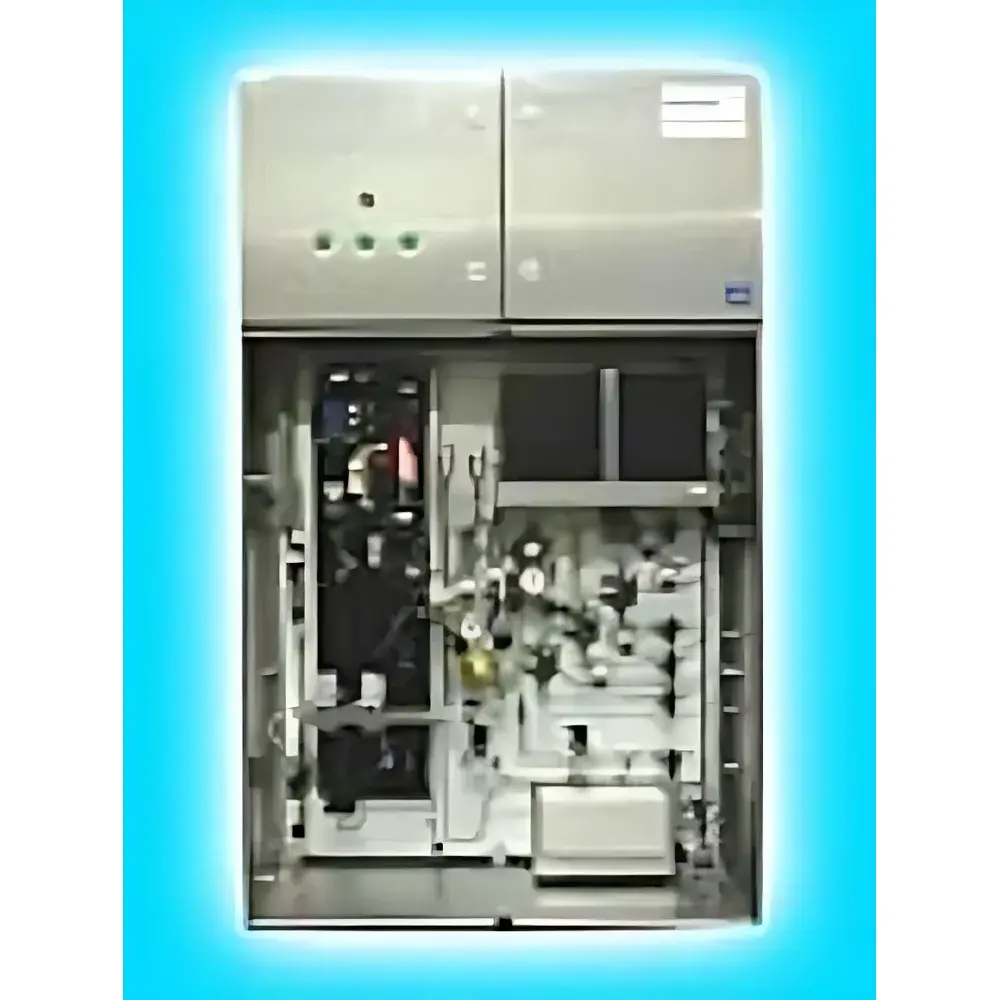
EyeTech Online Oil-in-Water Analyzer
| Origin | Imported |
|---|---|
| Manufacturer Type | Authorized Distributor |
| Model | EyeTech Online Oil-in-Water Analyzer |
| Price | Upon Request |
| Measurement Parameters | Particle Size & Shape |
| Concentration Range | 0–2000 ppm |
| Particle Size Range | 2–300 µm |
| Accuracy | ±4% or ±4 ppm |
| Sample Temperature | 2–120 °C |
| Sample Pressure | Up to 20 bar |
| Automation Level | Fully Automatic |
| Cleaning System | Integrated Thermal Boosted Water Wash |
| Real-time Output | Alarm triggers on oil concentration threshold, particle size threshold, and wash pressure failure |
Overview
The EyeTech Online Oil-in-Water Analyzer is a robust, real-time optical imaging-based particle characterization system engineered for continuous monitoring of oil droplets and suspended solids in industrial process water streams. Unlike traditional methods relying on solvent extraction, fluorescence, or light scattering—whose outputs are indirect proxies influenced by refractive index, viscosity, or Brownian motion—the EyeTech employs high-resolution digital in-line microscopy combined with advanced image analysis algorithms. This enables direct, morphology-resolved quantification of individual particles and oil droplets within flowing media. Its measurement principle is grounded in pixel-accurate segmentation and geometric feature extraction from raw grayscale or contrast-enhanced video frames captured at controlled flow velocities. Designed for deployment in demanding environments—including offshore platforms, refinery effluent lines, seawater injection systems, and ballast water treatment—EyeTech operates continuously under hazardous area conditions (Class I, Division 1 certified enclosures available) and withstands process temperatures up to 120 °C and pressures up to 20 bar.
Key Features
- Fully automated alignment and focus calibration—no manual intervention or periodic recalibration required.
- Solvent-free, reagent-free operation compliant with international environmental regulations prohibiting ozone-depleting substances (e.g., CFCs) and hazardous solvents per EPA Method 1664 and ISO 9377-2 Annex A.
- Direct particle sizing and classification: measurements derive from actual projected area, Feret diameter, aspect ratio, circularity, and convexity—not inferred from attenuation, scattering intensity, or dielectric response.
- Immunity to optical interference: performance remains stable across wide variations in fluid refractive index (1.33–1.52), dynamic viscosity (0.8–10 cP), and thermal gradients—eliminating artifacts from convection currents or Brownian diffusion.
- High-resolution imaging engine with adjustable magnification and depth-of-field control ensures reliable detection of particles as small as 2 µm while maintaining full-field coverage up to 300 µm.
- Integrated thermal-boosted water wash system prevents fouling during extended unattended operation; self-diagnostic pressure monitoring triggers maintenance alerts upon wash line degradation.
Sample Compatibility & Compliance
The EyeTech analyzer accommodates aqueous process streams containing free oil, emulsified hydrocarbons, mineral fines, corrosion products, and organic debris. It is validated for use in produced water, cooling tower blowdown, boiler feedwater, and bilge water applications where regulatory compliance requires trace-level oil detection and particulate load reporting. The system meets mechanical and electrical requirements for installation in Zone 1/21 hazardous locations (ATEX, IECEx, and UL Class I Div 1 certifications optional). Data integrity protocols align with GLP and GMP expectations: audit trails record all configuration changes, alarm events, and cleaning cycles. While not intrinsically FDA 21 CFR Part 11-compliant out-of-the-box, the optional secure software package supports electronic signatures, role-based access control, and immutable data logging for regulated environments.
Software & Data Management
The EyeTech Control Suite runs on an embedded Linux platform and provides web-based HMI accessible via standard browsers. Real-time dashboards display live particle count histograms, size distribution curves (d10, d50, d90), shape factor trends, and cumulative oil-in-water concentration (ppm). Alarms are configurable per parameter and severity level (warning, critical), with email/SNMP notifications and Modbus TCP/RTU output for integration into DCS or SCADA systems. Historical data is stored locally (SD card or internal SSD) with automatic rollover and export capability in CSV, PDF, or XML formats. All image archives and metadata are timestamped and indexed for forensic review during incident investigations or regulatory audits.
Applications
- Offshore oil & gas: Continuous monitoring of produced water discharge for OSPAR and MARPOL Annex I compliance.
- Refinery wastewater treatment: Early detection of emulsion breakthrough in API separators and dissolved air flotation units.
- Power generation: Monitoring turbine lube oil carryover and rust particle generation in closed-loop cooling systems.
- Marine engineering: Bilge water treatment verification prior to overboard discharge per IMO MEPC.107(49).
- Chemical manufacturing: Quantifying catalyst fines and polymer agglomerates in quench water circuits.
- Pharmaceutical utilities: Verification of filter integrity and particulate shedding in purified water (PW) and water-for-injection (WFI) distribution loops.
FAQ
Does the EyeTech require periodic calibration with reference standards?
No—its optical geometry and pixel-to-micron mapping are factory-validated and remain stable over time. Auto-focus and illumination normalization eliminate drift-related recalibration needs.
Can it distinguish between oil droplets and solid particles in the same sample stream?
Yes—using multi-threshold segmentation and texture analysis, the system classifies objects based on edge sharpness, internal homogeneity, and dynamic behavior under laminar flow, enabling separate reporting of hydrocarbon vs. inorganic particulates.
Is the system suitable for high-salinity or turbid seawater applications?
Yes—optical compensation algorithms correct for background scattering from dissolved salts and colloidal matter; validation testing includes North Sea produced water with TDS > 35,000 ppm.
What maintenance intervals are recommended for continuous operation?
The thermal wash cycle activates automatically every 2–4 hours depending on fouling risk; annual inspection of flow cell optics and seal integrity is advised. No consumables beyond potable water for cleaning are required.
How is data security handled in network-connected installations?
All firmware updates and remote access sessions employ TLS 1.2+ encryption; local storage encryption (AES-256) and configurable password policies meet NIST SP 800-53 controls for industrial IoT endpoints.
Related Products