
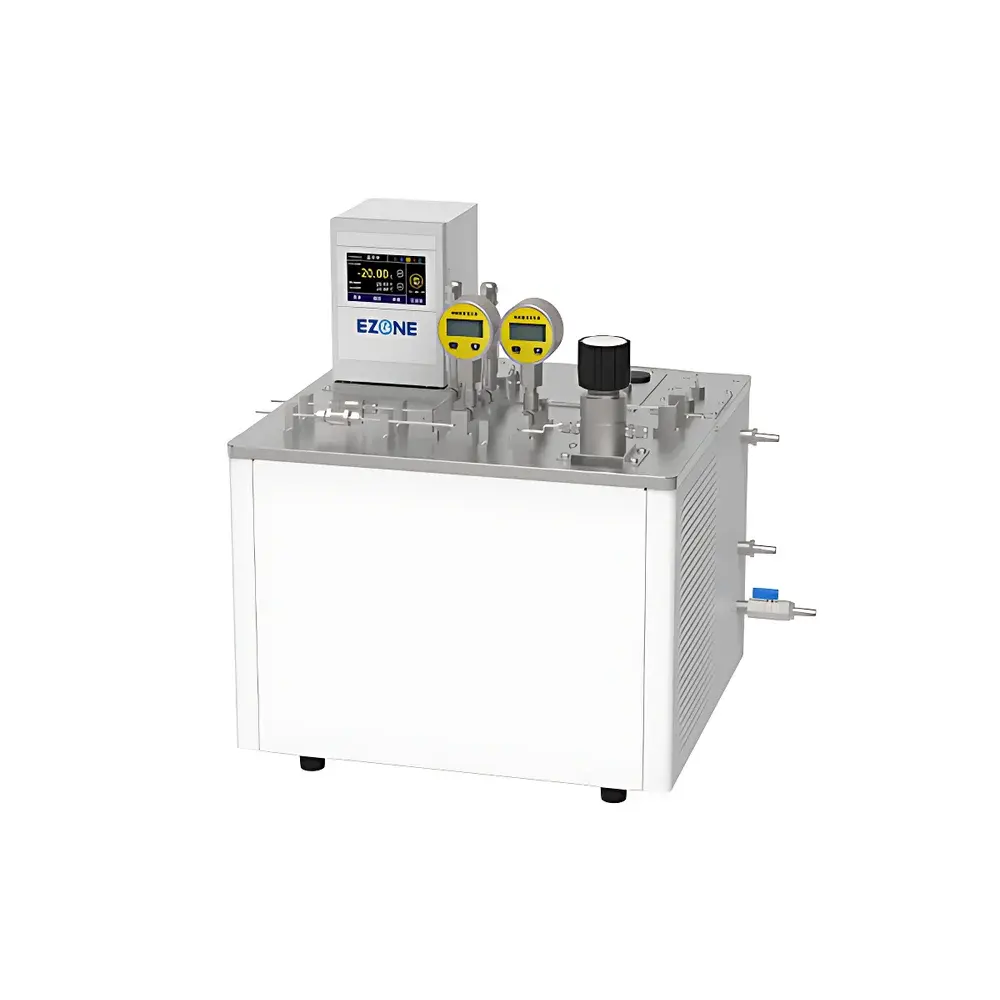
EZONE CHEMIST MR-200 Microchannel Fixed-Bed Reactor
| Brand | EZONE CHEMIST |
|---|---|
| Origin | Guangdong, China |
| Model | MR-200 |
| Temperature Range | −20 to 200 °C |
| Temperature Control Accuracy | ±0.1 °C |
| Operating Pressure | ≤100 bar |
| Reaction Volume | 1–10 mL |
| Microchannel Dimensions | 0.25 × 0.2 mm |
| Flow Rate | 0.2–10 mL/min |
| Wetted Materials | 316L stainless steel, FFKM, PTFE |
| Reactor Configuration | Modular microchannel + fixed-bed, switchable or combinable (series/parallel) |
Overview
The EZONE CHEMIST MR-200 Microchannel Fixed-Bed Reactor is an engineered continuous-flow platform designed for rigorous process development under elevated temperature and pressure conditions. It integrates two complementary reactor architectures—microchannel mixing elements and packed-bed catalytic zones—within a single, thermally and mechanically robust housing. The core fluidic architecture employs a zig-zag microchannel geometry with precise cross-sectional dimensions (0.25 × 0.2 mm), enabling rapid diffusive mass transfer and enhanced interfacial contact between gaseous, liquid, and solid-phase reactants. This design adheres to fundamental principles of microfluidic residence time distribution control and heterogeneous catalysis kinetics, supporting reproducible scale-down studies aligned with Quality by Design (QbD) frameworks. The system operates across a broad thermal envelope (−20 to 200 °C) with high-fidelity temperature regulation (±0.1 °C), and maintains structural integrity up to 100 bar, making it suitable for exothermic hydrogenations, oxidations, nitration, and Fischer–Tropsch-type syntheses where heat and mass transfer limitations dominate conventional batch performance.
Key Features
- Modular dual-mode configuration: Independent or combined operation of microchannel mixing units and fixed-bed catalyst cartridges—enabling methodical decoupling of mixing efficiency from catalytic residence time.
- Zig-zag microchannel geometry fabricated from electropolished 316L stainless steel, ensuring low surface roughness (<0.4 µm Ra), corrosion resistance, and compatibility with aggressive reagents including halogenated solvents and strong acids.
- High-pressure fluidic interface rated to 100 bar, with integrated FFKM and PTFE seals providing chemical resilience across pH 0–14 and organic/aqueous media.
- Precise temperature control via dual-zone Peltier-heated/cooled jacket and embedded Pt100 sensors, delivering spatial uniformity within ±0.3 °C across the entire active reaction volume (1–10 mL).
- Standardized 1/4″ VCR fittings and Swagelok-compatible ports facilitate seamless integration with HPLC pumps, back-pressure regulators, online IR/UV flow cells, and automated sampling manifolds.
Sample Compatibility & Compliance
The MR-200 supports gas–liquid–solid triphasic reactions, including slurry-phase catalysis, immobilized enzyme transformations, and trickle-bed configurations. Its wetted-path materials—316L SS, FFKM, and PTFE—are compliant with ASTM F2028 (elastomer biocompatibility), USP Class VI, and ISO 10993-5 cytotoxicity standards. The reactor architecture enables direct correlation to pilot-scale tubular reactors per ISO 17511 and ASTM E2656 guidelines for analytical instrument qualification. System documentation supports GLP/GMP audit readiness, including full traceability of calibration records, maintenance logs, and operational parameter history.
Software & Data Management
While the MR-200 operates as a hardware-integrated platform without proprietary closed software, it is fully compatible with third-party industrial control systems (e.g., LabVIEW, DeltaV, Ignition SCADA) via analog 4–20 mA and digital RS485 Modbus RTU interfaces. All critical process variables—including temperature setpoint/actual, pressure feedback, flow rate, and cooling power—are timestamped and exportable in CSV/Excel format. Audit trails comply with FDA 21 CFR Part 11 requirements when deployed with validated electronic record systems, supporting electronic signatures, user access controls, and immutable data archiving.
Applications
- Process intensification studies for API intermediate synthesis under ICH Q8(R3) guidance.
- Kinetic modeling of heterogeneous catalytic reactions (e.g., Pd/C-catalyzed Suzuki couplings, Ru-based asymmetric hydrogenations).
- Thermal hazard evaluation using adiabatic calorimetry coupling (e.g., ARC-MR-200 hybrid setups).
- Development of continuous manufacturing workflows compliant with FDA’s Emerging Technology Program.
- Screening of supported catalysts (e.g., Ni/Al₂O₃, Pt/TiO₂) under industrially relevant GHSV and LHSV conditions.
FAQ
Can the MR-200 be used for exothermic reactions requiring precise thermal management?
Yes—the dual-zone Peltier system provides active heating and cooling simultaneously, enabling dynamic thermal profiling and safe operation during highly exothermic events.
Is the reactor compatible with corrosive reagents such as oleum or anhydrous HF?
FFKM seals and 316L stainless steel construction offer broad resistance; however, prolonged exposure to anhydrous HF requires optional Hastelloy C-276 wetted parts—contact technical support for custom configurations.
How is catalyst loading performed in the fixed-bed module?
The cartridge-style fixed-bed section accepts pre-packed catalyst beds (1–5 mm particle size) or allows in-situ packing via standardized loading ports with vibration-assisted settling.
Does the system support real-time reaction monitoring?
Yes—standard 1/8″ ports accommodate inline FTIR, UV-Vis, or Raman flow cells; integration with mass spectrometry is achievable via heated transfer lines and membrane interfaces.
What validation documentation is provided with the MR-200?
Each unit ships with Factory Acceptance Test (FAT) reports, material certificates (EN 10204 3.1), pressure test records, and temperature calibration certificates traceable to NIST standards.



