
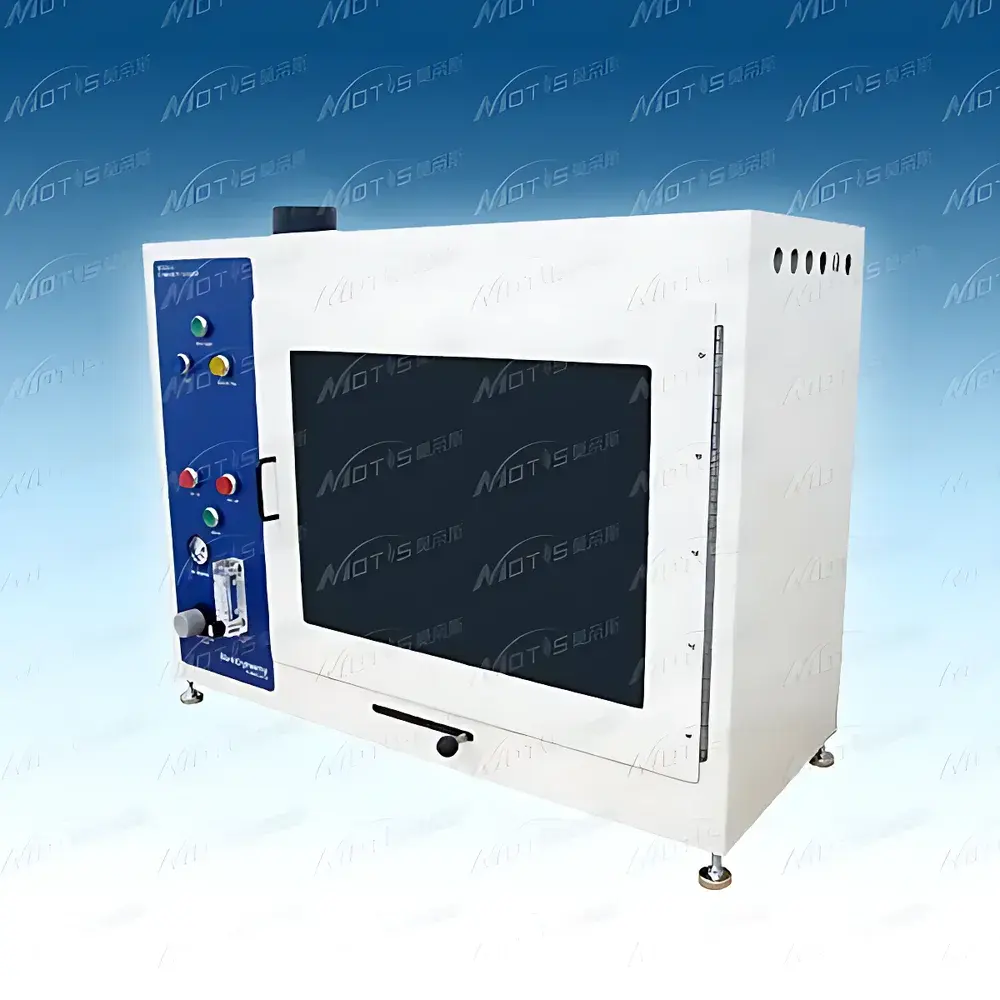
FAA-Approved Multi-Angle Combustion Test Chamber ME1000-3
| Brand | MEI (Marlin Engineering) |
|---|---|
| Origin | USA |
| Model | ME1000-3 |
| Application Scope | FAA AC 20-135, FAR Part 25.853, ASTM D635, ASTM D3801, HB5469, HB5470 |
| Construction | Stainless steel interior chamber with electrostatically coated exterior |
| Viewing Window | Tempered heat-resistant borosilicate glass (≥600 °C continuous service) |
| Ignition Method | High-voltage electric spark ignition system |
| Burner Mounting | Linear precision slide rail for rapid repositioning |
| Gas Control | Dual-stage pressure regulator and mass flow controller (propane or methane) |
| Sample Fixtures | Stainless steel clamps with calibrated 60° tilt jig and ASTM-compliant weight assembly |
| Flame Height Gauge | Precision stainless steel ruler (0–150 mm, ±0.5 mm accuracy) |
| Positioning Aid | Laser-aligned sample-to-burner distance gauge (fixed 20 mm ±0.2 mm per FAA vertical test requirement) |
Overview
The ME1000-3 FAA-Approved Multi-Angle Combustion Test Chamber is an engineered platform designed to perform standardized flammability assessments of aerospace-grade wire insulation, thermal acoustic insulation, and cabin interior materials in strict compliance with U.S. Federal Aviation Administration (FAA) regulatory guidance—specifically Advisory Circular AC 20-135 and Title 14 CFR Part 25.853. It implements the fundamental principle of controlled flame propagation under defined geometric orientations: vertical (90°), horizontal (0°), 45°, and 60° configurations—each governed by distinct ignition source geometry, specimen support mechanics, and flame exposure duration. The chamber integrates a calibrated Bunsen-type burner, gas delivery subsystem, and positional metrology tools to ensure repeatable thermal input and spatial reproducibility across test angles. Its architecture supports both FAA-mandated qualification testing and domestic Chinese civil aviation standards HB5469 (vertical burn test for aircraft wires) and HB5470 (horizontal burn test for aircraft wires), enabling dual-regulatory validation without hardware modification.
Key Features
- Stainless steel inner chamber (304 SS, 2 mm thickness) with high-temperature resistance up to 800 °C and corrosion-resistant electrostatic powder-coated carbon steel outer enclosure.
- Large-diameter (Ø300 mm), 25 mm-thick borosilicate viewing window rated for continuous operation at ≥600 °C, equipped with internal air purge port to prevent soot deposition during extended tests.
- Integrated dual-stage propane/methane gas regulation system featuring upstream pressure stabilization (0–100 psi) and downstream mass flow control (0–5 L/min, ±1% full scale), traceable to NIST standards.
- Motorized linear slide rail (precision-ground aluminum alloy, ±0.1 mm repeatability) enabling sub-second repositioning of the burner assembly between vertical, horizontal, and oblique (45°/60°) test alignments.
- High-energy electric spark igniter (≥15 kV pulse, 10 ms duration) with fail-safe interlock logic to prevent unintended ignition during setup or maintenance cycles.
- Dedicated 60° combustion fixture including ISO-certified stainless steel sample clamp, calibrated tilt base (±0.2° angular tolerance), and ASTM-compliant 150 g weighted pendulum for consistent mechanical loading during angled flame exposure.
- Traceable flame height measurement tool: hardened stainless steel ruler with engraved 1 mm graduations and zero-reference notch aligned to burner tip per ASTM D635 Section 7.3.
Sample Compatibility & Compliance
The ME1000-3 accommodates wire specimens ranging from 0.5 mm to 6.0 mm outer diameter and flat-sheet insulation materials up to 100 mm × 300 mm. All fixtures meet dimensional tolerances specified in FAA AC 20-135 Appendix A and ASTM D3801 Annex A1. The system is validated for use with Class A, B, and C wiring per SAE AS4373 and supports test execution under ambient conditions per ISO 291 (23 °C ±2 °C, 50% RH ±5%). Documentation includes full traceability to NIST-traceable calibration certificates for pressure transducers, flow meters, and angular positioning sensors. The chamber design conforms to laboratory safety requirements outlined in NFPA 56 and OSHA 1910.106 for flammable gas handling.
Software & Data Management
While the ME1000-3 operates as a manually controlled test platform per FAA procedural requirements, it supports optional digital data acquisition integration via RS-485 or analog 4–20 mA outputs for pressure, flow, and thermocouple signals (Type K, –50 °C to +1200 °C). When paired with third-party DAQ systems compliant with FDA 21 CFR Part 11, audit trails—including operator ID, timestamped parameter logs, and test configuration metadata—can be generated for GLP/GMP-aligned quality records. All physical test reports are structured to align with FAA Form 8110-3 documentation requirements and include space for signature verification, instrument calibration status, and environmental condition logging.
Applications
- Qualification testing of primary and secondary aircraft wiring insulation (e.g., ETFE, FEP, polyimide, and silicone-based compounds) against FAR 25.853(a) and AC 20-135 criteria.
- Development-stage screening of novel fire-retardant polymer formulations used in thermal/acoustic blankets and ducting systems.
- Regulatory submission support for CAAC Type Certification projects requiring HB5469/HB5470 conformance evidence.
- Root cause analysis of field-reported wire charring incidents through controlled replication of flame exposure profiles.
- Training and proficiency verification for FAA-certified test laboratories and OEM quality assurance personnel.
FAQ
Does the ME1000-3 meet FAA AC 20-135 Appendix A certification requirements for test equipment?
Yes—the chamber’s burner geometry, gas flow calibration methodology, specimen mounting fixtures, and flame height verification protocol have been independently verified against AC 20-135 Appendix A specifications.
Can the system be used for both propane and natural gas (methane)?
Yes—dual-gas capability is supported via interchangeable orifice plates and recalibrated flow controllers; all configurations are documented in the included gas conversion matrix.
Is operator training provided with the system?
MEI offers on-site or virtual commissioning and standard operating procedure (SOP) development services aligned with FAA-recommended practices and internal lab quality management systems.
What maintenance intervals are recommended for long-term compliance?
Burner tip inspection and cleaning every 50 test cycles; pressure regulator and flow sensor calibration annually or per ISO/IEC 17025 laboratory accreditation requirements.
Are test report templates included for HB5469 and HB5470 submissions?
Yes—fully editable Microsoft Word and PDF templates compliant with CAAC reporting conventions are supplied with the system documentation package.



