
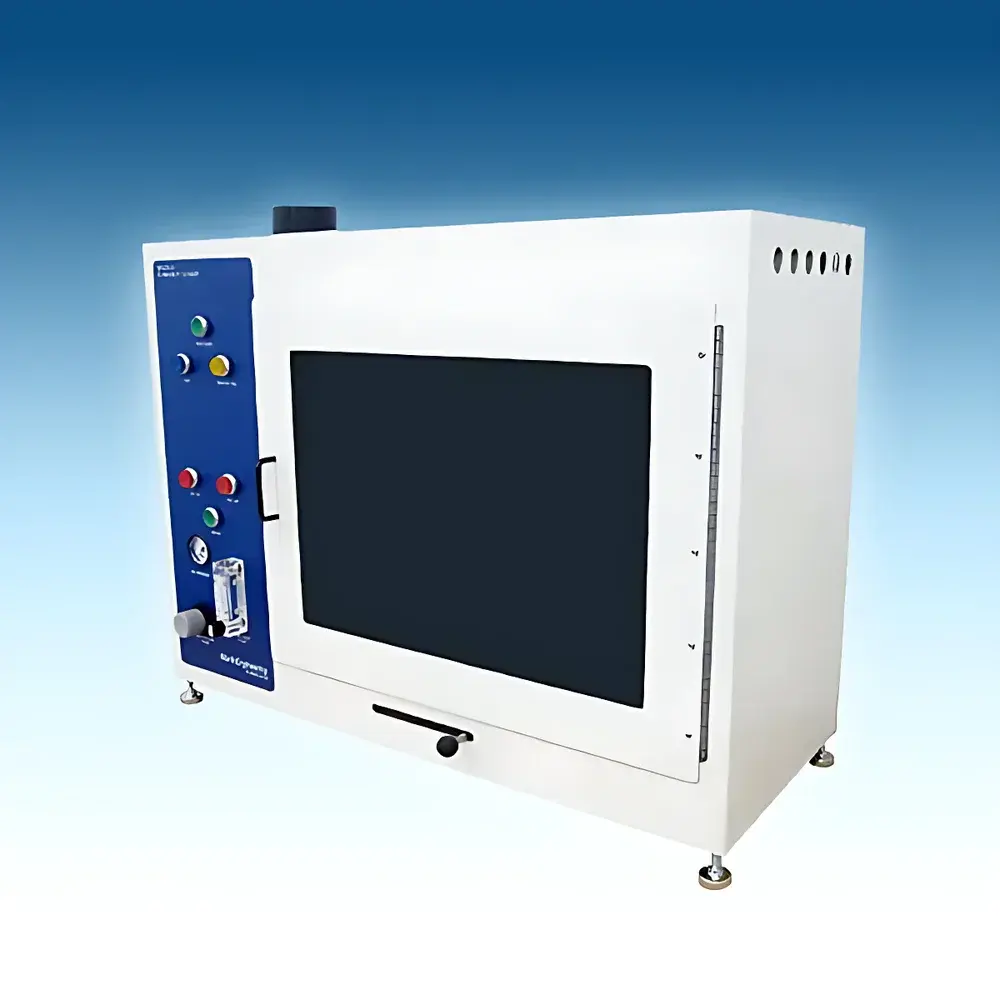
FAA Multi-function Combustion Test Chamber FAR-ME1000-3
| Origin | USA |
|---|---|
| Manufacturer Type | Authorized Distributor |
| Origin Category | Imported |
| Model | FAR-ME1000-3 |
| Pricing | Upon Request |
Overview
The FAA Multi-function Combustion Test Chamber FAR-ME1000-3 is a rigorously engineered benchtop combustion testing system designed and validated to meet the stringent fire safety evaluation requirements mandated by the U.S. Federal Aviation Administration (FAA) for aircraft interior materials. It operates on the principle of controlled flame exposure under standardized thermal and airflow conditions, enabling quantitative assessment of material flammability, burn rate, afterflame time, and flaming droplet generation. This chamber supports multiple test configurations—including vertical burning (FAR 25 Appendix F, Part I(a)(1)(ii)), horizontal burning (Part I(a)(1)(i)), 45° angle burning (Part I(a)(1)(iv)/(v)), and 60° insulated wire burning (Part I(a)(2)(iii) and Part I(a)(3))—within a single, reconfigurable platform. Its architecture complies with the fundamental test environment specifications defined in FAR 25 Appendix F, ensuring reproducible ignition source geometry, flame stoichiometry, and specimen orientation across all test modes.
Key Features
- Robust stainless-steel inner chamber with electrostatically coated outer enclosure for corrosion resistance and long-term thermal stability.
- Expanded internal volume (≥ 1.2 m³) minimizes oxygen depletion during extended-duration tests, maintaining consistent combustion dynamics per ASTM E1354 and FAA guidance.
- Large heat-resistant borosilicate glass viewport (≥ 300 × 400 mm) enables real-time visual monitoring without compromising chamber integrity or thermal containment.
- Integrated precision gas pressure regulator and mass-flow-controlled propane delivery system, calibrated to deliver ±1% flow accuracy across 0.5–2.0 L/min range.
- Motorized linear rail-mounted Bunsen burner assembly allows rapid, repeatable positioning for vertical, horizontal, and angled test configurations—achieving sub-millimeter positional repeatability.
- High-energy spark ignition module (≥ 10 kV) ensures reliable, non-contact ignition independent of ambient humidity or fuel vapor concentration.
- Dedicated stainless-steel specimen holders, including gravity-loaded 60° wire test fixtures conforming to FAR 25.853(a)(3) geometry requirements.
- Calibrated flame height gauge (0–100 mm scale, ±0.5 mm resolution) and laser-aligned specimen positioning jigs ensure traceable compliance with dimensional tolerances specified in FAR 25 Appendix F and AITM 2.002A.
Sample Compatibility & Compliance
The FAR-ME1000-3 accommodates rigid and flexible specimens up to 300 mm × 100 mm × 25 mm (L × W × T), including seat cushion foams, thermal/acoustic insulation blankets, decorative laminates, wiring harnesses, and cargo liner panels. It fully supports test protocols referenced in FAR Part 25 Appendix F, Sections I(a)(1) through I(a)(3), as well as Boeing Standard Specification BSS 7230 (F-1 through F-6), Airbus AITM 2.002A, 2.003, 2.004, and 2.005, and Chinese civil aviation standards HB 5469 and HB 5470. All mechanical and thermal components are certified to UL 61010-1 and CE EN 61010-1 for laboratory safety. The chamber’s operational parameters—including burner tip-to-specimen distance (20 ± 1 mm), flame impingement angle tolerance (±0.5°), and ambient air exchange rate (0.5–1.0 air changes per minute)—are documented in the factory calibration report and traceable to NIST-traceable references.
Software & Data Management
While the FAR-ME1000-3 operates as a manually supervised test platform per FAA regulatory intent, it integrates with optional digital data acquisition modules supporting IEEE 1451.2-compliant sensor interfaces. Time-synchronized video capture (120 fps, H.264 encoding) and thermocouple logging (Type K, ±0.5 °C accuracy) can be archived with timestamped metadata. All test records—including operator ID, specimen ID, ambient conditions, ignition timing, flame duration, and pass/fail determinations—are structured to align with FDA 21 CFR Part 11 electronic record requirements when deployed within GxP-compliant quality management systems. Audit trails, user access controls, and electronic signatures are configurable via third-party LIMS integration.
Applications
This test chamber serves as a primary qualification tool for aerospace OEMs, Tier-1 suppliers, and FAA-certified testing laboratories conducting material flammability screening prior to component installation in transport-category aircraft. Typical use cases include pre-submission testing for FAA PMA (Parts Manufacturer Approval), validation of flame-retardant additive efficacy in polyimide foams, comparative evaluation of next-generation wire insulation polymers (e.g., ETFE, Polyolefin blends), and root-cause analysis of non-conformities identified during full-scale cabin fire propagation studies. Its multi-angle capability also supports developmental research into anisotropic flame spread behavior in composite laminates and hybrid textile substrates.
FAQ
Does the FAR-ME1000-3 include automated pass/fail decision logic?
No. Per FAA regulatory philosophy, final determination of compliance with FAR 25 Appendix F criteria remains the responsibility of the qualified test engineer. The chamber provides measurement-grade repeatability but does not replace human interpretation of observed flame behavior.
Is third-party calibration certification included with shipment?
Yes. Each unit ships with a NIST-traceable calibration certificate covering burner alignment, gas flowmeter accuracy, thermocouple response, and dimensional verification of all fixture components.
Can the chamber be configured for non-FAA test methods such as ISO 6941 or UL 94?
With appropriate fixture adaptation and procedural validation, it may support certain elements of ISO 6941 (vertical flame) and UL 94 V-0/V-1/V-2; however, formal equivalency requires method-specific IQ/OQ documentation and is not covered under standard FAA certification scope.
What electrical supply and ventilation requirements apply?
Requires 230 VAC ±10%, 50/60 Hz, 16 A dedicated circuit. Exhaust ducting must provide ≥ 300 CFM continuous flow with backpressure ≤ 0.1 in. w.g. at the chamber exhaust port, per ASHRAE 110 guidelines.



