
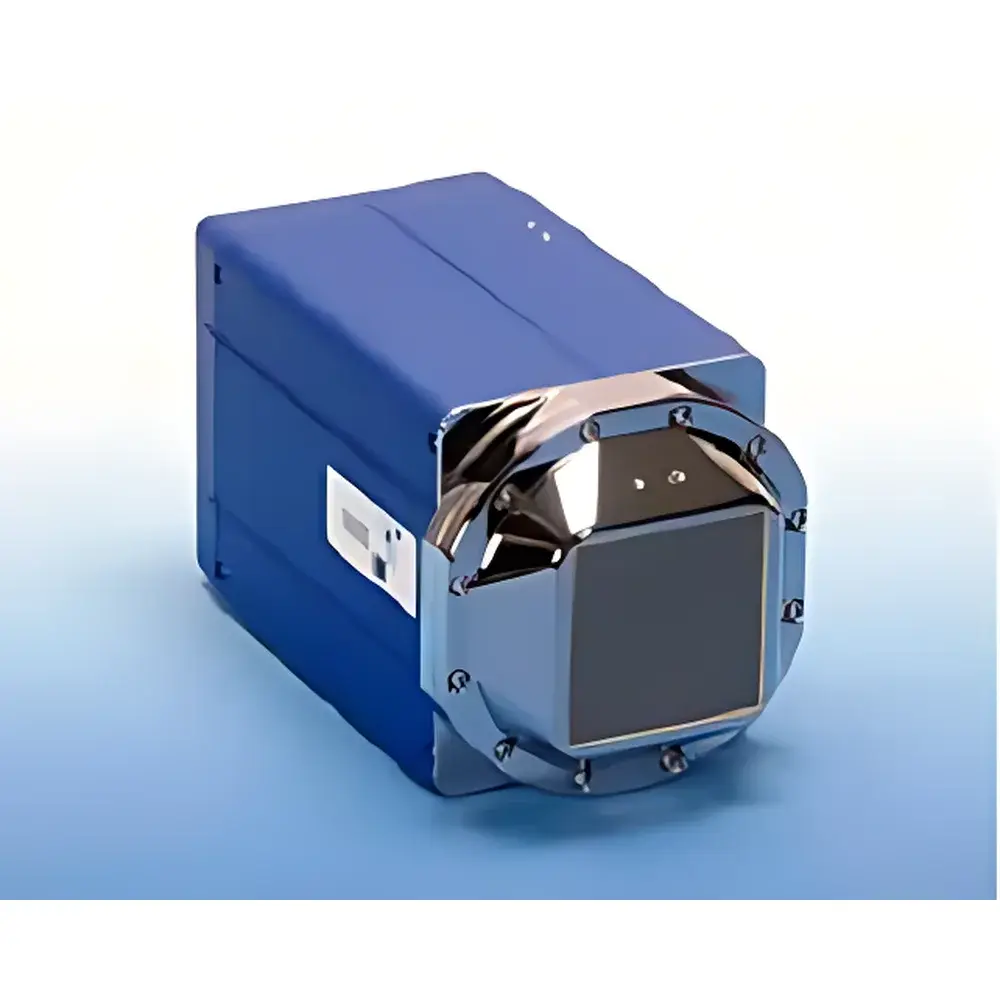
Fairchild Condor Series High-Sensitivity Fiber-Optic Coupled CCD Camera
| Origin | USA |
|---|---|
| Manufacturer Type | Authorized Distributor |
| Origin Category | Imported |
| Model | Condor 486 Series (486:90, 486:135, 486:200, 486:90EF) |
| Sensor Format | 4096 × 4096 pixels |
| Pixel Size | 15 µm × 15 µm |
| Fiber Taper Diameters | 90 mm, 135 mm, 200 mm |
| Fiber Taper Ratios | 1:1, 1.5:1, 2.2:1 |
| Readout Ports | Quad-port (4-channel) |
Overview
The Fairchild Condor Series represents a class of high-sensitivity, large-format scientific CCD cameras engineered for low-light, high-dynamic-range imaging applications where photon collection efficiency and spatial fidelity are critical. These cameras integrate a back-illuminated, 4096 × 4096 pixel CCD sensor with custom fiber-optic tapers—optical couplers that preserve resolution while enabling efficient light transfer from large-area scintillators or phosphor screens to the smaller active sensor area. The underlying measurement principle relies on direct charge integration in a deep-depletion silicon photodiode array, cooled thermoelectrically to reduce dark current and enhance signal-to-noise ratio (SNR). This architecture is particularly suited for indirect detection modalities such as X-ray imaging (via Gd₂O₂S:Tb or CsI:Tl scintillators), synchrotron beamline diagnostics, electron microscopy image intensification, and high-resolution flat-panel display metrology. Unlike standard lens-coupled systems, the fiber taper interface eliminates optical aberrations and maintains near-unity MTF across the full field, making the Condor platform ideal for quantitative radiography and metrological-grade image acquisition.
Key Features
- Large-area 4096 × 4096 pixel CCD sensor with 15 µm × 15 µm pixel pitch, optimized for high quantum efficiency (>85% at 600 nm) and low read noise (<5 e⁻ rms per port)
- Modular fiber-optic taper interface with selectable diameters (90 mm, 135 mm, 200 mm) and reduction ratios (1:1, 1.5:1, 2.2:1), enabling tailored magnification and light-gathering trade-offs
- Quad-port parallel readout architecture delivering sub-second frame times for full-frame acquisition, supporting high-throughput data collection in time-resolved experiments
- Thermoelectric cooling to –40 °C (standard) with optional liquid-assisted stabilization for extended exposure applications requiring ultra-low dark current
- Ruggedized aluminum chassis with EMI-shielded electronics, designed for integration into vacuum-compatible or radiation-hardened environments (e.g., beamlines, X-ray hutch enclosures)
- Support for external triggering, programmable exposure control, and hardware binning via IEEE-1394a (FireWire) or Camera Link interface options
Sample Compatibility & Compliance
The Condor Series is compatible with a wide range of scintillation materials—including thallium-doped cesium iodide (CsI:Tl), terbium-doped gadolinium oxysulfide (Gd₂O₂S:Tb), and zinc sulfide (ZnS:Ag)—commonly used in X-ray and neutron imaging systems. Its fiber-optic coupling design ensures mechanical and thermal stability under prolonged irradiation, satisfying long-term operational requirements in regulated environments. While not certified as medical devices, the system conforms to IEC 61000-6-3 (EMC emission standards) and IEC 61000-6-2 (immunity), and supports audit-ready operation under GLP and GMP frameworks when integrated with compliant data acquisition software. All models meet RoHS 2011/65/EU directives and carry CE marking for use within the European Economic Area.
Software & Data Management
Cameras ship with Fairchild’s proprietary Condor Acquisition Suite, a cross-platform application (Windows/Linux) supporting real-time preview, non-uniformity correction (NUC), flat-field normalization, and pixel defect mapping. Raw 16-bit TIFF and FITS output formats ensure compatibility with third-party analysis tools including MATLAB, Python (Astropy, scikit-image), and ImageJ/Fiji. The SDK provides C/C++ and Python APIs for custom automation, enabling seamless integration into LabVIEW-based control systems or Python-driven synchrotron experiment pipelines. Audit trail functionality—including timestamped metadata, user ID logging, and parameter change history—is available upon configuration for FDA 21 CFR Part 11–compliant workflows.
Applications
- X-ray radiography and tomography in materials science and non-destructive testing (NDT), especially for thick-sample inspection requiring high detective quantum efficiency (DQE)
- Synchrotron-based phase-contrast imaging, where preservation of fringe contrast demands minimal optical distortion and high modulation transfer function
- Electron beam-induced luminescence (EBIL) and cathodoluminescence (CL) mapping in SEM/TEM systems using phosphor-coated fiber tapers
- Flat-panel display characterization—including Mura detection, luminance uniformity mapping, and subpixel response analysis—leveraging the camera’s large active area and linear response
- Time-resolved plasma diagnostics and laser-induced breakdown spectroscopy (LIBS), where quad-port readout enables kHz-rate burst acquisition with minimal inter-frame dead time
FAQ
What cooling method is used, and what is the typical operating temperature?
The Condor Series employs two-stage thermoelectric (Peltier) cooling, achieving stable sensor temperatures down to –40 °C; optional water-assisted heat sinking extends this to –55 °C for ultra-low-dark-current applications.
Is vacuum integration possible?
Yes—the camera housing is rated for operation up to 10⁻⁴ mbar; feedthrough-compatible versions with CF-35 or KF-40 flanges are available upon request.
Can the fiber taper be replaced or customized for specific scintillator thicknesses?
Fairchild offers OEM taper fabrication services, including custom numerical aperture matching, anti-reflective coatings, and hermetic sealing for hygroscopic scintillators like CsI:Tl.
Does the system support synchronized multi-camera acquisition?
Yes—via TTL trigger input/output and GenICam-compliant timing registers, enabling precise synchronization across multiple Condor units or hybrid detector arrays.
What is the maximum sustainable frame rate at full resolution?
With quad-port readout and 1×1 binning, full-frame rates range from 0.8 Hz (486:200, 2.2:1 taper) to 1.4 Hz (486:90, 1:1 taper); region-of-interest (ROI) modes enable >10 Hz operation.





