
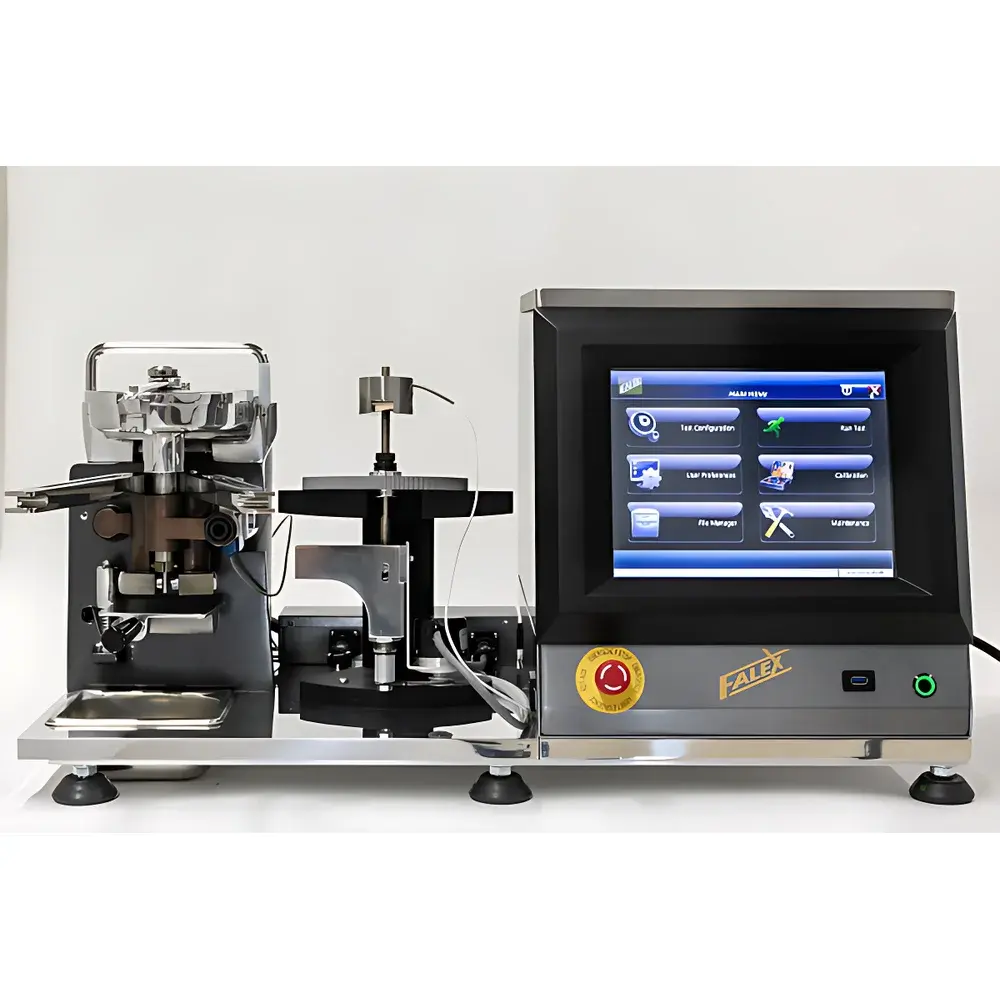
Falex 000-001-305 Pin-and-V-Block Friction and Wear Tester
| Brand | Falex |
|---|---|
| Origin | USA |
| Model | 000-001-305 |
| Test Method Compliance | ASTM D2670, D2625, D3233, D5620 |
| Load Range | 200–3000 lbf (±2% FS) |
| Rotational Speed | 290 ± 10 rpm |
| Torque Measurement | 0–100 in-lb (±2% FS) |
| Wear Resolution | 0.001 inch (0.025 mm) per 14.4 ratchet clicks |
| Operating Temperature | Ambient to 100 °C |
Overview
The Falex 000-001-305 Pin-and-V-Block Friction and Wear Tester is a precision-engineered tribological evaluation system designed for quantitative assessment of lubricant performance under boundary and extreme pressure (EP) conditions. Based on the classical pin-and-v-block geometry, it operates under controlled load, rotational speed, and temperature to generate reproducible frictional torque and wear data—key indicators of lubricant film strength, anti-wear (AW), and extreme pressure (EP) additive efficacy. Widely adopted across lubricant formulation labs, OEM engineering centers, and military specification testing facilities, this instrument delivers standardized mechanical response data directly traceable to internationally recognized test protocols. Its robust mechanical architecture ensures long-term dimensional stability and minimal hysteresis, enabling high repeatability across multi-day test campaigns and inter-laboratory correlation studies.
Key Features
- Direct-load application via calibrated spring-loaded lever arm with dual-scale indication: analog dial (200–3000 lbf) and digital electronic load sensor (±2% full-scale accuracy)
- Constant-speed motor drive maintaining 290 ± 10 rpm at the test shaft, independent of load or viscosity-induced torque fluctuations
- Integrated digital torque meter (0–100 in-lb range, ±2% FS) with real-time display and analog output for external data acquisition systems
- Mechanical wear measurement using a precision ratchet mechanism: 14.4 clicks correspond to 0.001 inch (0.025 mm) linear wear displacement, enabling high-resolution tracking without optical interference or thermal drift
- Thermostatically regulated test chamber accommodating ambient-to-100 °C operation, compatible with optional oil bath immersion or air-heated enclosures
- Modular test fixture design supporting rapid interchange of standard pins (1/4″ diameter, hardened steel) and V-blocks (carbide-tipped, 90° included angle), compliant with ASTM D2670 geometry specifications
Sample Compatibility & Compliance
The Falex 000-001-305 accommodates neat base oils, formulated lubricants (engine oils, gear oils, hydraulic fluids), greases (via modified pin geometry), and additive concentrates. Test specimens include standardized AISI E52100 steel pins and hardened tool-steel V-blocks, with optional custom substrates available for specialized material compatibility studies. The system meets full mechanical and procedural requirements of ASTM D2670 (Standard Test Method for Wear Properties of Lubricating Greases Using the Falex Block-on-Ring Machine), ASTM D2625 (Standard Test Method for Extreme Pressure Properties of Lubricating Oils Using the Falex Pin-and-V-Block Apparatus), ASTM D3233 (Standard Test Method for Determination of Weld Point of Lubricants Using the Falex Pin-and-V-Block Apparatus), and ASTM D5620 (Standard Test Method for Determination of Load-Wear Index of Lubricating Oils Using the Falex Pin-and-V-Block Apparatus). It further supports U.S. Department of Defense Federal Test Method Standard FTM-791-3807.1 (wear) and FTM-791-3812.1 (weld point), as well as IP 241 (Institute of Petroleum), Chrysler Engineering Standards 461-C-84-01/02/03, and Ford Motor Company Specification FMC-BJ1-1.
Software & Data Management
While the base configuration operates as a stand-alone analog/digital hybrid instrument, the system integrates seamlessly with third-party data acquisition platforms via 0–5 V analog outputs for torque, load, and temperature signals. Optional Falex-certified DAQ modules provide time-synchronized logging at 10 Hz resolution, supporting GLP-compliant audit trails when paired with validated software environments (e.g., LabVIEW-based validation packages compliant with FDA 21 CFR Part 11 requirements). All raw test parameters—including elapsed time, cumulative wear displacement, peak torque, and load stability—are recorded in CSV-compatible format for post-processing in MATLAB, Python (Pandas), or statistical analysis suites. Calibration certificates are NIST-traceable and include uncertainty budgets per ISO/IEC 17025 guidelines.
Applications
- Quantitative screening of anti-wear (ZDDP, ashless AW) and extreme pressure (sulfur-phosphorus, organomolybdenum) additives during lubricant development
- Performance benchmarking of commercial lubricants against OEM-specific specifications (e.g., Ford WSS-M2C945-A, Chrysler MS-6395)
- Root-cause analysis of field failures involving scuffing, scoring, or seizure in gearboxes, differentials, and hydraulic systems
- Accelerated aging studies correlating oxidation-induced viscosity change with wear progression under sustained load
- Material compatibility testing of coated pins (DLC, TiN) or alternative block geometries for next-generation tribosystems
- Supporting MIL-PRF-2104G, MIL-PRF-81322G, and SAE J300/J306 qualification submissions
FAQ
What standards does the Falex 000-001-305 fully support out-of-the-box?
It complies mechanically and procedurally with ASTM D2670, D2625, D3233, D5620; IP 241; FTM-791-3807.1 and -3812.1; and OEM specifications including Chrysler 461-C-84-01/02/03 and Ford FMC-BJ1-1.
Is the wear measurement system traceable to national standards?
Yes—the ratchet mechanism is factory-calibrated against NIST-traceable micrometers; calibration certificate includes uncertainty analysis per ISO/IEC 17025.
Can the instrument operate above 100 °C?
No—the standard configuration is rated to 100 °C ambient; higher-temperature testing requires custom thermal shielding and fluid-circulation modifications, subject to engineering review.
Does Falex provide method validation documentation for GLP/GMP environments?
Yes—validated IQ/OQ/PQ protocols, along with 21 CFR Part 11-compliant electronic record templates, are available upon request for regulated laboratories.
What maintenance intervals are recommended for long-term accuracy?
Biannual verification of load cell linearity, torque sensor zero drift, and ratchet gear backlash is advised; annual recalibration by an ISO 17025-accredited service provider is recommended for compliance-critical applications.
Related Products






