
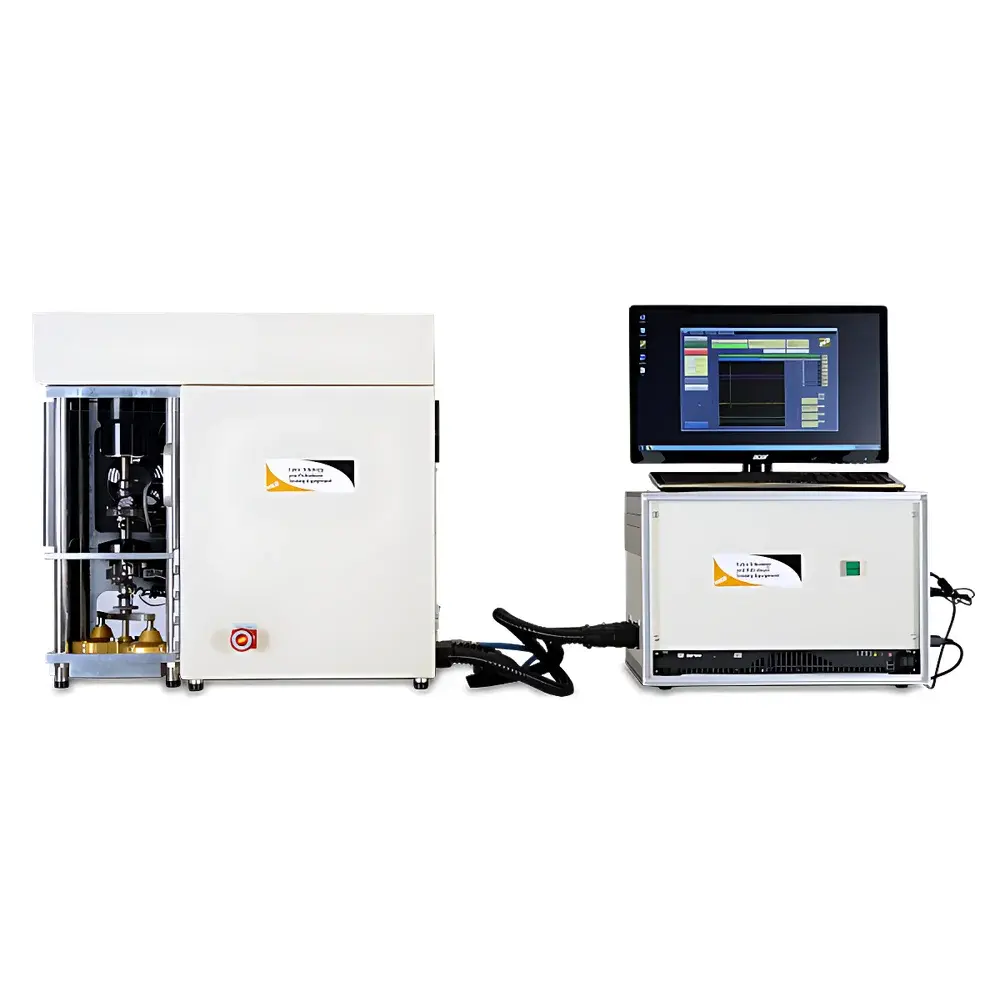
Falex 006‐001‐330 Multi-Specimen Tribometer
| Brand | Falex |
|---|---|
| Origin | USA |
| Model | 006‐001‐330 |
| Testing Type | Friction and Wear |
| Compliance | ASTM D3702, D2266, D4172, D5183, G99 |
| Speed Range | 30–3600 rpm (standard), 0.01–10,000 rpm (with optional gear reducer) |
| Load Range | 1–160 lbf (2:1 lever), 20–800 lbf (10:1 lever) |
| Temperature Range | Ambient to 150°C (standard), 30–200°C (with optional heating/cooling modules) |
| Control | Computer-controlled servo motor, pneumatic auto-loading (programmable), real-time torque & displacement monitoring |
Overview
The Falex 006‐001‐330 Multi-Specimen Tribometer is an engineered precision instrument for quantitative tribological evaluation of materials, coatings, and lubricants under controlled mechanical, thermal, and environmental conditions. Based on the standardized pin-on-ring and block-on-ring configurations defined in ASTM D3702 and D2266, it operates on a fundamental Coulomb-friction and wear-volume displacement measurement principle. The system applies calibrated normal loads via dual-ratio mechanical levers or programmable pneumatic actuators while rotating the counterface at precisely regulated speeds. Real-time torque transduction enables dynamic calculation of the coefficient of friction (COF), while high-resolution linear displacement sensing quantifies wear depth or mass loss equivalents. Designed for laboratory-based R&D and quality assurance workflows, it supports reproducible generation of PV-limit curves, scuffing thresholds, and wear rate kinetics—critical inputs for lubricant formulation validation, surface engineering development, and component life modeling.
Key Features
- Multi-geometry specimen compatibility: Accommodates over 20 standardized test configurations—including pins, blocks, disks, and custom fixtures—enabling direct correlation across ASTM, ISO, and internal specification protocols.
- Dual-load architecture: Semi-automatic models feature 2:1 and 10:1 mechanical leverage systems with calibrated deadweight loading (0–80 lbf砝码); programmable variants integrate closed-loop pneumatic loading with adjustable ramp rates, dwell times, and cyclic load profiles (10–800 lbf).
- Wide operational speed range: Standard servo-driven rotation from 30 to 3600 rpm (±0.5% full-scale accuracy); optional gear-reduced configuration extends control down to 0.01 rpm for low-slip or creep regime studies.
- Thermal environment flexibility: Integrated worktable heater supports testing from ambient to 150°C; add-on heated cups and refrigerated recirculating chillers extend operational range to 30–200°C with ±1°C stability.
- Modular environmental expansion: Optional humidity control chambers, pressurized test enclosures, and sample circulation loops enable simulation of field-relevant service conditions—e.g., engine oil sump dynamics or hydraulic fluid aging pathways.
Sample Compatibility & Compliance
The Falex 006‐001‐330 is validated for use with metallic alloys (steel, aluminum, titanium), polymer composites, ceramic coatings, and elastomeric surfaces. Its fixture design ensures repeatable alignment per ASTM D3702 (pin-on-ring), D2266 (block-on-ring), D4172 (four-ball wear), D5183 (high-pressure scuffing), and D2714 (temperature-dependent friction). All mechanical and thermal subsystems are traceably calibrated to NIST-traceable standards. The platform meets GLP documentation requirements for audit-ready test execution, including timestamped metadata logging for load, speed, temperature, torque, and displacement channels. Full compliance with ISO/IEC 17025 calibration management principles is supported through optional certified calibration kits and third-party verification services.
Software & Data Management
Falex SoftWEAR software provides deterministic real-time acquisition at 100 Hz sampling rate across all analog and digital I/O channels. It features configurable alarm thresholds for COF deviation, wear displacement limits, torque overload, or thermal excursion—triggering automatic test termination and event-tagged data archiving. All raw datasets are stored in vendor-neutral CSV and HDF5 formats, supporting post-processing in MATLAB, Python (Pandas/NumPy), or commercial statistical platforms. Audit trails comply with FDA 21 CFR Part 11 requirements, including electronic signatures, user role-based access control, and immutable change logs. Optional API integration enables bidirectional communication with LIMS and MES systems for automated result ingestion and certificate-of-analysis generation.
Applications
- Lubricant performance qualification: Screening anti-wear (AW), extreme pressure (EP), and friction modifier additives under varying PV conditions.
- Coating durability assessment: Quantifying wear resistance of DLC, CrN, MoS₂, and polymer-based thin films on bearing substrates.
- Material pairing optimization: Evaluating tribosystem compatibility between shafts, bushings, gears, and seals in powertrain and hydraulic applications.
- Regulatory submission support: Generating data packages compliant with OEM specifications (e.g., GMW16038, Ford WSS-M2C945-A) and industry consortia (ILSAC, API).
- Fundamental tribology research: Investigating transition regimes between boundary, mixed, and hydrodynamic lubrication through controlled parameter sweeps.
FAQ
What ASTM standards does the Falex 006‐001‐330 directly support?
It is fully configured for ASTM D3702 (pin-on-ring), D2266 (block-on-ring), D4172 (four-ball wear), D5183 (scuffing load capacity), and D2714 (friction vs. temperature)—with fixture sets and software templates preloaded for each method.
Can the system operate under inert or controlled-atmosphere conditions?
Yes—optional sealed test chambers with gas inlet/outlet ports support nitrogen purging, vacuum operation, or reactive gas environments (e.g., H₂S for sour service simulation).
Is wear measurement traceable to mass loss or volumetric wear rate?
Displacement-based wear is calibrated against gravimetric measurements using certified reference specimens; software includes built-in conversion tools for Archard wear coefficient (k) derivation and specific wear rate (mm³/N·m) reporting.
How is data integrity ensured during long-duration tests (e.g., >100 hours)?
Continuous checksum verification, redundant storage buffers, and automatic resume-from-interrupt functionality prevent data corruption or loss due to power fluctuation or network interruption.
Does the system support remote monitoring and control?
Yes—via secure HTTPS web interface and OPC UA server implementation, enabling real-time dashboard viewing, parameter adjustment, and alarm notification through enterprise IT infrastructure.







