
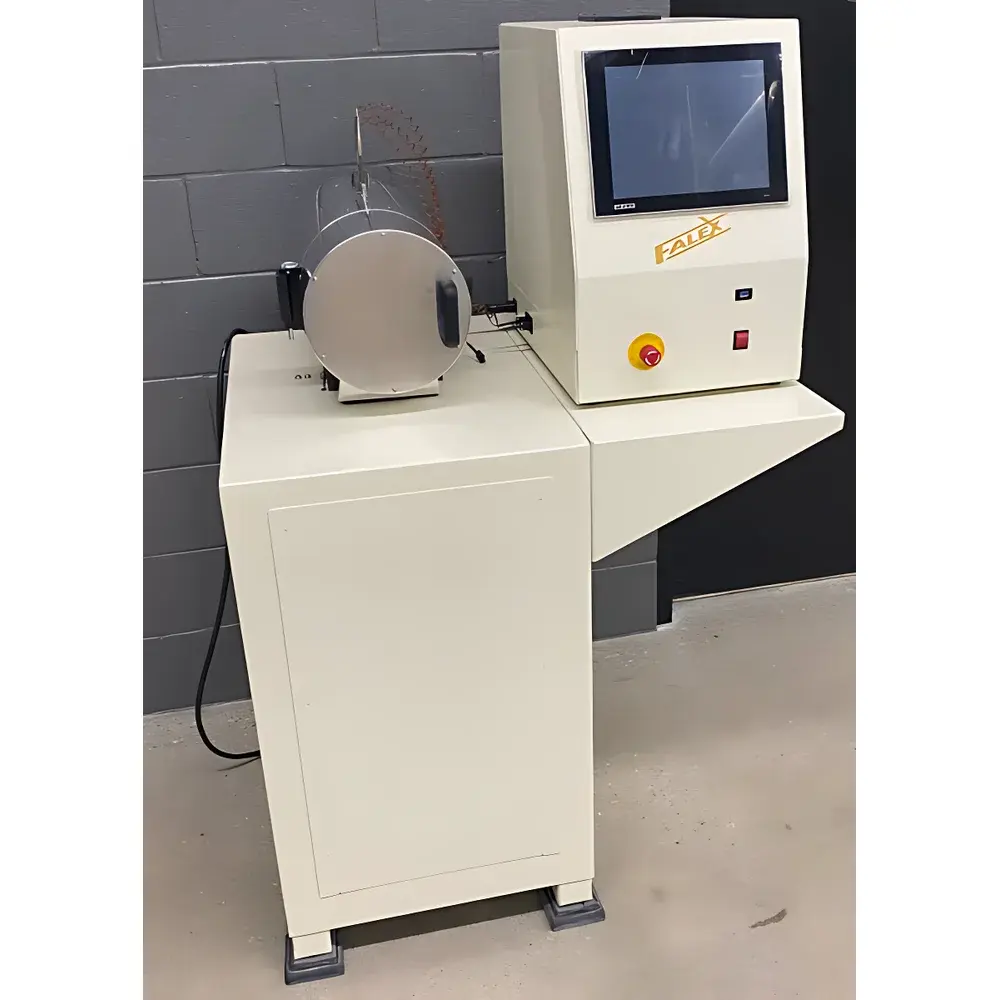
Falex 016-001-002 High-Speed, High-Temperature Ball Bearing Life Tester
| Brand | Falex |
|---|---|
| Origin | USA |
| Model | 016-001-002 |
| Test Method Compliance | ASTM D3336, SH/T 0428 |
| Maximum Rotational Speed | 20,000 rpm (light-load condition) |
| Axial Load Capacity | 15 lbs (mechanically applied) |
| Heating Chamber Max Temperature | 371 °C |
| Torque Measurement | Digital display with high/low torque shutdown threshold |
| Drive Motor | Dual 1 HP, single-phase AC motors with thermal protection |
| Timing Control | Digital on/off elapsed-time counter |
| Standard Shaft | CRC-type shaft |
| Application Focus | Grease-lubricated ball bearing life evaluation under accelerated thermal–mechanical stress |
Overview
The Falex 016-001-002 High-Speed, High-Temperature Ball Bearing Life Tester is an engineered test platform designed to evaluate the functional endurance of grease-lubricated rolling-element bearings under rigorously controlled, accelerated operational conditions. It operates on the principle of sustained rotational fatigue testing, wherein a standardized CRC-type shaft rotates at precisely regulated speeds while subjected to defined axial loading and elevated thermal exposure. The system replicates real-world degradation mechanisms—including oxidation-induced grease thickening, base oil volatility, additive depletion, and surface wear initiation—enabling quantitative assessment of lubricant performance and bearing compatibility over time. Its design adheres strictly to ASTM D3336 (“Standard Test Method for Ball Bearing Life Testing of Lubricating Greases”) and SH/T 0428 (“Petroleum Products — Determination of Grease Life in Ball Bearings”), making it a primary reference instrument for lubricant formulation validation, quality control in grease manufacturing, and OEM specification compliance verification.
Key Features
- Thermally isolated heating chamber capable of stable operation up to 371 °C, with independent PID-controlled temperature regulation and calibrated thermocouple feedback.
- Dual-motor drive architecture: two 1 HP single-phase AC motors equipped with integrated thermal overload protection ensure continuous, low-vibration rotation at speeds up to 20,000 rpm under light-load conditions (≤15 lbs axial load).
- Digitally monitored torque sensing circuitry provides real-time readout and programmable high/low torque thresholds for automatic test termination—critical for detecting incipient failure modes such as seizure, scuffing, or rapid grease breakdown.
- Electromechanically actuated axial loading system delivers repeatable, non-dynamic force application; load is verified via traceable calibration weights prior to each test sequence.
- Digital elapsed-time counter records total cumulative run time with ±0.1 s resolution, supporting precise correlation between operational duration and observed failure indicators (e.g., torque excursion, audible noise, visual inspection post-test).
- CRC-standard shaft geometry ensures inter-laboratory comparability and eliminates variability arising from dimensional inconsistency across test platforms.
Sample Compatibility & Compliance
The instrument accommodates standard 6204-series deep-groove ball bearings mounted on the CRC shaft, permitting direct comparison across grease formulations without hardware modification. Test specimens include commercial and developmental greases (lithium, calcium sulfonate, polyurea, and complex-soap thickeners), as well as specialty high-temperature synthetic oils used in aerospace, turbine, and electric drivetrain applications. All test procedures comply with ASTM D3336’s procedural requirements—including pre-conditioning, speed ramping, load application protocol, and failure criteria definition—and are fully compatible with SH/T 0428 for domestic Chinese regulatory submissions. Data outputs meet GLP documentation standards, including timestamped operator entries, environmental chamber logs, and torque history files suitable for FDA 21 CFR Part 11–compliant electronic record systems when integrated with validated laboratory information management software (LIMS).
Software & Data Management
While the Falex 016-001-002 operates as a stand-alone benchtop instrument with analog/digital hybrid controls, its torque and timing signals are accessible via 0–10 VDC analog outputs for integration into third-party data acquisition systems (e.g., National Instruments DAQ, LabVIEW, or MATLAB-based analysis environments). Users may configure custom pass/fail logic, generate statistical summaries (mean time to failure, Weibull distribution parameters), and export CSV-formatted datasets for trending analysis across multiple grease batches or supplier qualifications. Audit trails—including operator ID, test date, ambient lab conditions, and calibration status—are maintained manually per GLP guidelines; optional external LIMS synchronization supports automated metadata tagging and version-controlled report generation.
Applications
- Accelerated life validation of high-temperature greases for electric motor bearings, wind turbine pitch/yaw systems, and industrial gearboxes.
- Comparative benchmarking of antioxidant package efficacy under oxidative stress at >300 °C.
- Supporting API, NLGI, and OEM grease specification development (e.g., GM 6277M, Ford WSS-M2C949-A, SKF LGMT 2).
- Root-cause analysis of premature bearing failures in field service reports through controlled replication of suspected thermal–mechanical boundary conditions.
- Research into grease rheology evolution under shear-thinning and thermal thinning regimes, correlating torque decay profiles with FTIR or RPVOT data.
FAQ
What bearing types are compatible with the Falex 016-001-002?
Standardized 6204 deep-groove ball bearings are required; other geometries (e.g., tapered roller or cylindrical) are not supported due to fixture and load-path constraints.
Is the instrument suitable for liquid lubricant testing?
No—this system is specifically configured for grease-lubricated ball bearings per ASTM D3336; liquid lubricants require alternative test methods such as Four-Ball Wear or SRV oscillating friction tests.
How often must the CRC shaft be recalibrated?
The shaft itself is a passive mechanical component and does not require calibration; however, axial load application and torque sensor electronics must be verified annually against NIST-traceable standards.
Can test data be exported for regulatory submission?
Yes—raw torque vs. time files and summary reports are exportable in ASCII/CSV format, and when paired with compliant LIMS infrastructure, satisfy audit requirements for ISO/IEC 17025-accredited laboratories.
Does the unit support automated multi-sample sequencing?
No—each test run is manually initiated and monitored; parallel testing requires multiple units or sequential scheduling within a shared lab workflow.







