
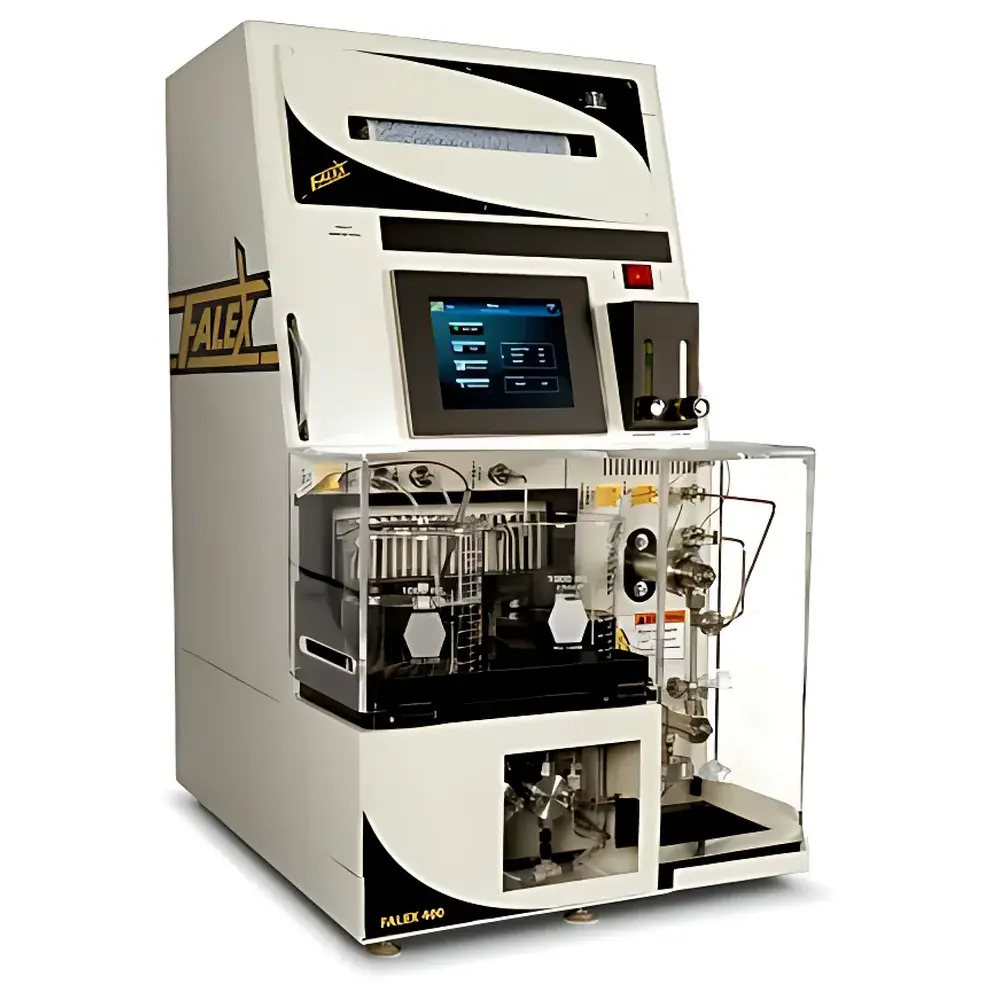
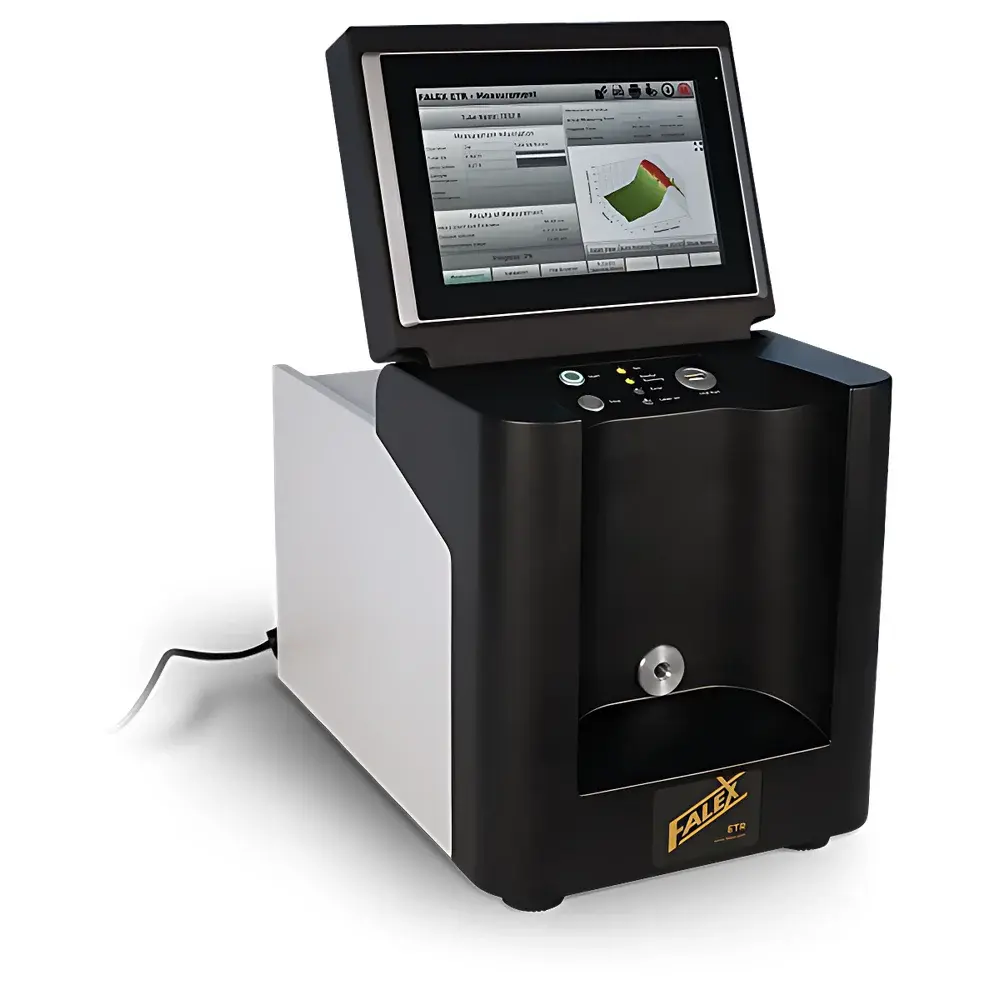
Falex FAL400 Jet Fuel Thermal Oxidation Tester
| Brand | Falex |
|---|---|
| Origin | USA |
| Model | FAL400 |
| Compliance | ASTM D3241, IP 323, GB/T 9169 |
| Heating Tube Certification | ASTM D3241 Table 2 Note c, IP 323 Table A.1 |
| Automation | Fully automated air purge (1.5 L/min), pre-test pump priming (60 s), flow verification at start/end |
| Pump System | Dual HPLC-grade precision pumps, pulse-free flow delivery |
| Control System | Embedded microprocessor (non-Windows), corrosion-resistant color touchscreen |
| Safety | Interlocked safety shield with real-time alarm |
| Filtration | Integrated activated carbon fume scrubber |
| Optional Accessory | FAL430 Deposit Rating Ellipsometer (ellipsometric thickness & 3D topography measurement) |
Overview
The Falex FAL400 Jet Fuel Thermal Oxidation Tester is a fully automated, ASTM D3241- and IP 323-compliant instrument engineered for precise evaluation of jet fuel thermal oxidative stability under simulated aircraft fuel system conditions. It operates on the principle of controlled high-temperature oxidation: a defined volume of aviation turbine fuel is pressurized and continuously flowed through a heated stainless-steel heater tube (typically maintained at 260–400 °C) while exposed to a regulated stream of compressed air (1.5 L/min). Under these accelerated conditions, thermally labile components oxidize and form insoluble deposits—primarily lacquer-like films and particulate residues—on the inner surface of the heater tube. The extent and morphology of deposit formation directly correlate with fuel stability, serving as a critical pass/fail indicator for military and civil aviation fuel certification.
Unlike legacy JFTOT systems reliant on manual flow calibration and single-pump architectures, the FAL400 integrates dual high-precision HPLC-grade positive displacement pumps. This eliminates pulsation-induced flow instability, removing the need for downstream pulse dampeners or capillary damping loops—components known to introduce flow resistance, cross-contamination risk, and progressive filter clogging (e.g., 0.5 µm in-line filters that degrade after ~20 runs). The embedded microprocessor control architecture—deliberately non-Windows-based—ensures deterministic real-time operation, long-term software stability, and immunity to OS-level vulnerabilities or compatibility drift. Its design meets MIL-STD-810G environmental robustness requirements, making it suitable for field-deployable and defense logistics laboratory use.
Key Features
- Fully automated sequence execution: 60-second pre-test pump priming, automatic 1.5 L/min air purge initiation/verification at test start and end, and timed thermal ramping—minimizing operator intervention and inter-laboratory variability.
- Dual independent HPLC-grade positive displacement pumps deliver stable, pulse-free flow across full operational range (0.5–2.0 mL/min), eliminating reliance on mechanical dampening circuits and associated failure modes.
- Corrosion-resistant 7-inch color touchscreen interface with intuitive menu navigation; all parameters—including temperature setpoint, run duration, and air flow rate—are configurable and password-protected.
- Three-tiered user access control: Administrator, Supervisor, and Operator levels enable program locking, method versioning, and audit-ready parameter change logging per GLP/GMP requirements.
- Integrated interlocked safety shield with hardware-enforced shutdown: Opening the shield during active heating triggers immediate thermal cutoff and audible/visual alarm, preventing exposure to >400 °C surfaces and hot vapors.
- Onboard activated carbon fume scrubber captures volatile organic compounds and pyrolysis byproducts generated during testing, maintaining ambient air quality and complying with OSHA PEL and ACGIH TLV guidelines.
Sample Compatibility & Compliance
The FAL400 is validated for aviation turbine fuels including Jet A, Jet A-1, JP-5, JP-8, and TS-1, as specified in ASTM D3241 Annex A1 and IP 323 Clause 5. It accepts standard 3.2 mm OD × 0.8 mm ID stainless-steel heater tubes conforming to ASTM D3241 Table 2 dimensional tolerances and material specifications (ASTM A269 TP316L). All heater tubes are traceably certified and supplied with individual calibration certificates. The instrument satisfies regulatory requirements for method equivalence per ASTM Round Robin Report D02-1728 and D02-1550, and its heater tube design is explicitly referenced in ASTM D3241 Table 2 Note c and IP 323 Table A.1. It supports compliance with U.S. Department of Defense MIL-DTL-83133H, NATO F-35, and China’s GB/T 9169–2016 standards.
Software & Data Management
The embedded firmware provides ISO/IEC 17025-aligned data integrity features: time-stamped test logs (including temperature profile, flow verification timestamps, pressure readings, and fault codes), electronic signature support, and exportable CSV reports compatible with LIMS integration. Audit trails record all parameter modifications, user logins, and method executions—fully compliant with FDA 21 CFR Part 11 for electronic records and signatures. No external PC is required; all data resides locally on encrypted internal flash memory with optional USB backup. Firmware updates are delivered via signed binary packages with cryptographic checksum validation.
Applications
- Quality assurance of refinery-produced jet fuels prior to shipment and blending.
- Stability screening of alternative aviation fuels (SAF), including hydroprocessed esters and fatty acids (HEFA), Fischer–Tropsch (FT), and alcohol-to-jet (ATJ) blends.
- Research into antioxidant additive efficacy (e.g., hindered phenols, amine-based stabilizers) and degradation kinetics under thermal stress.
- Supporting ASTM D3241 Method B (breakpoint temperature determination up to 400 °C) for fuel specification waivers and engine manufacturer approvals.
- Deposition mechanism studies in collaboration with the FAL430 Ellipsometric Deposit Rating System for quantitative film thickness (±0.5 nm resolution), volumetric deposition, and 3D surface topography mapping.
FAQ
Does the FAL400 require external PC connectivity for routine operation?
No. It operates autonomously using an embedded real-time microprocessor; no Windows OS or external computer is needed for test execution, data logging, or reporting.
How is flow accuracy verified during each test cycle?
The system performs automatic flow verification at both test initiation and termination using calibrated mass flow sensors, with results logged and flagged if deviation exceeds ±2% of setpoint.
Can custom test protocols be created and secured against unauthorized modification?
Yes. Up to three user-defined methods can be stored, each assigned to a specific access level with configurable password protection and immutable parameter locking.
What maintenance intervals are recommended for the dual-pump system?
Pump seals and check valves are rated for ≥10,000 cycles; preventive maintenance is scheduled annually or after 500 tests—no consumables required between services.
Is the FAL430 Ellipsometer necessary for ASTM D3241 compliance?
No. Visual rating per ASTM D3241 Section 9 remains acceptable; however, the FAL430 provides objective, repeatable quantification aligned with emerging industry trends toward digital deposit metrology and AI-assisted failure mode classification.




