
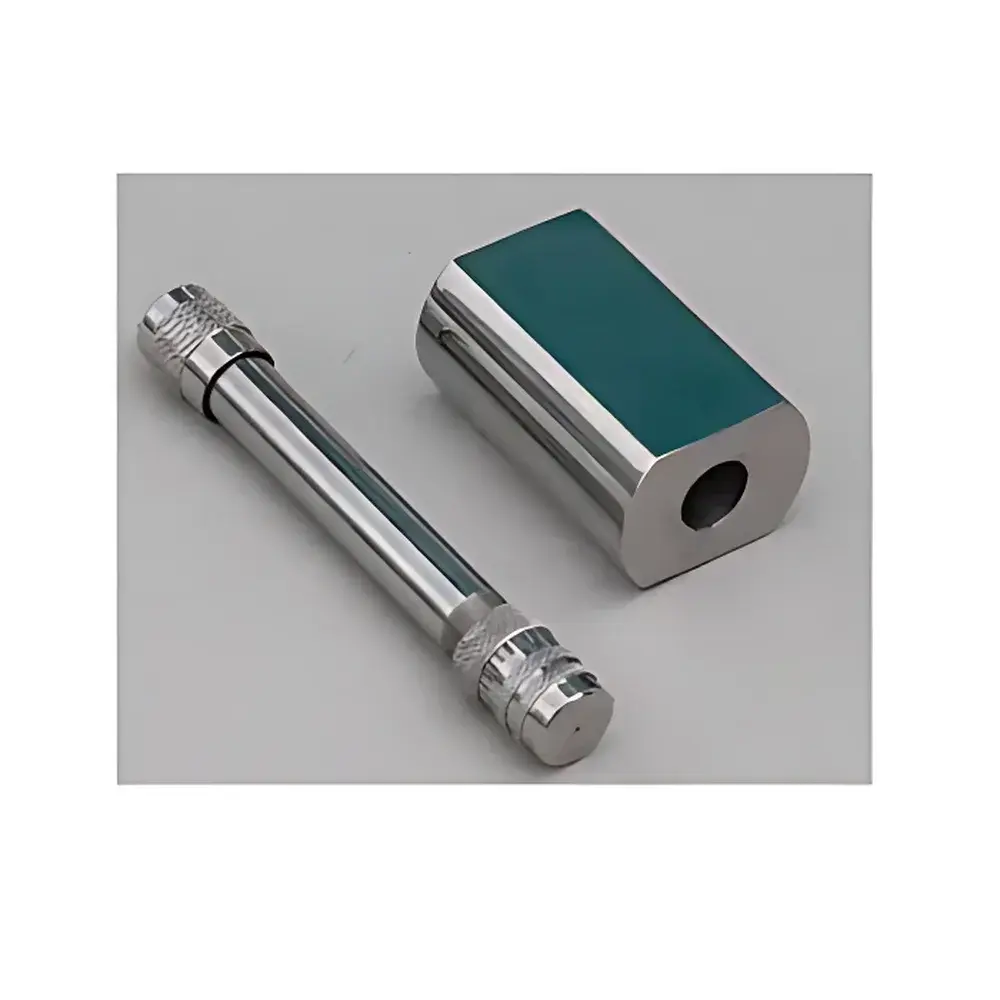
Fangyuan FY-RLJD Sharp Point Tester
| Brand | Fangyuan Instruments |
|---|---|
| Origin | Guangdong, China |
| Manufacturer Type | Authorized Distributor |
| Country of Origin | China |
| Model | FY-RLJD |
| Pricing | Upon Request |
| Compliance Standards | 16 CFR 1500.48, ASTM F963 §4.8, EN71-1:1998 §8.12 |
| Test Force | 1 lbf (4.5 N) |
| Aperture Dimensions | 0.040 in × 0.045 in (1.02 mm × 1.14 mm) |
| Activation Depth Threshold | 0.015 in (0.38 mm) |
| Spring Resistance | 0.5 lbf (2.22 N) |
| Additional Displacement for Detection | 0.005 in (0.13 mm) |
Overview
The Fangyuan FY-RLJD Sharp Point Tester is a precision mechanical safety assessment instrument engineered for regulatory conformance testing of toy and children’s product surfaces. It operates on the principle of controlled mechanical penetration resistance: a calibrated aperture (0.040 in × 0.045 in) accepts a protruding feature, and detection occurs when the tip penetrates to a defined depth (≥0.015 in) and further displaces a spring-loaded sensor by an additional 0.005 in under a nominal 1 lbf (4.5 N) axial load. This dual-threshold mechanism—geometric constraint plus force-displacement response—ensures objective, repeatable identification of hazardous sharp points per U.S. CPSC 16 CFR 1500.48, ASTM F963–2023 Section 4.8, and EN71-1:2014+A1:2018 Clause 8.12. The device delivers pass/fail output via integrated LED indication, eliminating subjective visual interpretation and supporting auditable, operator-independent test outcomes.
Key Features
- Mechanically self-contained design with no external power supply or software dependency—ideal for lab, production floor, or third-party certification environments.
- Adjustable tail cap with engraved micrometer scale (0.001 in resolution) enabling precise calibration verification and traceable re-zeroing between tests.
- Two-stage detection logic: initial insertion depth threshold (0.015 in) followed by spring-overcome displacement (0.005 in), directly mirroring the physical injury mechanism described in ASTM F963 Annex A4.8.
- Robust aluminum housing with hardened steel aperture insert ensuring long-term dimensional stability and resistance to wear during high-frequency use.
- Integrated red LED status indicator with unambiguous on/off state—illuminates only when both geometric and mechanical criteria are simultaneously met.
- Lock-ring mechanism secures calibration position post-adjustment, preventing inadvertent drift during handling or transport.
Sample Compatibility & Compliance
The FY-RLJD accommodates a broad range of product geometries, including but not limited to: stuffed toys with sewn-on plastic eyes, action figures with molded appendages, ride-on vehicle handles, and educational kits with protruding connectors. Samples must be preconditioned per ASTM D4332 at 23 ± 2°C and 20–70% RH for ≥4 hours prior to testing to normalize material stiffness and eliminate hygrothermal artifacts. The instrument satisfies all functional requirements for sharp point evaluation under 16 CFR 1500.48(a)(1), ASTM F963–2023 §4.8.1, and EN71-1:2014+A1:2018 §8.12.1. While not a certified reference standard itself, it is designed to replicate the geometry and force profile of the TNC28A (ASTM-compliant) and TNC28B (EN-compliant) reference testers, and is routinely used in ISO/IEC 17025-accredited laboratories as part of their method validation protocols.
Software & Data Management
The FY-RLJD is a standalone mechanical tester with no embedded firmware, connectivity, or digital data logging capability. Its operation aligns with GLP and GMP principles where manual recording is required: test date, sample ID, environmental conditions (temperature/humidity log), operator ID, calibration verification timestamp, and pass/fail result are documented on standardized paper-based or LIMS-integrated test records. For laboratories requiring electronic audit trails, integration is achieved via external documentation systems that capture photographic evidence of LED status and calibrated micrometer position. The absence of software eliminates 21 CFR Part 11 compliance overhead while preserving full traceability through physical calibration logs and ISO 17025-mandated equipment history files.
Applications
- Pre-market safety validation of juvenile products prior to CPSC or EU Notified Body submission.
- In-process quality control at toy manufacturing facilities to verify mold release integrity and post-assembly trimming effectiveness.
- Root cause analysis of field complaints involving puncture or laceration incidents.
- Supplier qualification audits where sharpness testing forms part of the technical specification package (e.g., Walmart RTA, Target SGS protocols).
- Educational use in product safety engineering curricula to demonstrate tactile hazard thresholds and regulatory logic mapping.
FAQ
What is the required preconditioning environment for samples before testing?
Samples must be conditioned at 23 ± 2°C and 20–70% relative humidity for a minimum of four hours per ASTM D4332.
How is calibration verified on the FY-RLJD?
Calibration is confirmed by observing the LED activation point during tail cap rotation and referencing the engraved micrometer scale; final setting requires back-off by five scale divisions (0.005 in) and lock-ring engagement.
Does this instrument meet FDA or ISO 13485 requirements?
While not intended for medical device evaluation, its mechanical design and traceable calibration process support use in ISO 13485-certified facilities for non-invasive pediatric product accessories.
Can the FY-RLJD be used for standards beyond ASTM F963 and EN71?
It is functionally aligned with AS/NZS ISO 8124-1:2023 and GB 6675.2–2014 sharp point clauses, though formal equivalence statements require laboratory-specific method validation per ISO/IEC 17025 Clause 7.2.2.
Is routine maintenance required?
Yes—aperture bore should be inspected monthly under 10× magnification for burrs or deformation; spring force should be verified annually using a calibrated force gauge per manufacturer’s maintenance schedule.





