
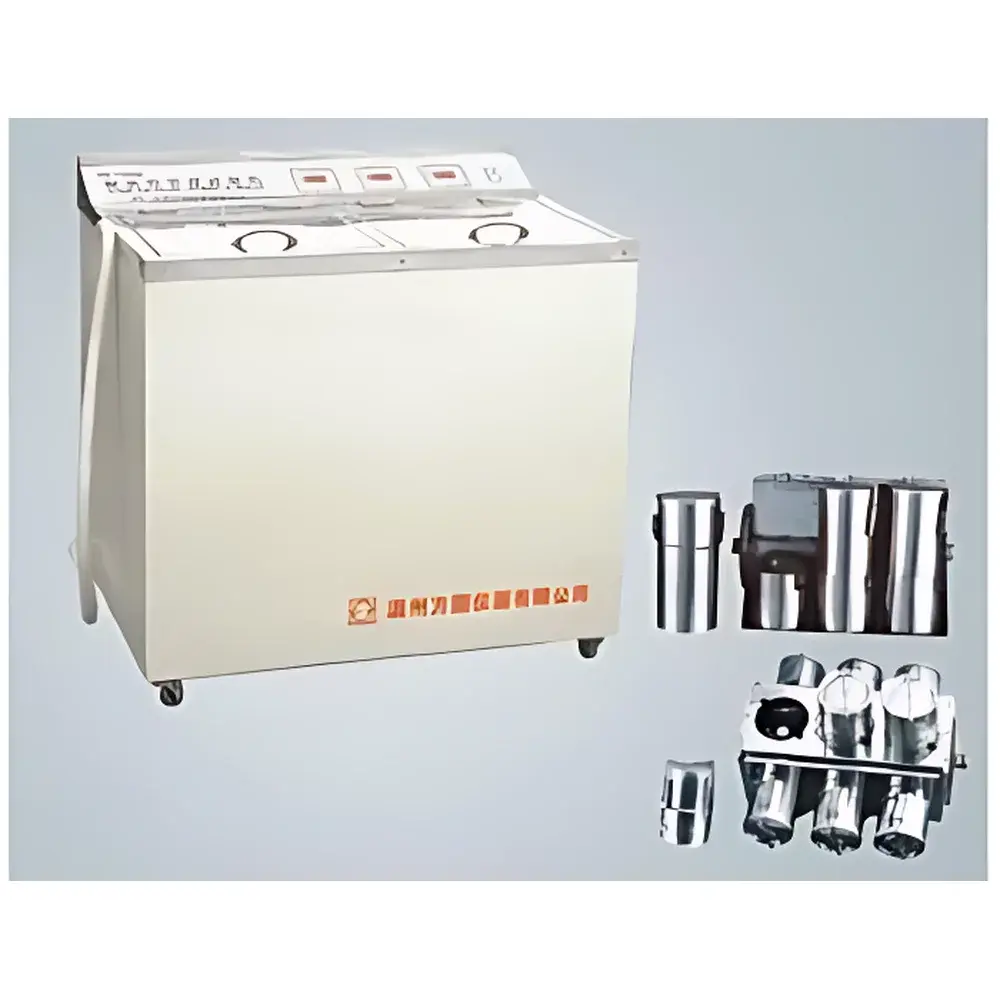
Fangyuan Instruments SW-Series Washing Fastness Tester
| Brand | Fangyuan Instruments |
|---|---|
| Origin | Zhejiang, China |
| Model | SW-Series |
| Cup Capacity | 535 mL (ISO), 1200 mL (AATCC) |
| Rotation Speed | 40 ± 2 rpm |
| Time Range | 0–999 min (±5 s accuracy) |
| Temperature Range | Ambient to 100 °C (±2 °C accuracy, 0.1 °C resolution) |
| Heating Method | Electric (dual 4.5 kW or 4.5/3.0 kW configurations) |
| Power Supply | AC 380 V, 50 Hz |
| Compliance | GB/T 3921.1–3921.5, GB/T 5711–1997, ISO 105-C01 to C05, ISO 105-D01, AATCC 61 |
Overview
The Fangyuan Instruments SW-Series Washing Fastness Tester is an electromechanical laboratory instrument engineered for precise, repeatable evaluation of color fastness to washing and dry cleaning in textile materials. It operates on the principle of controlled mechanical agitation under standardized thermal and chemical conditions—mimicking real-world laundering environments through regulated rotation of specimen cups within heated detergent solutions. The device conforms to internationally harmonized test protocols including ISO 105-C01 through C05 (color fastness to washing), ISO 105-D01 (color fastness to dry cleaning), GB/T 3921.1–3921.5 (Chinese national equivalents of ISO 105-C series), GB/T 5711–1997 (dry cleaning fastness), and AATCC Test Method 61 (home and commercial laundering). Its core function is to quantify both color change (fading) and staining (transfer to adjacent white fabric), enabling objective assessment of dye performance, fiber-dye affinity, and finishing efficacy across natural (cotton, wool, silk, linen) and synthetic (polyester, nylon, acrylic) substrates.
Key Features
- Microprocessor-controlled PID temperature regulation with 0.1 °C resolution and ≤±2 °C deviation over full range (ambient to 100 °C), eliminating thermal overshoot during critical wash cycles;
- Stable rotational drive system using spur-gear transmission and stainless-steel waterproof bearings, delivering consistent 40 ± 2 rpm motion across all cup positions;
- Dual independent heating modules (4.5 kW × 2 or 4.5/3.0 kW split configuration) for rapid, uniform thermal equilibration and multi-zone thermal management;
- Robust solid-state relay (SSR) heating control—no mechanical contacts—ensuring long-term reliability, silent operation, and immunity to contact wear;
- Waterproof PVC control panel with tactile membrane switches and integrated splash-resistant film, certified for safe operation in wet laboratory environments;
- Programmable timer with 999-minute capacity and ±5-second accuracy, supporting complex multi-step wash protocols (e.g., pre-wash, main wash, rinse phases);
- Integrated dry-run protection circuitry that automatically deactivates heaters when liquid level falls below operational threshold;
- Modular cup rack design with quick-release mechanism compatible with both ISO-standard 535 mL and AATCC-standard 1200 mL specimen vessels;
- Adjustable left/right drainage ports for flexible installation in constrained lab layouts;
- Pre-heating chamber (370 × 370 × 280 mm) included on SW-12M and SW-12A models to stabilize bath temperature prior to test initiation.
Sample Compatibility & Compliance
The SW-Series accommodates a broad spectrum of textile specimens—including woven, knitted, nonwoven, and dyed or printed fabrics—as well as loose fibers and yarns mounted on standard multifiber test cloths. Each test requires pairing the specimen with specified adjacent white fabric (e.g., multifiber DW, cotton, wool, or acetate per ISO/AATCC requirements), stitched into a composite swatch. The instrument supports simultaneous testing of up to 24 specimens (SW-24A model) or 12 specimens (SW-12M/SW-12A), enabling statistically robust inter-laboratory comparisons. All operational parameters—including temperature ramp profiles, agitation duration, detergent composition (per ISO 105-C03/C04), and steel ball count—are fully configurable to meet exact clause-level requirements of referenced standards. The system architecture supports audit-ready documentation workflows compliant with GLP and ISO/IEC 17025 quality management frameworks.
Software & Data Management
While the SW-Series operates via embedded industrial-grade Mitsubishi 16-bit microcontroller firmware (no external PC dependency), it provides RS-232 serial interface for optional integration with laboratory information management systems (LIMS) or custom data logging software. Time-stamped temperature and runtime logs can be exported for traceability in regulated environments requiring FDA 21 CFR Part 11–compliant electronic records. Firmware supports user-defined protocol templates, allowing storage of multiple standardized test methods (e.g., ISO 105-C03 at 40 °C vs. AATCC 61-2A at 60 °C) with recallable setpoints. All parameter changes are logged with timestamp and operator ID when connected to networked LIMS infrastructure.
Applications
- Quality assurance of dyed and printed textiles in OEM manufacturing and contract dye houses;
- R&D validation of novel reactive, disperse, acid, and vat dyes under accelerated wash conditions;
- Comparative evaluation of finishing agents (e.g., crosslinkers, softeners, resin treatments) on color retention;
- Regulatory conformance testing for global market access (EU REACH, OEKO-TEX® Standard 100, GOTS, UL EcoLogo);
- Internal benchmarking of fiber blends (e.g., polyester/cotton) against mono-fiber controls;
- Calibration verification of spectrophotometric color difference measurements (ΔE*CMC, ΔE*00) post-wash using ISO 105-J01 reference scales.
FAQ
What standards does the SW-Series fully support?
The instrument is validated for ISO 105-C01 to C05, ISO 105-D01, GB/T 3921.1–3921.5, GB/T 5711–1997, and AATCC Test Method 61—including all specified temperature, time, detergent, and mechanical action variables.
Can the SW-Series accommodate both ISO and AATCC cup sizes simultaneously?
Yes—SW-12A and SW-24A models accept either twelve 535 mL cups (ISO) or six 1200 mL cups (AATCC) using interchangeable racks; SW-12M is optimized for ISO 535 mL only.
Is dry-run protection active during pre-heating mode?
Yes—the low-water cutoff sensor remains operational throughout all phases, including pre-heat chamber conditioning and active wash cycles.
How is temperature uniformity verified across multiple cups?
Each unit undergoes factory calibration using NIST-traceable PT100 probes placed at geometric center positions in representative cups; users may perform periodic verification using calibrated immersion thermometers per ISO/IEC 17025 Clause 6.5.
Does the controller support multi-stage temperature programming (e.g., ramp-hold-cool)?
No—the SW-Series implements single-setpoint thermal control per test cycle; multi-stage profiles require external programmable bath integration or manual intervention between phases.
Related Products






