
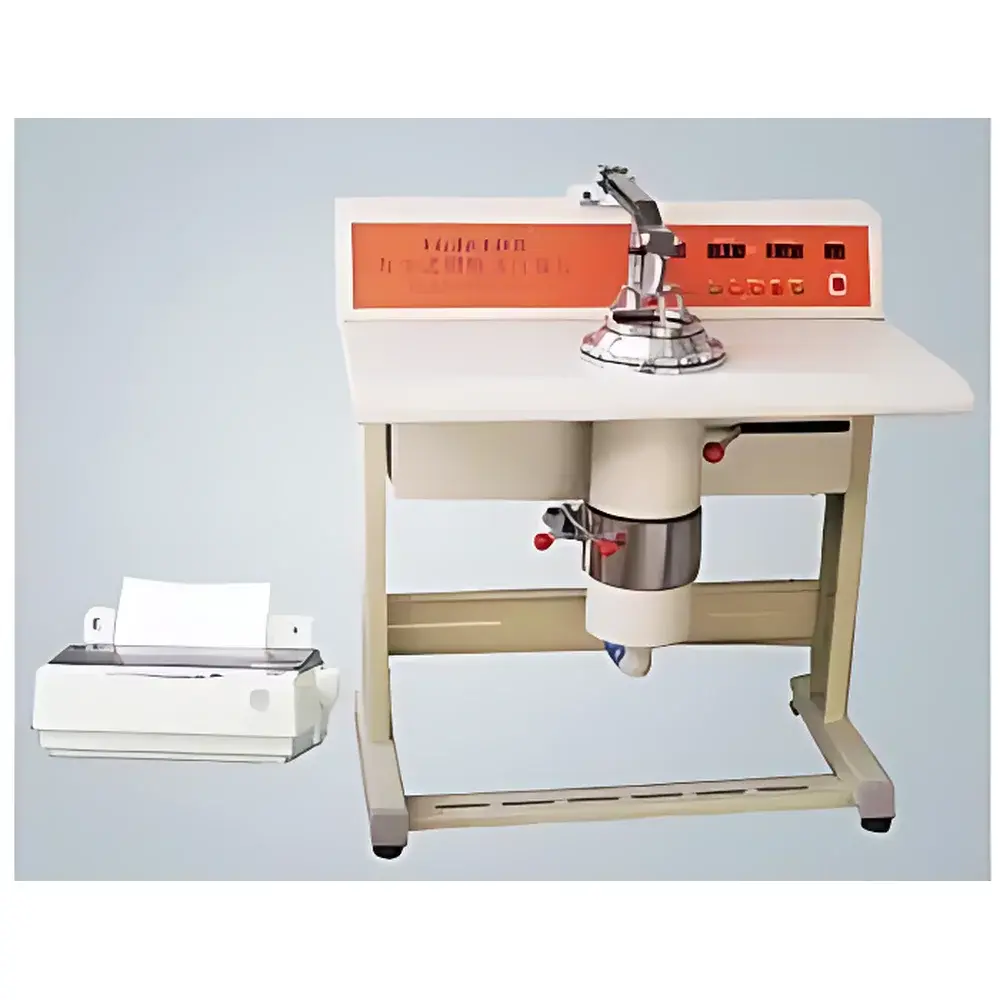
Fangyuan YG461D Digital Fabric Air Permeability Tester
| Brand | Fangyuan |
|---|---|
| Model | YG461D |
| Measurement Principle | Constant-pressure air flow through fabric under standardized differential pressure |
| Pressure Range | 50–4000 Pa |
| Measurable Air Permeability | 1–9999 mm/s |
| Accuracy | ≤ ±2% |
| Sample Thickness Limit | ≤ 8 mm |
| Standardized Test Areas | 5, 20, 50, 100 cm² and Ø50 mm (≈19.6 cm²), Ø70 mm (≈38.5 cm²) |
| Nozzle Set | 11 calibrated stainless-steel nozzles |
| Power Supply | AC 220 V, 50 Hz, 1200 W |
| Dimensions | 820 × 600 × 1300 mm (L×W×H) |
| Weight | 65 kg |
| Compliance | GB/T 5453–1997, ISO 9237, ASTM D737, JIS L1096, DIN 53387, BS 5636, NF G07-111 |
Overview
The Fangyuan YG461D Digital Fabric Air Permeability Tester is an engineered instrument designed for precise, repeatable quantification of air permeability in textile and industrial sheet materials. It operates on the fundamental principle of constant-pressure differential air flow measurement: a regulated pressure drop is maintained across a conditioned fabric specimen, and the volumetric air flow rate per unit area—expressed as mm/s or L/m²·s—is measured under controlled environmental conditions. This parameter directly reflects the resistance to airflow imposed by fiber architecture, yarn packing density, inter-yarn void geometry, coating integrity, and substrate porosity. Unlike empirical breathability proxies, the YG461D delivers traceable, physics-based data essential for R&D validation, QC release testing, and regulatory documentation in technical textiles, protective apparel, filtration media, and composite laminates.
Key Features
- Mitsubishi 16-bit microcontroller core with enhanced electromagnetic interference (EMI) immunity and onboard non-volatile memory supporting up to 99 test records with timestamping and parameter logging.
- High-stability digital pressure sensor (±0.5% FS) coupled with closed-loop, real-time feedback control of suction airflow—ensuring dynamic compensation for system drift and maintaining target differential pressure within ±1 Pa during extended runs.
- Full-range calibration of all 11 stainless-steel precision nozzles against NIST-traceable reference standards; each nozzle validated at ≥5 pressure points across its operational range to eliminate interpolation error.
- Integrated high-resolution LCD display presenting real-time differential pressure, airflow rate, calculated air permeability (mm/s), and normalized permeability (L/m²·s) without manual lookup tables or external computation.
- Modular test area selection via six interchangeable fixed-area rings (5, 20, 50, 100 cm² and Ø50 mm / Ø70 mm), enabling direct compliance with multiple international test protocols without geometric correction factors.
- Optional RS-232 or USB interface for connection to external thermal printers or laboratory information management systems (LIMS); report output includes test ID, operator, date/time, environmental conditions (optional hygrothermograph integration), raw sensor values, and final permeability result.
Sample Compatibility & Compliance
The YG461D accommodates flat, flexible sheet specimens up to 8 mm thick—including woven fabrics, knits, nonwovens, coated textiles, technical membranes, filter papers, synthetic leathers, and polymer films. Its mechanical clamping system ensures uniform sealing without edge leakage, critical for low-permeability substrates such as laminated rainwear or medical barrier fabrics. The instrument meets the mechanical and procedural requirements of GB/T 5453–1997 (China), ISO 9237:1995 (International), ASTM D737–22 (USA), JIS L1096:2010 (Japan), DIN 53387:1992 (Germany), BS 5636:1978 (UK), and NF G07-111:1979 (France). It supports configurable test pressures from 50 Pa to 4000 Pa, allowing users to replicate application-specific differential conditions—e.g., 100 Pa for apparel comfort assessment, 200 Pa for industrial filter validation, or 160 Pa for parachute fabric certification per DIN 53387.
Software & Data Management
While the YG461D operates as a standalone benchtop instrument with embedded firmware, its data architecture aligns with GLP/GMP documentation practices. All measurements are stored with immutable metadata: test sequence number, user ID (via keypad entry), ambient temperature/humidity (when interfaced with optional sensors), applied pressure, selected orifice area, and raw analog-to-digital converter (ADC) outputs from both pressure and airflow transducers. Exported reports comply with FDA 21 CFR Part 11 audit trail requirements when paired with validated third-party LIMS software—supporting electronic signatures, version-controlled configuration files, and secure data archiving. Firmware updates are performed via USB flash drive with checksum verification to ensure integrity.
Applications
- Performance validation of sportswear and outdoor apparel fabrics for ISO 9237-compliant breathability grading.
- Quality assurance of filtration media used in HVAC, automotive cabin filters, and medical face masks (ASTM F2101/F2299 correlation studies).
- Development of fire-resistant and chemical-barrier textiles where reduced air permeability correlates with enhanced protection efficacy.
- Characterization of geotextiles and agricultural mulch films for root-zone aeration and moisture vapor transmission rate (MVTR) modeling.
- Regulatory submission support for PPE certification (EN 14325, ISO 13997) requiring documented air resistance metrics.
- Process control in nonwoven manufacturing lines—monitoring calendering pressure, binder distribution, and web consolidation effects on pore structure.
FAQ
What pressure differentials does the YG461D support, and how are they selected?
The instrument provides continuous pressure control from 50 Pa to 4000 Pa. Users select the target differential via numeric keypad input; the system automatically adjusts fan speed using PID-regulated feedback to maintain setpoint stability within ±1 Pa tolerance throughout the test duration.
Can the YG461D measure very low-permeability materials such as coated nylon or laminated membranes?
Yes—its 11-nozzle array includes low-flow orifices optimized for sub-10 mm/s permeability ranges. Combined with high-resolution pressure sensing and zero-drift compensation algorithms, it achieves reliable measurement down to 1 mm/s with ≤±2% full-scale error.
Is calibration traceable to national metrology institutes?
All pressure and airflow transducers are factory-calibrated against NIST-traceable deadweight testers and rotameter standards. Certificate of Calibration (CoC) with uncertainty budget is supplied with each unit; annual recalibration is recommended per ISO/IEC 17025 guidelines.
Does the instrument meet requirements for ISO/IEC 17025-accredited laboratories?
Yes—the YG461D’s documented measurement uncertainty, repeatability (CV ≤ 1.2% over 10 replicates), linearity (R² ≥ 0.9998), and environmental sensitivity profile satisfy Clause 6.4 and Annex A of ISO/IEC 17025:2017 for textile physical testing equipment.
How is sample thickness limitation of 8 mm enforced mechanically?
The clamping frame incorporates adjustable stop screws and a precision-ground compression surface that limits maximum specimen deformation. Exceeding 8 mm triggers physical interference with the upper platen, preventing erroneous sealing and ensuring consistent gasket compression across all test areas.




