
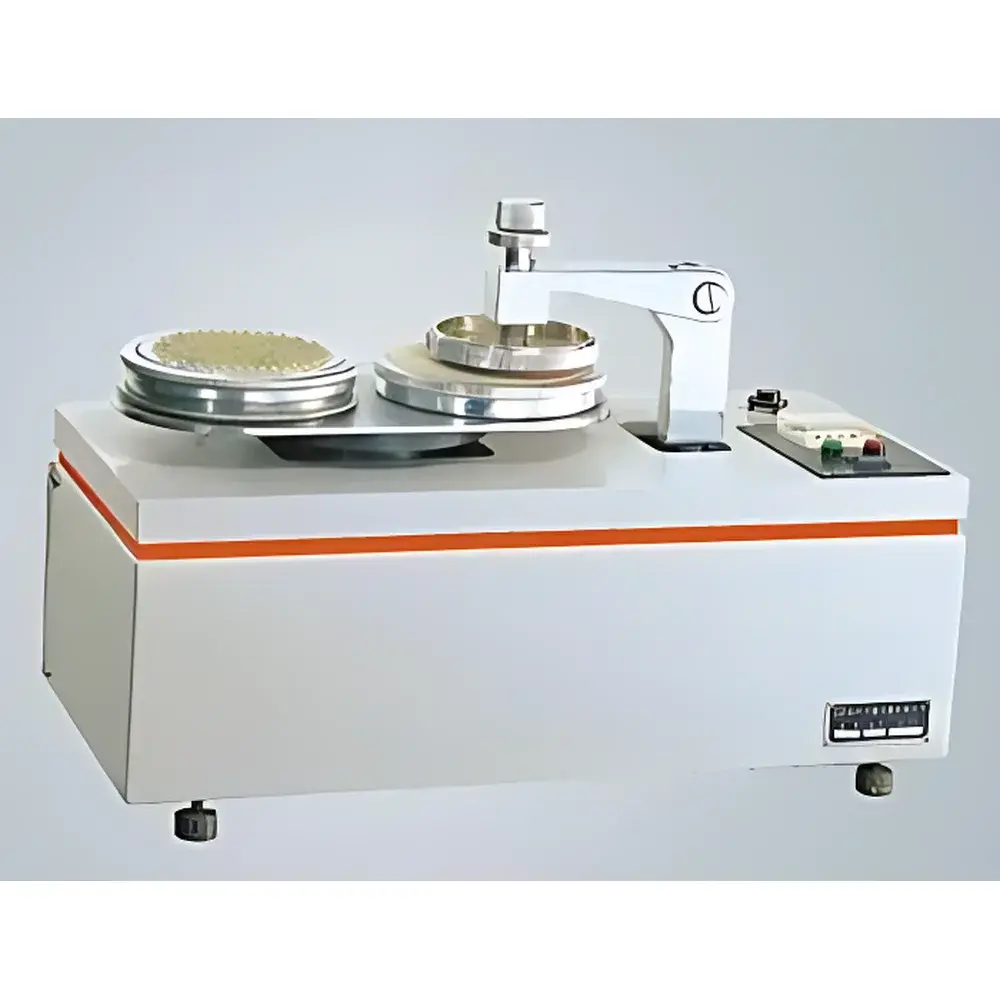
Fangyuan YG502 Fabric Pilling and Fuzzing Tester
| Brand | Fangyuan Instruments |
|---|---|
| Origin | Zhejiang, China |
| Manufacturer Type | Authorized Distributor |
| Country of Origin | China |
| Model | YG502 |
| Pricing | Available Upon Request |
| Motion Trajectory | Φ40 mm circular path |
| Brush Height Adjustment Range | 2–12 mm (continuously adjustable) |
| Sample Area | 100 cm² |
| Pre-set Counter Range | 1–9999 cycles (digital input) |
| Oscillation Frequency | 60 cycles/min |
| Test Load | Synthetic fabrics: 590 cN (achieved via 100 cN + 490 cN weights) |
| Worsted wool fabrics | 780 cN (100 cN + 290 cN + 490 cN) |
| Woolen fabrics | 490 cN (single 490 cN weight) |
| Standard Weights Included | 100 cN ×1, 290 cN ×1 (sample holder self-weight: 490 cN) |
| Standard Abrasive | 2201 Standard Gabardine (2 pieces) |
| Foam Pads | 4 pcs |
| Power Supply | 1 HP, AC 220 V, 50 Hz, 100 W |
| Dimensions (L×W×H) | 540 × 250 × 345 mm |
| Net Weight | 30 kg |
Overview
The Fangyuan YG502 Fabric Pilling and Fuzzing Tester is an electromechanical instrument engineered for standardized assessment of surface degradation in textile materials under controlled mechanical abrasion. It operates on the principle of circular trajectory abrasion—where a rotating brush applies consistent tangential shear stress to a clamped fabric specimen mounted over a foam pad, simulating real-world wear mechanisms such as rubbing against clothing or furniture surfaces. Designed in strict accordance with GB/T 4802.1–2008 (“Textiles — Pilling Resistance of Fabrics — Part 1: Circular Locus Method”), the YG502 delivers repeatable, operator-independent test conditions essential for comparative evaluation across fiber types, yarn structures, and finishing treatments. Its core function is to induce and quantify pilling (formation of small fiber balls) and fuzzing (loosening of surface fibers), both critical quality indicators in apparel, upholstery, and technical textile development.
Key Features
- Synchronous motor-driven brush mechanism ensures precise rotational speed stability and eliminates gear-reduction maintenance requirements—no periodic lubrication or backlash calibration needed.
- Digital pre-set counter (1–9999 cycles) with audible end-of-test alert enables unattended operation and traceable cycle documentation.
- Adjustable brush height (2–12 mm range) allows optimization of contact pressure and abrasion intensity across varying fabric thicknesses and compressibility.
- Modular weight system supports three standardized load configurations: 490 cN (woolen), 590 cN (synthetic), and 780 cN (worsted wool), achieved through combinable calibrated masses (100 cN, 290 cN, 490 cN) and fixed sample holder mass.
- Fixed 60-cycle-per-minute oscillation frequency complies with GB/T 4802.1–2008 timing requirements, ensuring temporal consistency across laboratories.
- Integrated foam pad support and standardized 2201 gabardine abrasive ensure uniform substrate compliance and inter-laboratory reproducibility.
Sample Compatibility & Compliance
The YG502 accommodates flat, non-stretch woven and knitted specimens measuring exactly 100 cm² (typically cut using a 113 mm diameter circular cutter). It is validated for use with natural fibers (e.g., worsted/woolen wool), synthetic filaments and staple fibers (e.g., polyester, nylon, acrylic), and their blends—including double-knits, fleece, and brushed cottons. All test parameters—including motion geometry (Φ40 mm circle), load application method, and abrasive specification—conform explicitly to GB/T 4802.1–2008. While not certified to ISO 12945-1 or ASTM D3512, its mechanical architecture permits direct correlation studies when operated under equivalent protocol adaptations. The device supports GLP-aligned documentation when paired with external lab notebooks or LIMS-integrated reporting workflows.
Software & Data Management
The YG502 operates as a standalone electromechanical tester with no embedded firmware or digital interface. Cycle count data is captured locally via its seven-segment LED display and retained only during active operation. For auditability, users are advised to record start/end counts, applied load configuration, and specimen ID manually—or integrate with third-party data loggers via auxiliary TTL pulse output (optional accessory). No software installation, network connectivity, or FDA 21 CFR Part 11 compliance features are included; however, the deterministic mechanical design ensures full traceability of test execution parameters without dependency on proprietary code or cloud services.
Applications
- Quality control of finished fabrics prior to cutting and sewing in garment manufacturing.
- Comparative evaluation of anti-pilling finishes (e.g., enzymatic bio-polishing, resin cross-linking, plasma treatment).
- R&D screening of novel yarn architectures (e.g., core-spun, compact, or air-jet textured threads) for surface stability.
- Validation of care labeling claims related to abrasion resistance and long-term appearance retention.
- Technical textile qualification for automotive interiors, contract upholstery, and medical scrubs where pilling compromises aesthetics or hygiene.
FAQ
What standards does the YG502 directly support?
GB/T 4802.1–2008 is the primary and fully implemented standard. Other methods (e.g., ISO 12945-1, ASTM D3512) require manual adaptation of load, cycle count, and abrasive selection—and are not factory-validated.
Is the 2201 gabardine abrasive supplied with the instrument?
Yes—two pieces of certified 2201 standard gabardine are included in the base configuration.
Can the YG502 be used for non-woven fabrics?
It may be used empirically, but results lack standardized interpretation since GB/T 4802.1–2008 applies exclusively to woven and knitted structures.
What maintenance is required for long-term reliability?
Annual inspection of brush bristle integrity, foam pad compression recovery, and weight calibration is recommended. The synchronous motor requires no routine servicing beyond visual inspection and dust removal.
Is electrical safety certification provided?
The unit complies with IEC 61010-1 for laboratory equipment and carries CE marking per EU Machinery Directive 2006/42/EC. Full test reports available upon request.




