
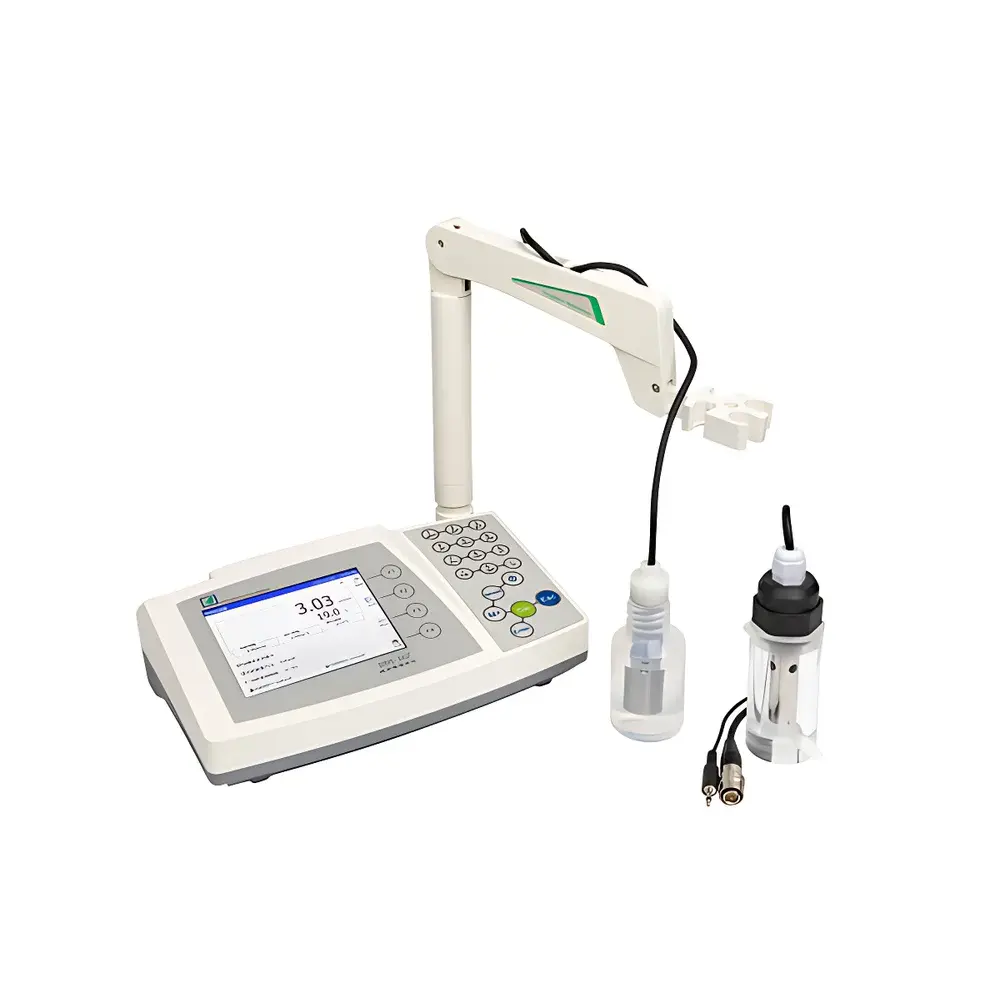
FangZhou DDS-302+ Benchtop Conductivity Meter
| Brand | FangZhou |
|---|---|
| Origin | Sichuan, China |
| Model | DDS-302+ |
| Form Factor | Benchtop |
| Application | Laboratory |
| Conductivity Range | (0–2×10⁵) µS/cm |
| TDS Range | (0.00–300.0) g/L |
| Resistivity Range | (5.00–10⁸) Ω·cm |
| Salinity Range | 0 ppt |
| Temperature Range | (−25.0–135.0) °C |
| Accuracy | ±0.5% FS |
| Minimum Conductivity Resolution | 0.0001 µS/cm |
| Instrument Class | 0.5 |
| Data Storage Capacity | ≥100,000 records |
| Calibration Points | 4 Chinese standard, 6 US/EU standard, 1 custom solution |
| Temperature Compensation | Automatic (ATC) and Manual (MTC), adjustable reference temperature (15.0–25.0 °C) |
| Compliance | GLP-compliant data logging with audit trail, ISO 9001 certified manufacturing |
Overview
The FangZhou DDS-302+ Benchtop Conductivity Meter is a high-precision, multi-parameter electrochemical analyzer engineered for rigorous laboratory environments where trace-level conductivity, resistivity, TDS, and temperature measurements must meet regulatory-grade repeatability and traceability. Operating on the fundamental principle of two-electrode or four-electrode conductometric measurement—where electrical current is applied across a known electrode geometry and the resulting voltage drop is used to calculate solution conductance—the DDS-302+ delivers stable, low-drift readings across seven auto-ranging conductivity spans. Its architecture supports both standard solution calibration and electrode constant determination, enabling accurate quantification across ultra-pure water (e.g., ASTM D1193 Type I–III, USP , EP 2.2.38) and high-conductivity industrial effluents. Designed for continuous operation in QC labs, pharmaceutical water systems, microelectronics cleanrooms, and power plant chemistry monitoring stations, the instrument integrates dual-mode temperature compensation (linear and non-linear), configurable reference temperatures, and application-specific water grade modes—including EP/USP-compliant Purified Water and Water for Injection (WFI) profiles with configurable alarm thresholds.
Key Features
- 7-range auto-scaling conductivity measurement with dynamic resolution from 0.0001 µS/cm (at lowest range) to 0.1 mS/cm (at highest range), ensuring optimal signal-to-noise ratio across orders of magnitude
- Integrated multi-parameter capability: simultaneous real-time display of conductivity, resistivity, TDS, salinity (0 ppt fixed), and temperature—with user-selectable units and conversion algorithms per ISO 7888 and ASTM D1125
- GLP-compliant data management system featuring time-stamped, operator-ID-logged measurements, full audit trail, and tamper-resistant storage of ≥100,000 datasets with sample-name indexing
- Configurable calibration framework supporting 4 Chinese national standard points (GB/T 6682, JJG 376), 6 international standards (e.g., NIST-traceable KCl solutions at 0.01, 0.1, 1.0, 10.0, 100.0, 1000.0 mS/cm), plus one user-defined standard
- Application-specific water grade modes: Lab Grade I/II/III (per ISO 3696), Pharmaceutical Purified Water & WFI (per USP and EP 2.2.38), and Electronic Grade Water EW-I/EW-II/EW-III (per SEMI F63)—each with programmable pass/fail limits and visual/audio alerts
- Dual temperature compensation: automatic (ATC) via integrated Pt1000 sensor or manual (MTC) input; non-linear compensation algorithm optimized for deionized and ultrapure water below 1 µS/cm
- Secure user management supporting up to 1,000 unique accounts with role-based access control (administrator, analyst, reviewer), password policies, and session timeout enforcement
Sample Compatibility & Compliance
The DDS-302+ accommodates standard DIN/ISO-compliant conductivity cells (DJS-0.01, DJS-0.1, DJS-1.0), including shielded four-electrode sensors for high-accuracy low-conductivity applications. It is validated for use with aqueous matrices ranging from ultrapure water (≥18.2 MΩ·cm) to concentrated brines and process cooling waters. All firmware and data handling routines comply with GLP requirements per 21 CFR Part 11 (electronic signatures, audit trails, data integrity controls) and support GMP-aligned workflows in pharmaceutical and biotech settings. The device’s manufacturing quality system is certified to ISO 9001:2015, and its calibration traceability aligns with national metrology institutes through documented chain-of-custody for reference standards.
Software & Data Management
Data export is natively supported via USB 2.0 and RS-232 interfaces, enabling direct transfer of measurement logs into Microsoft Excel, Word, or plain-text formats without proprietary software. The built-in reporting engine generates three standardized output templates: Simple (minimal metadata), Standard (including calibration history and operator ID), and GLP (full compliance mode with electronic signature fields, instrument ID, environmental conditions, and version-controlled method IDs). All stored entries retain timestamp, temperature, electrode ID, calibration status, and method name—ensuring full forensic traceability during regulatory audits. Internal clock synchronization supports ISO 8601 date/time formatting and daylight saving time awareness.
Applications
- Pharmaceutical water system validation and routine monitoring (Purified Water, WFI, Clean Steam condensate)
- Microelectronics ultrapure water (UPW) qualification per SEMI F63 and ITRS specifications
- Power generation boiler feedwater and condensate purity assurance (ASTM D4582, D5119)
- Environmental lab analysis of surface water, wastewater, and leachates per EPA Method 120.1
- Academic and industrial research requiring high-stability conductivity profiling under controlled thermal conditions
- QC release testing of excipients, buffers, and parenteral formulations per USP chapters and
FAQ
Does the DDS-302+ support four-electrode conductivity cells for low-conductivity measurements?
Yes—it accepts standard four-electrode sensors with DJS-0.01 and DJS-0.1 cell constants, enabling accurate sub-0.1 µS/cm measurements with minimized polarization error.
Can calibration data be exported for external audit review?
Absolutely. All calibration events—including date, operator ID, standard used, measured value, deviation, and acceptance criteria—are stored with timestamps and exported in CSV or PDF-GLP format.
Is non-linear temperature compensation active in all water grade modes?
Yes—non-linear compensation is enabled by default in Purified Water, WFI, and EW-grade modes, applying the ISO 7888-derived polynomial correction for enhanced accuracy below 10 µS/cm.
How does the instrument ensure data integrity under power interruption?
It features non-volatile flash memory with automatic save-on-power-loss functionality, preserving the last 100 measurements and full calibration history even after unexpected shutdown.
What security protocols govern user access and method editing?
Role-based permissions restrict method creation/modification to administrator-level users; analyst-level accounts may only execute pre-approved methods and cannot alter calibration parameters or system settings.




