
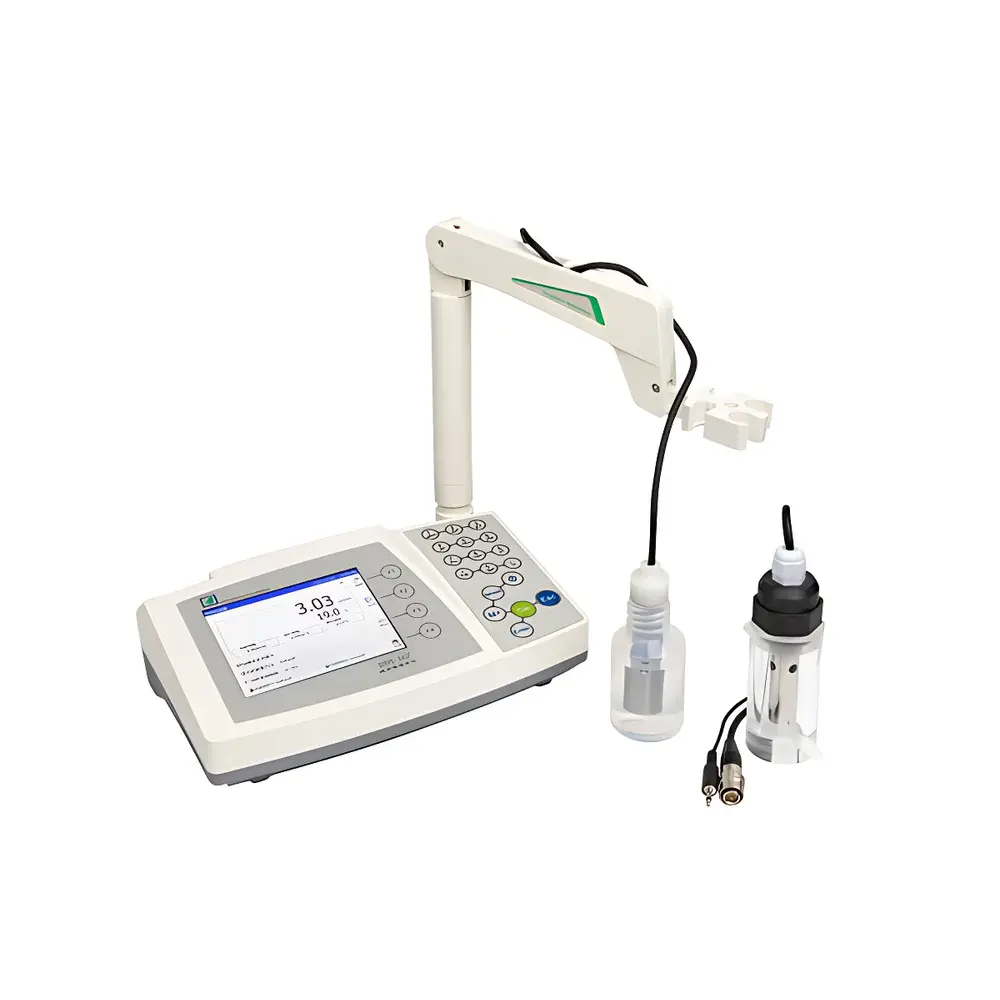
FangZhou DDS-302+ Laboratory-Grade Conductivity Meter for Ultrapure Water
| Brand | FangZhou |
|---|---|
| Origin | Sichuan, China |
| Model | DDS-302+ |
| Form Factor | Benchtop |
| Application | Laboratory |
| Conductivity Range | (0–2×10⁵) µS/cm |
| TDS Range | (0.00–300.0) g/L |
| Resistivity Range | (5.00–10⁸) Ω·cm |
| Salinity Range | 0 ppt |
| Temperature Range | (−25.0–135.0) °C |
| Accuracy | ±0.5% FS |
| Minimum Conductivity Resolution | 0.0001 µS/cm |
| Instrument Class | 0.5 |
| Data Storage Capacity | ≥100,000 records |
| Calibration Points | 4 Chinese standard, 6 US/EU standard, 1 custom solution |
| Temperature Compensation | Automatic (ATC) and Manual (MTC), with adjustable reference temperature (15.0–25.0 °C) |
| Compliance | GLP-compliant data logging, ISO 9001 certified manufacturing |
Overview
The FangZhou DDS-302+ Laboratory-Grade Conductivity Meter is an engineered solution for high-precision electrical conductivity, resistivity, TDS, and temperature measurement in ultrapure water applications. Designed specifically for compliance-critical environments—including pharmaceutical purified water (PW), water for injection (WFI), electronic-grade water (EW-I/EW-II/EW-III), and ASTM D1193 Type I/II/III laboratory water—the instrument employs four-electrode AC conductivity measurement principles to minimize polarization errors and electrode fouling. Its dual-mode temperature compensation—linear and non-linear—enables accurate correction across wide thermal gradients typical in boiler feedwater, semiconductor rinse baths, and biopharmaceutical buffer preparation. The device meets the metrological requirements of ISO/IEC 17025-accredited laboratories and supports traceability through full GLP audit trails.
Key Features
- Benchtop form factor with high-resolution color LCD display and adjustable backlight for optimal readability under varied ambient lighting conditions
- Seven auto-ranging conductivity scales (0.0000–0.2000 µS/cm to 2.00–20.00 mS/cm), each optimized for specific electrode constants (DJS = 0.01, 0.1, or 1.0 cm⁻¹)
- One-touch electrode calibration with automatic cell constant determination and real-time validation of calibration integrity
- Configurable reference temperature (15.0–25.0 °C) and temperature coefficient (α) for application-specific compensation algorithms
- Comprehensive user management system supporting up to 1,000 unique operator accounts with role-based access control and password enforcement
- Electrode lifecycle tracking: stores electrode ID, serial number, calibration history, drift logs, and replacement reminders
- Method library supporting 100 user-defined measurement protocols—including PW, WFI, EW, and ASTM D1193 modes—with configurable alarm thresholds and pass/fail criteria
- Integrated clock and calendar with timestamped data capture; all measurements include operator ID, method ID, electrode ID, and environmental metadata
Sample Compatibility & Compliance
The DDS-302+ is validated for use with low-conductivity aqueous matrices where ionic contamination must be quantified at sub-ppb levels. It accommodates standard platinum or stainless-steel conductivity cells (DJS-0.01, DJS-0.1, DJS-1.0), as well as specialized flow-through cells for inline monitoring. The instrument complies with key regulatory frameworks: its data management architecture satisfies FDA 21 CFR Part 11 requirements for electronic records and signatures when paired with secure USB/RS232 host systems; built-in audit trail functionality enables full GLP/GMP traceability; and calibration workflows align with ISO 8665 (water quality — conductivity measurement) and USP (Water for Pharmaceutical Purposes). All firmware and calibration logic are validated per ICH Q2(R2) guidelines for analytical instrument qualification.
Software & Data Management
Data storage capacity exceeds 100,000 measurement records, each containing conductivity, resistivity, TDS, salinity, temperature, date/time stamp, operator ID, method name, electrode ID, and calibration status. Export is supported via USB mass storage or RS232 serial interface directly into Microsoft Excel (.csv), Word (.txt), or plain-text formats—no proprietary software required. The internal database supports query-by-sample name, date range, operator, or method ID. All exported files retain embedded metadata required for regulatory submission. Audit trail logs record every configuration change, calibration event, user login/logout, and data deletion attempt—retained indefinitely unless manually purged under administrator privilege.
Applications
- Pharmaceutical water systems: continuous verification of PW, WFI, and purified steam condensate per USP and EU Ph. Eur. 2.2.38
- Semiconductor manufacturing: monitoring of ultrapure rinse water (EW-I/EW-II/EW-III) per SEMI F63 standards
- Power generation: feedwater and condensate purity assessment in thermal and nuclear plants per ASTM D4582 and IAPWS guidelines
- Academic and contract research labs: routine QC of deionized water, buffer solutions, and cell culture media
- Environmental testing labs: compliance reporting for drinking water (EPA Method 120.1) and wastewater effluent
FAQ
Does the DDS-302+ support non-linear temperature compensation for ultrapure water?
Yes—it implements the ISO 7888-derived non-linear algorithm optimized for waters below 10 µS/cm, ensuring accuracy across −25.0 to 135.0 °C without manual curve fitting.
Can calibration data be traced to national metrology institutes?
Calibration points include NIST-traceable US/EU standard solutions (e.g., KCl 0.01 mol/kg, 0.1 mol/kg) and GB/T 601-certified Chinese reference materials; certificate of analysis templates are exportable.
Is firmware upgrade capability available via USB?
Yes—field-upgradable firmware is delivered as signed .bin files; version history and update timestamps are logged in the system audit trail.
What security controls prevent unauthorized data modification?
All data entries are write-once; deletion requires dual authentication (admin password + confirmation code); audit logs cannot be edited or cleared without physical USB export and administrative override.
How does the instrument handle electrode drift during extended operation?
Real-time stability monitoring triggers automatic recalibration alerts when deviation exceeds user-defined tolerance (±0.2% FS over 24 h); historical drift trends are graphically viewable in the method review interface.






