
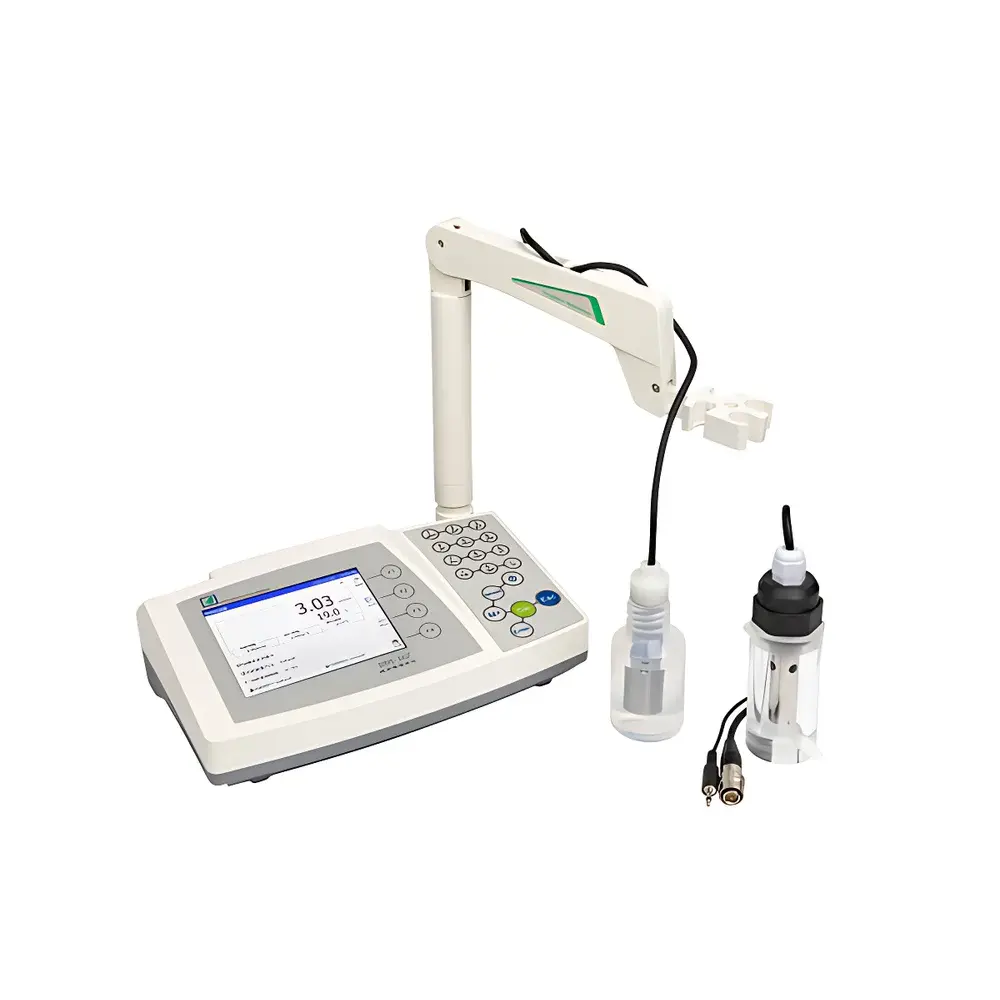
FangZhou DDS-302+ Power Plant Grade Conductivity Meter
| Brand | FangZhou |
|---|---|
| Origin | Sichuan, China |
| Model | DDS-302+ |
| Form Factor | Benchtop |
| Application | Laboratory |
| Conductivity Range | (0–2×10⁵) µS/cm |
| TDS Range | (0.00–300.0) g/L |
| Resistivity Range | (5.00–10⁸) Ω·cm |
| Salinity Range | 0 ppt |
| Temperature Range | (−25.0–135.0) °C |
| Accuracy | ±0.5% FS |
| Minimum Conductivity Resolution | 0.0001 µS/cm |
| Instrument Class | 0.5 |
| Data Storage Capacity | ≥100,000 records |
| Calibration Points | 4 Chinese standard, 6 US/EU standard, 1 custom solution |
| Temperature Compensation | Automatic (ATC) & Manual (MTC), adjustable reference temperature (15.0–25.0 °C) |
| Compliance | GLP-compliant data logging with audit trail, ISO 9001 certified manufacturing |
Overview
The FangZhou DDS-302+ Power Plant Grade Conductivity Meter is a high-precision benchtop electrochemical analyzer engineered for rigorous water quality monitoring in thermal power generation, semiconductor fabrication, pharmaceutical manufacturing, and ultra-pure water production facilities. It operates on the principle of two-electrode or four-electrode conductivity measurement—applying an alternating current across a conductive cell to determine solution conductance, corrected for electrode geometry via user-configurable cell constant (DJS). Its design prioritizes metrological integrity in low-conductivity regimes (down to 0.0000 µS/cm at DJS=0.01 cm⁻¹), where trace ionic contamination critically impacts boiler feedwater, condensate, and ultrapure process water. The instrument supports standardized water classification protocols—including ASTM D1125, ISO 3696 (Grade I–III), USP , EP 2.2.38, and SEMI F63 (EW-I–EW-III)—with built-in mode-specific non-linear temperature compensation algorithms optimized for deionized and distilled water matrices.
Key Features
- Benchtop form factor with high-resolution color LCD display featuring adjustable backlight, alphanumeric keypad, and intuitive icon-driven navigation
- Seven auto-ranging conductivity scales (0.0000–0.2000 µS/cm to 2.00–20.00 mS/cm), enabling seamless transition between ultrapure water and high-salinity applications without manual range selection
- Dual calibration methodology: standard solution calibration (using preloaded Chinese GB/T 6682, USP, ASTM, or ISO reference solutions) and cell constant determination via known KCl standard
- Comprehensive parameter measurement: conductivity, resistivity, TDS, salinity (0 ppt fixed), and temperature—with simultaneous real-time display of all values
- Configurable reference temperature (15.0–25.0 °C) and temperature coefficient (0.00–10.00 %/°C), supporting both linear and non-linear (ultrapure water) compensation models
- Robust data governance architecture: 100,000+ measurement records stored with timestamp, operator ID, method name, electrode ID, calibration history, and environmental conditions
Sample Compatibility & Compliance
The DDS-302+ is validated for use with Type I–III laboratory water (per ISO 3696), USP Purified Water and Water for Injection (WFI), and SEMI-grade Electronic Water (EW-I to EW-III). Its low-range sensitivity and stable DJS=0.01 cm⁻¹ electrode support measurements in resistivity ranges up to 10⁸ Ω·cm—critical for detecting sub-ppb ionic leachates from piping systems or resin exhaustion in mixed-bed polishers. All measurement modes include configurable alarm thresholds and visual/audible alerts for out-of-specification results. The device complies with GLP documentation requirements: each data record includes immutable metadata (user login, method version, calibration status, sensor serial number), satisfying audit readiness for FDA 21 CFR Part 11–aligned environments when paired with secure USB or RS232 export workflows.
Software & Data Management
Data export occurs via native USB or RS232 interfaces, generating plain-text (.csv, .txt) or structured reports directly compatible with Microsoft Excel, Word, or LIMS ingestion pipelines. Three report formats are supported: Simple (minimal fields), Standard (full measurement context), and GLP (including electronic signature placeholders, calibration verification logs, and instrument firmware revision). Internal clock and calendar ensure time-stamped traceability; power-loss protection retains settings and unsaved data during unexpected shutdowns. Up to 100 user-defined methods can be stored—each specifying electrode type, temperature compensation model, reference temperature, TDS conversion factor, and alarm limits—enabling SOP-driven operation across multi-shift laboratory environments.
Applications
- Continuous monitoring of boiler feedwater, turbine condensate, and demineralizer effluent in coal-, gas-, and nuclear-fired power plants
- Validation of water purification systems (RO, EDI, UV oxidation, ultrafiltration) per ASTM D5127 and IAPWS guidelines
- QC release testing of purified water and WFI in pharmaceutical cleanrooms operating under EU GMP Annex 1 and USP
- Resistivity verification of rinse water in semiconductor wafer cleaning lines (SEMI F63 compliance)
- Calibration verification of online conductivity sensors using grab-sample correlation protocols
FAQ
Does the DDS-302+ support four-electrode conductivity measurement?
Yes—it accepts both two-electrode (for general-purpose and low-conductivity applications) and four-electrode (for high-conductivity or fouling-prone samples) probe configurations via standardized BNC and mini-DIN sensor interfaces.
Can calibration data be exported for regulatory review?
Yes—calibration events (date/time, standard used, measured value, deviation, operator ID) are embedded in every GLP-format report and stored internally with full audit trail.
Is temperature compensation adjustable per application?
Yes—the reference temperature is user-selectable between 15.0 and 25.0 °C, and the temperature coefficient is programmable from 0.00 to 10.00 %/°C to match matrix-specific behavior.
What electrode constants are supported?
The instrument accommodates DJS values of 0.01, 0.1, 1.0, and 10.0 cm⁻¹, with automatic scaling of displayed conductivity units based on active cell constant.
How is user access controlled?
Role-based authentication supports 1,000 unique user IDs with password protection; administrator privileges govern method editing, calibration execution, and data deletion rights.
Related Products




