
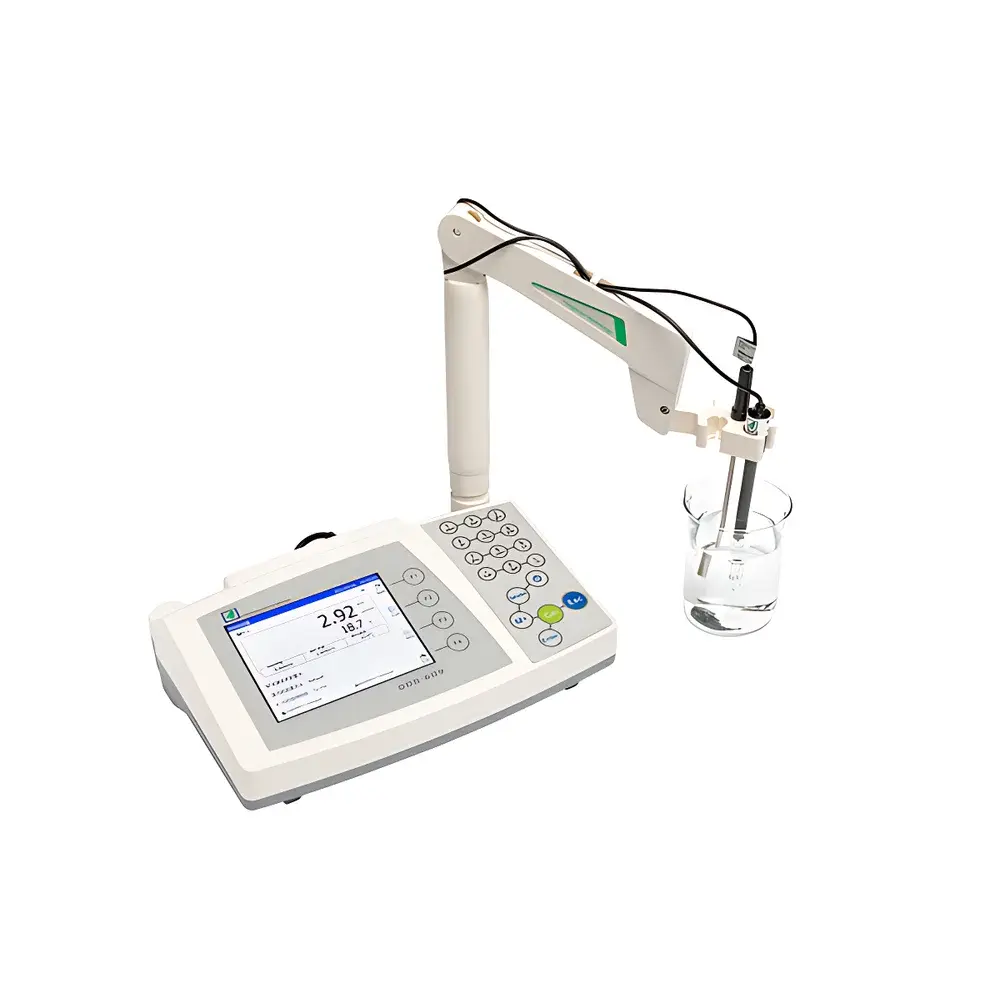
FangZhou DDS-609 Benchtop Laboratory Conductivity Meter
| Brand | FangZhou |
|---|---|
| Origin | Sichuan, China |
| Model | DDS-609 |
| Form Factor | Benchtop |
| Application | Laboratory |
| Conductivity Range | (0–2×10⁵) µS/cm |
| TDS Range | (0.00–300.0) g/L |
| Resistivity Range | (5.00–10⁸) Ω·cm |
| Salinity Range | (0.00–80.00) ppt |
| Temperature Range | (−25.0–135.0) °C |
| Accuracy | ±0.5% FS |
| Minimum Conductivity Resolution | 0.0001 µS/cm |
| Calibration Points | 4 Chinese Standard, 6 US/EU Standard, 1 Custom Solution |
| Temperature Compensation | Automatic (ATC) & Manual (MTC), Adjustable Reference Temp (15.0–25.0 °C) |
| Data Storage | ≥100,000 measurement records |
| Interfaces | RS-232, USB, 0–20 mV analog output |
| Compliance | GLP-compliant data logging with full audit trail, ISO 9001 certified manufacturing |
Overview
The FangZhou DDS-609 Benchtop Laboratory Conductivity Meter is an ISO 9001-certified, multi-parameter electrochemical analyzer engineered for high-reproducibility conductivity, resistivity, TDS, salinity, and temperature measurements in regulated laboratory environments. Based on the fundamental principle of two-electrode or four-electrode conductometric measurement—where electrical conductance across a defined cell geometry (cell constant DJS = 0.01, 0.1, 1.0, or 10 cm⁻¹) is converted to conductivity via Ohm’s law—the instrument delivers traceable, metrologically sound results aligned with ASTM D1125, ISO 7888, and USP . Designed specifically for water quality analysis in pharmaceutical, environmental, and industrial R&D labs, the DDS-609 supports all major water purity classifications—including ASTM Type I/II/III, EP/USP Purified Water, WFI, and SEMI Grade EW-I/EW-II/EW-III—with configurable alarm thresholds and dedicated operational modes. Its dual-temperature-sensing architecture (integrated Pt1000 sensor + optional external probe) enables precise linear and non-linear temperature compensation per IEC 60746-3.
Key Features
- 8-range auto-ranging conductivity measurement with dynamic resolution from 0.0001 µS/cm to 2000 mS/cm, eliminating manual range selection errors
- GLP-compliant data architecture: full audit trail including operator ID, electrode ID, calibration history, timestamp, method name, and diagnostic status
- Dual-mode temperature compensation: automatic (ATC) with real-time Pt1000 sensing or manual (MTC) input; adjustable reference temperature (15.0–25.0 °C) and temperature coefficient (0.0–10.0 %/°C)
- Comprehensive electrode management system: stores DJS value, calibration date, validity status, and usage count per electrode ID
- 1000-user role-based access control with password protection and hierarchical permissions (admin/operator/analyst)
- 1000 customizable measurement methods—each defining electrode type, TDS factor (0.2–1.00), salinity algorithm, temperature model, and reporting format
- Onboard storage of ≥100,000 datasets with searchable metadata (sample ID, method, operator, date/time, electrode status)
- Three export formats: simplified (CSV), standard (tabular ASCII), and GLP-compliant (PDF/Excel with digital signature fields, compliant with FDA 21 CFR Part 11 requirements for electronic records)
Sample Compatibility & Compliance
The DDS-609 is validated for aqueous matrices ranging from ultrapure water (resistivity up to 18.2 MΩ·cm) to concentrated brines (up to 80.00 ppt salinity). It accommodates standard DIN/ISO-compliant conductivity cells (DJS-0.01 to DJS-10) and supports both two-electrode (low-conductivity) and four-electrode (high-ionic-strength, polarization-resistant) configurations. All firmware and calibration routines adhere to ISO/IEC 17025 technical competency requirements for testing laboratories. The device meets electromagnetic compatibility (EMC) per IEC 61326-1 and safety standards per IEC 61010-1. Regulatory documentation—including Certificate of Conformance, Factory Calibration Report (traceable to NIM, China), and ISO 9001:2015 certification—is provided with each unit.
Software & Data Management
Data acquisition and reporting are fully integrated with PC-based analysis via native USB or RS-232 serial communication. Raw datasets export directly into Microsoft Excel (.xlsx), Word (.docx), or generic CSV without proprietary software dependency. The embedded protocol supports direct import into LIMS environments using standard SCPI command sets. Audit logs retain all critical metadata: user login/logout timestamps, method version hash, electrode drift diagnostics, and out-of-specification event flags. All stored data include cryptographic checksums to ensure integrity during transfer or archival. Optional firmware updates maintain alignment with evolving pharmacopeial revisions (e.g., USP 2024 update).
Applications
- Pharmaceutical QC: Purified Water (PW), Water for Injection (WFI), and Clean Steam condensate testing per USP and EP 2.2.38
- Environmental monitoring: Surface water, groundwater, wastewater effluent, and drinking water compliance per GB/T 5750.4–2023 and EPA Method 120.1
- Semiconductor process water: Monitoring EW-I/EW-II/EW-III grade ultrapure water in fab tool recirculation loops
- Academic research: Electrolyte characterization, membrane fouling studies, and ion exchange resin regeneration endpoint detection
- Food & beverage: TDS verification in brewing water, dairy processing rinse solutions, and desalination product validation
FAQ
Does the DDS-609 support FDA 21 CFR Part 11 compliance?
Yes—when used with enabled user authentication, electronic signatures, and GLP-formatted reports, it satisfies electronic record and signature requirements for regulated environments.
Can the instrument store calibration curves for multiple electrodes simultaneously?
Yes—electrode-specific constants, calibration dates, and drift history are retained independently per electrode ID in non-volatile memory.
Is non-linear temperature compensation available for high-precision ultrapure water measurement?
Yes—the instrument implements the CaCl₂-based non-linear algorithm per ISO 7888 Annex B for resistivity values >10 MΩ·cm.
What is the maximum allowable cable length between the meter and a remote temperature probe?
For Pt1000 sensors, maximum recommended length is 10 meters using shielded twisted-pair cable with proper grounding to minimize noise-induced error.
How does the DDS-609 handle electrode polarization at high conductivity levels?
When configured with a four-electrode cell (DJS-10), the instrument applies AC excitation at selectable frequencies (1–3 kHz) to suppress polarization effects and ensure stable readings up to 2000 mS/cm.






