
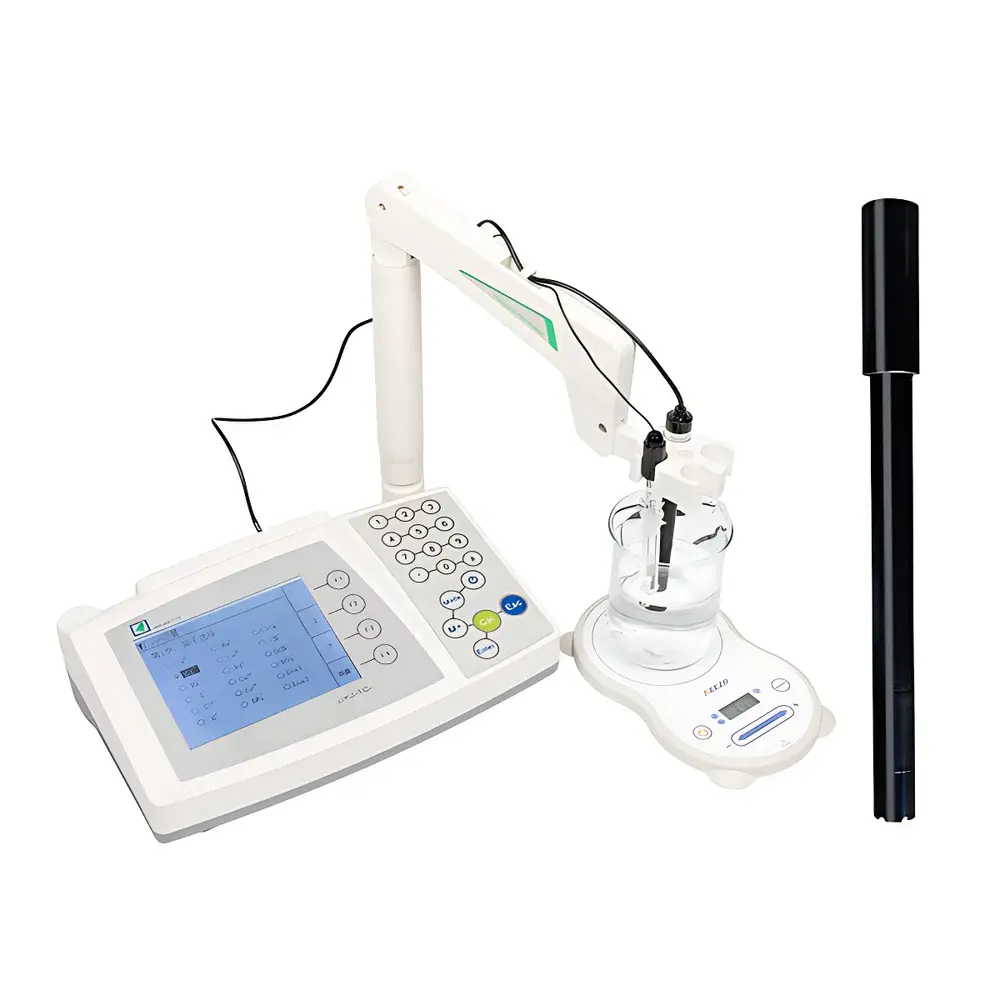
FangZhou PXJ-1C+ Ammonia-Sensitive Ion Meter
| Brand | FangZhou |
|---|---|
| Origin | Sichuan, China |
| Manufacturer Type | Authorized Distributor |
| Country of Origin | China |
| Model | PXJ-1C+ Ammonia-Sensitive Ion Meter |
| Instrument Type | Benchtop |
| Ion Measurement Range | 0–99999 ppm |
| Detection Limit | 9999 ppm |
| Response Time | 3 s |
| Measurement Accuracy | ±0.5% FS ±1 digit |
| Temperature Range | −20.0 to 135.0 °C |
| Temperature Resolution | 0.1 °C |
| Temperature Accuracy | ±0.2 °C ±1 digit |
| Input Impedance | ≥3 × 10¹² Ω |
| Data Storage Capacity | 4096 sets |
| GLP Compliance | Yes |
| Calibration Points | 2–9 points (ion), up to 5 points (pH) |
| pH Range | −10.000 to 20.000 |
| pH Resolution | 0.001/0.01/0.1 pH (selectable) |
| pH Accuracy | ±0.002 pH ±1 digit |
| mV Range | −2000.00 to 2000.00 mV |
| mV Resolution | 0.01/0.1/1 mV (selectable) |
| mV Accuracy | ±0.02% FS ±1 digit |
| Units Supported | pX, ppm, ppb, ppt, mol/L, mmol/L, µmol/L, nmol/L, %, µg/L, mg/L, g/L, ng/L |
| Interface | BNC electrode port, Pt1000/NTC temperature input, USB, RS232, 0–20 mV analog output |
| Power Supply | DC 9 V, 500 mA (center-positive) |
Overview
The FangZhou PXJ-1C+ Ammonia-Sensitive Ion Meter is a high-precision benchtop analytical instrument engineered for quantitative determination of ammonia ion activity in aqueous solutions using gas-permeable membrane-based ion-selective electrode (ISE) technology. Unlike conventional direct-contact ISEs, this system employs an ammonia gas-sensing electrode configuration: dissolved NH₄⁺ equilibrates with NH₃(g) across a hydrophobic membrane, and the resulting pH shift in an internal electrolyte solution is measured potentiometrically via a sealed reference-pH electrode pair. This indirect but highly selective method eliminates interference from common cations (e.g., Na⁺, K⁺, Ca²⁺) and anions (e.g., Cl⁻, SO₄²⁻), making it particularly robust for environmental water analysis, wastewater effluent monitoring, aquaculture management, and fertilizer runoff assessment. The instrument integrates multi-parameter capability—simultaneous measurement of ion concentration (pX), pH, mV, ORP, and temperature—with full compliance to Good Laboratory Practice (GLP) data integrity requirements.
Key Features
- Benchtop design with large backlit LCD display supporting dual-line parameter viewing (e.g., ion concentration + temperature)
- Configurable resolution: 0.001 pH / 0.01 mV / 1–3 significant digits for ion concentration
- Comprehensive ion library: pre-programmed calibration coefficients for F⁻, Cl⁻, Br⁻, NH₄⁺, NO₃⁻, Na⁺, and 10 additional ions; supports two user-defined ions
- Flexible unit conversion: 13 concentration units—including ppm, ppb, mol/L, mmol/L, µg/L, mg/L—automatically interconvertible without manual calculation
- Advanced calibration architecture: 9-point ion calibration with automatic standard curve fitting (linear or logarithmic); up to 5-point pH calibration with auto-recognition of NIST/ISO traceable buffers
- Intelligent temperature compensation: ATC (Automatic Temperature Compensation) via integrated Pt1000 or NTC sensor; manual override available within −20.0 to 135.0 °C range
- Robust data governance: 4096-stored measurements with timestamp (date + time), electrode ID logging, calibration history, and operator ID tagging per GLP protocols
- Dual interface support: USB and RS232 for real-time data streaming; 0–20 mV analog output for integration into SCADA or PLC systems
Sample Compatibility & Compliance
The PXJ-1C+ is validated for use with standard ammonia gas-sensing electrodes (e.g., double-junction, polymer membrane types) and compatible with common laboratory-grade temperature sensors. It accepts samples across a broad matrix range—including surface water, groundwater, municipal wastewater, nutrient solutions, and industrial process streams—provided turbidity remains below 5 NTU and suspended solids are minimized to prevent membrane fouling. All measurements adhere to ASTM D1426–22 (Standard Test Methods for Nitrogen in Water) and ISO 7888:2021 (Water quality — Determination of ammonium — Ammonia-selective electrode method). The instrument’s firmware enforces audit-trail functionality required under FDA 21 CFR Part 11 for regulated laboratories, including immutable calibration logs, user authentication prompts, and electronic signature support when used with FangZhou pH-Link software.
Software & Data Management
Supplied with FangZhou pH-Link PC software (Windows-compatible), the PXJ-1C+ enables secure bidirectional communication for configuration export/import, real-time graphing of concentration vs. time, statistical reporting (mean, SD, RSD, min/max), and customizable PDF report generation—including GLP headers, instrument ID, electrode serial numbers, and analyst metadata. Data files are saved in .csv and native .fzq formats with embedded CRC checksums to ensure file integrity. Software updates are distributed via encrypted firmware packages signed by FangZhou’s ISO 9001-certified development team. All stored datasets include mandatory timestamping compliant with ISO/IEC 17025:2017 clause 7.7.1 (result reporting requirements).
Applications
- Regulatory compliance testing for ammonia discharge limits under EPA NPDES permits
- Process control in biological nitrogen removal (BNR) systems at WWTPs
- Quality assurance of drinking water post-chloramination
- Research-grade quantification of NH₃/NH₄⁺ speciation in limnological and marine studies
- In-line verification of ammonia scrubber efficiency in semiconductor fab exhaust treatment
- Educational use in analytical chemistry labs for teaching ISE theory, calibration strategies, and error propagation analysis
FAQ
What electrode types are compatible with the PXJ-1C+ for ammonia measurement?
The instrument supports industry-standard ammonia gas-sensing electrodes with BNC connectors and integrated temperature sensing (e.g., Orion 95-12, Metrohm 6.0258.100). Double-junction reference electrodes with KNO₃ or LiCl electrolytes are recommended to minimize junction potential drift.
Does the PXJ-1C+ meet ISO/IEC 17025 requirements for accredited testing labs?
Yes—when operated with calibrated electrodes, documented procedures, and pH-Link audit-trail enabled, it satisfies clauses 6.4 (equipment), 7.7 (results reporting), and 7.8 (reporting of sampling uncertainty) of ISO/IEC 17025:2017.
Can the device perform simultaneous pH and ammonia measurement on the same sample?
Yes—dual-channel input allows concurrent connection of a pH electrode and ammonia ISE; measurements are synchronized and logged with identical timestamps.
Is temperature compensation mandatory during ion measurement?
While manual compensation is permitted, ATC is strongly recommended: ammonia equilibrium is highly temperature-dependent (van’t Hoff behavior), and uncorrected readings may deviate >3% per °C outside 25 °C.
How is calibration verification performed between scheduled intervals?
The built-in self-diagnostic mode checks electrode slope, asymmetry potential, and reference junction stability against factory baselines; deviation alerts trigger recalibration prompts per GLP workflow rules.







