
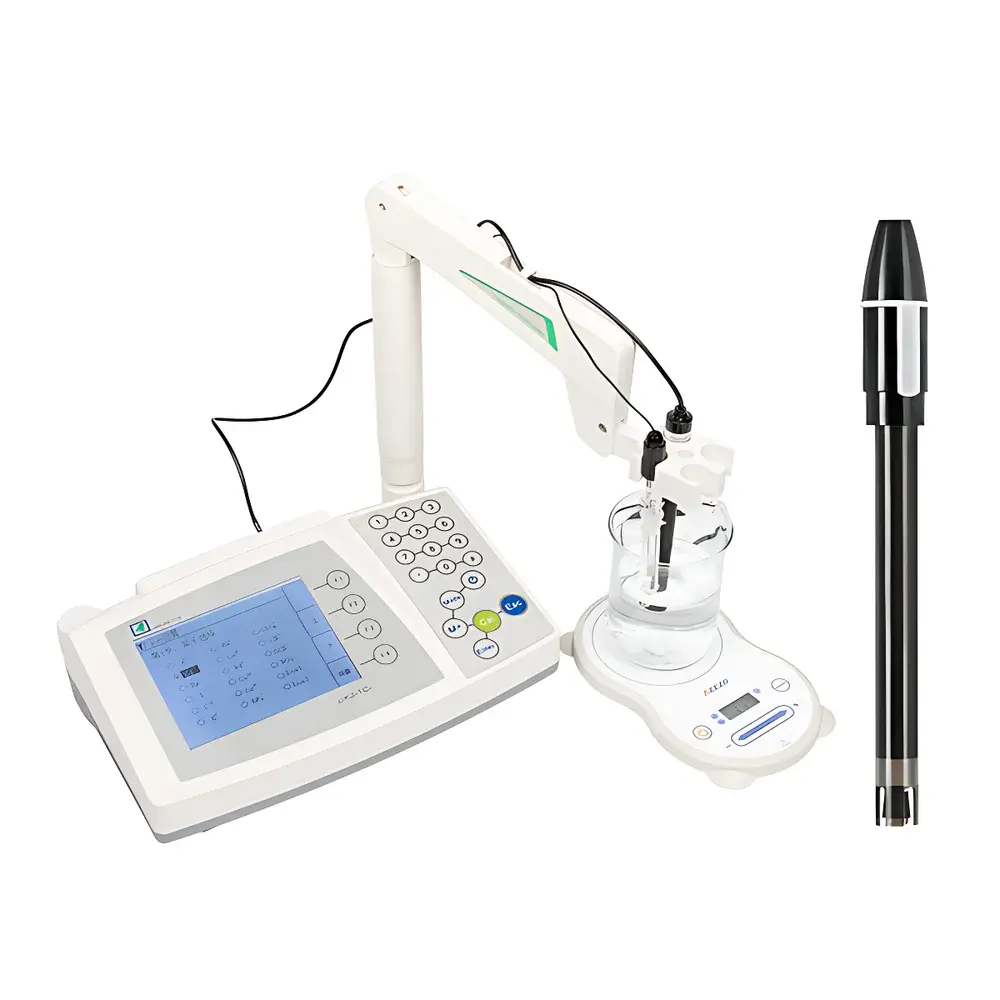
FangZhou PXJ-1C+ Benchtop Copper Ion Analyzer
| Brand | FangZhou |
|---|---|
| Origin | Sichuan, China |
| Manufacturer Type | Authorized Distributor |
| Product Category | Domestic |
| Model | PXJ-1C+ |
| Instrument Type | Benchtop |
| Ion Measurement Range | 0–99999 ppm |
| Detection Limit | 9999 ppm |
| Response Time | 3 s |
| Measurement Accuracy | ±0.5% FS ±1 digit |
| Temperature Range | −20.0–135.0 °C |
| Temperature Resolution | 0.1 °C |
| Temperature Accuracy | ±0.2 °C ±1 digit |
| Input Impedance | ≥3×10¹² Ω |
| Data Storage Capacity | 4096 sets |
| GLP Compliance | Yes |
| Calibration Points | 2–9 points (ion), up to 5 points (pH) |
| Supported Units | pX, ppm, ppb, ppt, mol/L, mmol/L, µmol/L, nmol/L, %, µg/L, mg/L, g/L, ng/L |
| Interface | BNC electrode port, Pt1000/NTC temperature input, USB, RS232, 0–20 mV analog output |
Overview
The FangZhou PXJ-1C+ Benchtop Copper Ion Analyzer is a high-precision, multi-parameter potentiometric analyzer engineered for reliable quantification of free copper ions (Cu²⁺) and other monovalent/divalent cations in aqueous environmental, industrial, and regulatory laboratory settings. Operating on the principle of ion-selective electrode (ISE) potentiometry, the instrument measures the electromotive force (EMF) generated at the interface between a copper-specific ISE membrane and the sample solution, converting the Nernstian potential response into concentration values via built-in calibration algorithms. Designed for compliance-critical applications—including wastewater discharge monitoring, drinking water safety verification, electroplating bath control, and aquaculture management—the PXJ-1C+ delivers trace-level detection with robust thermal compensation and long-term electrode stability. Its architecture supports dual-mode operation (direct pX measurement and concentration-based reporting), enabling seamless integration into routine QC workflows governed by ISO 17025, EPA Method 6010D, or ASTM D1129 for ion analysis.
Key Features
- Triple-function capability: simultaneous measurement of Cu²⁺ concentration (ppm), pH (−10.000 to 20.000), and redox potential (−2000.00 to +2000.00 mV) with user-selectable resolution (0.001 pH / 0.01 mV)
- Advanced 9-point ion calibration algorithm—supports non-linear standard curve generation using certified reference solutions for improved accuracy across extended dynamic ranges
- Auto-temperature compensation (ATC) with Pt1000/NTC sensor compatibility and manual override; temperature measurement range −20.0 to 135.0 °C with ±0.2 °C accuracy
- GLP-compliant data management: time-stamped records (date + clock), audit-ready storage of 4096 datasets including electrode ID, calibration history, operator ID, and environmental metadata
- Modular electrode interface with universal BNC input and dedicated adapter support for multiple ISE types (e.g., Cu²⁺, F⁻, Cl⁻, NO₃⁻, NH₄⁺, Na⁺), accommodating both rigid-body and refillable configurations
- Configurable display: backlit LCD with intuitive menu navigation, real-time graphical trend view, and customizable unit conversion (13 concentration units preloaded, including µg/L, mg/L, mol/L, and pX)
Sample Compatibility & Compliance
The PXJ-1C+ is validated for use with clarified, low-turbidity aqueous matrices—including surface water, groundwater, treated effluent, cooling tower water, and process rinse solutions. It meets functional requirements of ISO 10523 (pH determination), ISO 7870-2 (control charts for analytical performance), and supports method validation per US EPA SW-846 Chapter 9 (potentiometric ion analysis). When paired with certified copper-selective electrodes (e.g., polyvinyl chloride membrane type with ETH 5432 ionophore), the system achieves reproducible results under GLP/GMP conditions. All stored data include mandatory traceability fields required for FDA 21 CFR Part 11–aligned environments when used with FangZhou’s pH-link software and digital signature protocols.
Software & Data Management
The included FangZhou pH-link PC software enables bidirectional communication via USB or RS232, supporting automated data export to CSV, Excel, or PDF formats. The application provides calibration curve visualization, statistical summary (mean, SD, RSD%), outlier detection, and batch report generation compliant with ISO/IEC 17025 documentation standards. Audit trail functionality logs all user actions—including parameter changes, calibration events, and data deletions—with timestamp and operator identification. Raw analog output (0–20 mV) permits integration into SCADA or LIMS platforms for continuous environmental monitoring networks.
Applications
- Regulatory compliance testing for Cu²⁺ in municipal wastewater prior to discharge (per local limits aligned with WHO Guidelines or EU Directive 2000/60/EC)
- In-process monitoring of copper sulfate concentration in PCB manufacturing etching baths
- Leachate analysis from mining tailings ponds and landfill sites
- Validation of chelating agent efficacy in copper removal systems (e.g., ion exchange or precipitation units)
- Educational laboratories performing Nernst equation verification and selectivity coefficient (Kpot) determination
FAQ
What ion-selective electrodes are compatible with the PXJ-1C+ for copper measurement?
The instrument accepts any commercially available Cu²⁺-selective electrode with standard BNC termination and recommended internal filling solution (e.g., 0.1 M Cu(NO₃)₂). FangZhou offers OEM-compatible electrodes optimized for pH-link calibration interoperability.
Does the PXJ-1C+ support automatic electrode diagnosis?
Yes—built-in self-diagnostic routines evaluate electrode slope, asymmetry potential, and junction resistance during startup and calibration; alerts trigger if parameters fall outside ISO 15197-defined acceptance criteria.
Can calibration curves be imported/exported between instruments?
Calibration coefficients and standard point data are stored in device memory and transferable via pH-link software; however, curve files are not cross-platform portable due to proprietary interpolation algorithms.
Is temperature compensation mandatory during copper ion measurement?
While manual compensation is permitted, ATC is strongly recommended—especially above 30 °C—as the Nernst slope varies by 0.198 mV/decade per °C change, directly impacting quantitation accuracy in field-deployed applications.
How does the PXJ-1C+ handle interfering ions such as Fe²⁺ or Zn²⁺?
The instrument itself does not suppress interference; users must apply matrix-matched calibration or employ selective electrodes with documented selectivity coefficients (log KCu,X ≤ −2.5) per IUPAC recommendations. Optional masking agents (e.g., cyanide-free chelators) may be added pre-measurement per ASTM D1129 Annex A4.
Related Products







