
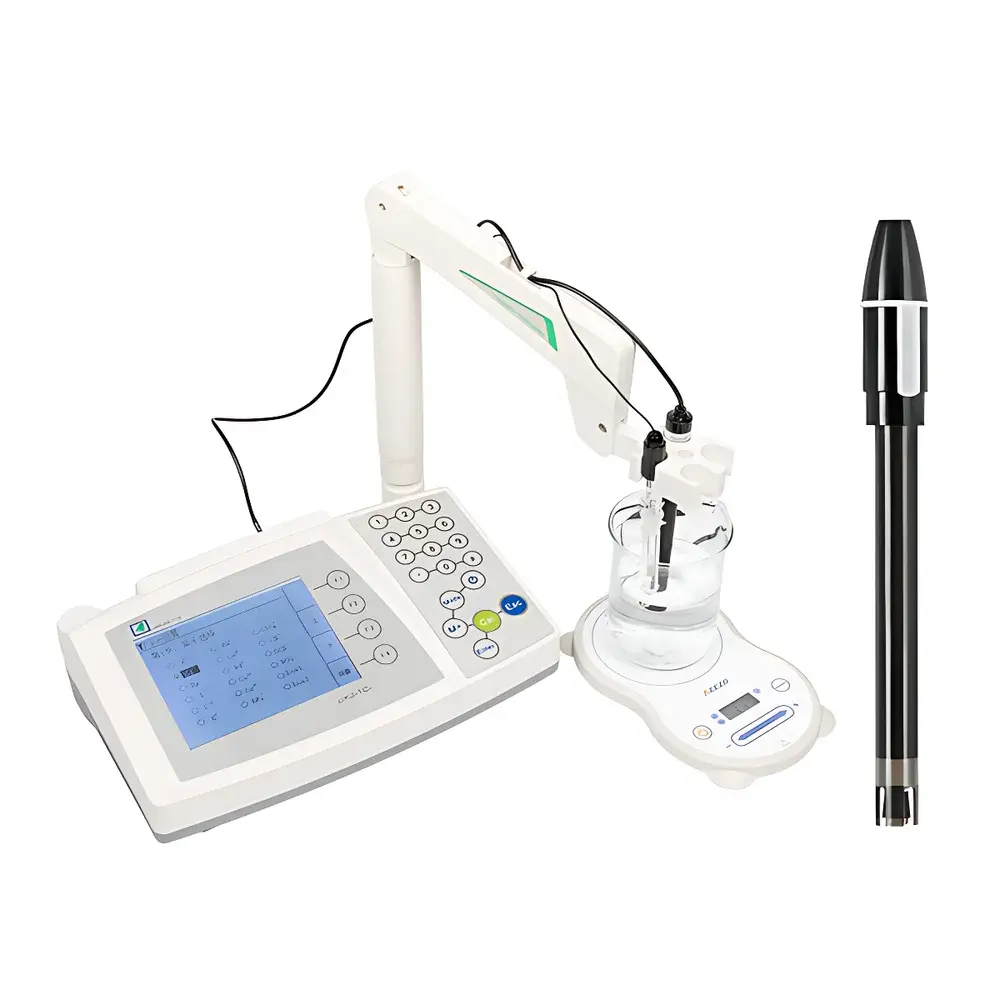
FangZhou PXJ-1C+ Borate Ion Analyzer
| Brand | FangZhou |
|---|---|
| Origin | Sichuan, China |
| Model | PXJ-1C+ Borate Ion Analyzer |
| Instrument Type | Benchtop Multi-Ion Analyzer |
| Measurement Range | 0–99,999 ppm |
| Detection Limit | 9,999 ppm |
| Response Time | 3 s |
| Measurement Resolution | 0.001 |
| Temperature Range | −20.0–135.0 °C |
Overview
The FangZhou PXJ-1C+ Borate Ion Analyzer is a high-precision benchtop potentiometric ion analyzer engineered for reliable quantification of borate (B(OH)₄⁻) and other common anions in aqueous environmental and industrial water samples. Based on selective ion electrode (ISE) measurement principles, the instrument employs electromotive force (EMF) detection to determine ion activity via Nernstian response—enabling direct concentration readout in multiple units without manual calculation. Designed specifically for regulatory-compliant water quality laboratories, it supports routine monitoring of borate in cooling tower water, geothermal effluents, desalination brines, and wastewater streams where boron speciation impacts corrosion control, membrane integrity, and ecological risk assessment. Its architecture integrates dual-sensor input (ion-selective electrode + temperature probe), automatic temperature compensation (ATC), and built-in reference electrode diagnostics—ensuring traceable, reproducible measurements under variable field or lab conditions.
Key Features
- Benchtop design with backlit LCD display and intuitive menu-driven interface for operation in low-light laboratory or field deployment environments
- GLP-compliant data management: stores up to 4,096 measurement records with timestamp (date + time), electrode ID, calibration history, and operator ID tagging
- Multi-ion capability: pre-configured calibration parameters for 16 standard ions (F⁻, Cl⁻, Br⁻, NH₄⁺, NO₃⁻, Na⁺, etc.) plus two user-defined ion profiles for custom analytes
- Flexible concentration unit conversion: supports 13 units including pX, ppm, ppb, ppt, mol/L, mmol/L, µmol/L, nmol/L, %, µg/L, mg/L, g/L, and ng/L—automatically applied per measurement session
- Advanced calibration architecture: 2–9 point ion concentration calibration with automatic standard curve generation and R² validation; supports both single-point and multi-point slope verification
- High-impedance input (>3 × 10¹² Ω) optimized for glass pH electrodes and solid-state or liquid-membrane ISEs; includes dedicated electrode converter for universal BNC, DIN, and mini-DIN compatibility
- Triple-mode acquisition: Auto-measurement (stable endpoint detection), Real-time (continuous logging), and Timed-measurement (programmable interval sampling)
Sample Compatibility & Compliance
The PXJ-1C+ is validated for use with aqueous matrices meeting standard EPA Method 300.0 and ISO 10523 guidelines for ion-selective electrode analysis. It accommodates samples with total dissolved solids (TDS) ≤ 50,000 mg/L and turbidity < 10 NTU. Electrode compatibility includes commercially available borate-selective electrodes (e.g., polymeric membrane type with quaternary ammonium ionophore) and combination pH/ISE probes. The instrument conforms to GLP documentation requirements per OECD Principles of Good Laboratory Practice and supports audit-ready data export for regulatory submissions. While not certified to IEC 61000-4 electromagnetic immunity standards, its analog front-end design meets typical Class II laboratory EMC expectations. All firmware and calibration logic are traceable to NIST-traceable reference standards.
Software & Data Management
The included FangZhou pH-Link PC software (Windows-compatible, USB/RS-232 interface) enables full bidirectional communication: real-time data streaming, batch calibration upload/download, report generation (PDF/CSV/XLSX), and audit log review. Software features include electronic signature support, version-controlled method templates, and configurable data retention policies aligned with FDA 21 CFR Part 11 Annex 11 expectations for electronic records. Raw EMF values, temperature-compensated mV, calculated concentrations, and calibration coefficients are stored with metadata—facilitating retrospective uncertainty analysis and method validation per ISO/IEC 17025 clause 7.7. Data output includes 0–20 mV analog signal for integration into SCADA or LIMS platforms.
Applications
- Environmental monitoring of borate in surface water, groundwater, and industrial discharge per Chinese HJ/T 342–2007 and EU WFD boron limits (≤1 mg/L as B)
- Process control in borosilicate glass manufacturing, nuclear reactor coolant systems, and detergent formulation where borate acts as buffer or stabilizer
- Wastewater treatment plant compliance testing for boron removal efficiency evaluation (e.g., RO/NF membrane performance assessment)
- Research applications in geochemistry involving boron isotopic fractionation studies requiring precise baseline concentration determination
- Calibration verification and inter-laboratory comparison exercises within CNAS-accredited testing facilities
FAQ
What ion-selective electrodes are compatible with the PXJ-1C+ for borate measurement?
The analyzer supports any commercially available borate-selective electrode with BNC or DIN connector output and output impedance ≤ 10⁹ Ω. Recommended models include those using tetraalkylammonium-based polymeric membranes with documented Nernstian slope (−57 ± 3 mV/decade at 25 °C).
Does the instrument support automatic calibration verification between measurements?
Yes—via optional “CalCheck” mode, users can re-measure a stored calibration standard post-analysis to quantify drift and trigger recalibration alerts based on user-defined tolerance thresholds (e.g., ±0.5% deviation).
Is temperature compensation applied during ion concentration calculation?
Yes—both automatic (via integrated Pt1000 sensor) and manual temperature entry are supported. The Nernst equation correction uses the actual measured temperature, not fixed 25 °C assumptions.
Can raw mV data be exported for third-party statistical analysis?
Yes—pH-Link software exports unprocessed EMF values (mV), temperature (°C), and timestamp in CSV format with column headers compliant with ASTM E2524-22 data interchange conventions.
What is the warranty coverage and service support structure?
The instrument carries a 36-month limited warranty covering parts and labor for defects in materials or workmanship. FangZhou provides technical documentation in English, firmware updates via secure portal, and remote diagnostic support through authorized regional service centers.







