
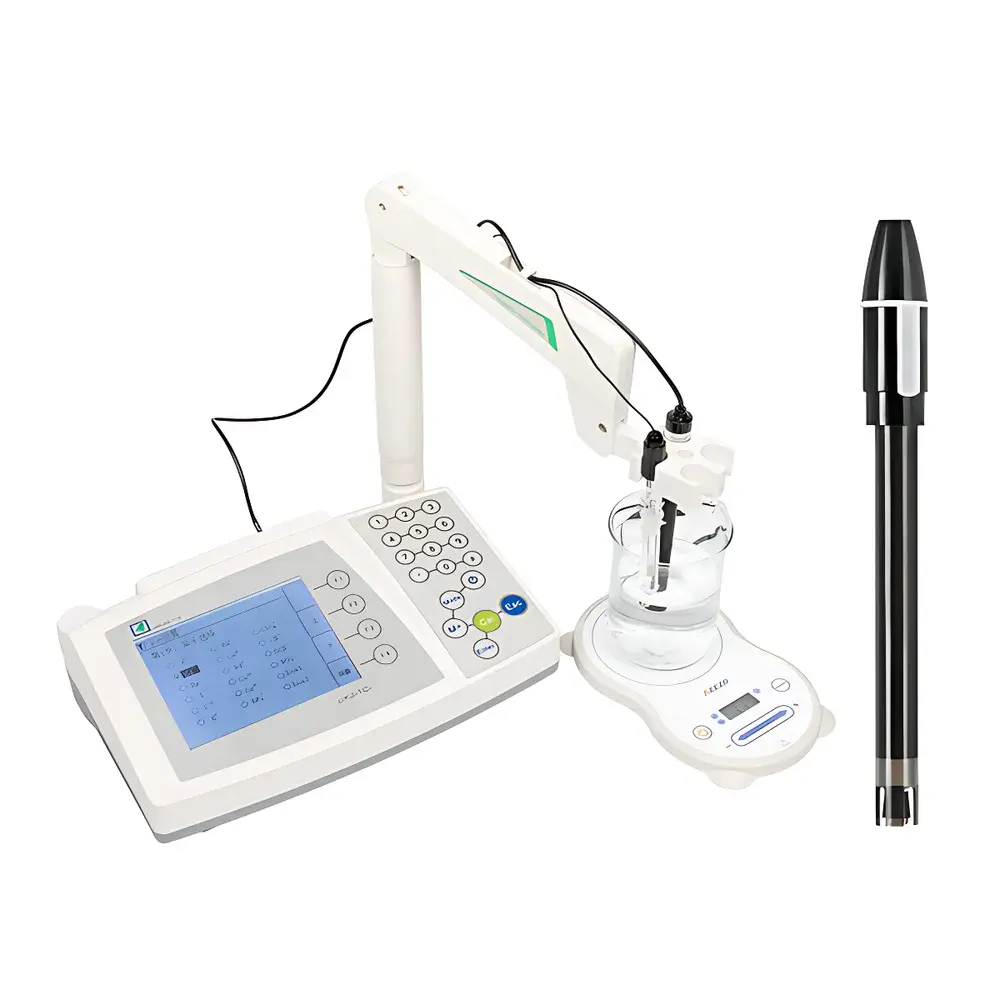
FangZhou PXJ-1C+ Bromide Ion Analyzer
| Brand | FangZhou |
|---|---|
| Origin | Sichuan, China |
| Manufacturer Type | Authorized Distributor |
| Product Category | Domestic |
| Model | PXJ-1C+ Bromide Ion Analyzer |
| Instrument Type | Benchtop |
| Ion Measurement Range | 0–99,999 ppm |
| Detection Limit | 9,999 ppm |
| Response Time | 3 s |
| Measurement Accuracy | ±0.5% FS ±1 digit |
| Temperature Range | −20.0 to 135.0 °C |
| Resolution | 0.001 pH / 0.01 mV / 0.1 °C |
| Input Impedance | ≥3 × 10¹² Ω |
| Data Storage Capacity | 4,096 sets |
| GLP Compliance | Yes |
| Calibration Points | 2–9 points (ion), up to 5 points (pH) |
| Supported Units | pX, ppm, ppb, ppt, mol/L, mmol/L, µmol/L, nmol/L, %, µg/L, mg/L, g/L, ng/L |
| Temperature Compensation | Automatic (ATC) or Manual |
| Interface | BNC electrode port, Pt1000/NTC temperature input, USB, RS-232, 0–20 mV analog output |
Overview
The FangZhou PXJ-1C+ Bromide Ion Analyzer is a high-precision, multi-parameter benchtop ion analyzer engineered for reliable quantification of bromide (Br⁻) and 16 pre-programmed ions—including fluoride, chloride, ammonia, nitrate, and sodium—in aqueous environmental and industrial samples. Based on potentiometric measurement using ion-selective electrodes (ISEs), the instrument operates under the Nernst equation principle, delivering stable, reproducible readings across wide dynamic concentration ranges. Its architecture integrates a low-noise, high-input-impedance amplifier (>3 × 10¹² Ω) optimized for ISE signal integrity, enabling accurate detection even in low-conductivity or high-resistivity matrices such as ultrapure water, groundwater, and treated effluent. Designed for routine compliance monitoring and laboratory QC workflows, the PXJ-1C+ meets foundational requirements for method validation under ISO/IEC 17025-accredited laboratories and supports traceable data acquisition aligned with GLP documentation standards.
Key Features
- Benchtop form factor with backlit LCD display and intuitive menu-driven navigation—no external PC required for operation
- Simultaneous measurement of bromide ion concentration (pX or mass-based units), pH, mV, ORP, and temperature—with selectable resolution (0.001 pH, 0.01 mV, 0.1 °C)
- Multi-point ion calibration capability: 2–9 point standard curve generation with real-time slope calculation and R² evaluation for rigorous method verification
- Comprehensive unit flexibility: 13 concentration units—including ppm, ppb, mol/L, mmol/L, µg/L, and %—with automatic interconversion without manual recalculations
- GLP-compliant data management: Timestamped storage of 4,096 measurement records with operator ID, calibration history, electrode ID, and environmental metadata
- Integrated ATC (Automatic Temperature Compensation) using Pt1000 or NTC sensors; manual override available for non-standard thermal environments
- Dual interface support: USB and RS-232 for direct connection to LIMS or QA/QC software; 0–20 mV analog output for integration into SCADA or PLC-based monitoring systems
Sample Compatibility & Compliance
The PXJ-1C+ is validated for use with standard liquid-phase environmental samples—including drinking water, wastewater, surface water, leachate, and industrial process streams—when paired with certified bromide-selective electrodes (e.g., Ag₂S-based or polymeric membrane ISEs). It complies with core functional requirements outlined in ASTM D6508 (Standard Test Method for Determination of Anions in Water by Ion Chromatography) for comparative ISE validation, and supports method adaptation per EPA Method 300.1 for halide anion screening. While not a standalone regulatory-certified instrument, its GLP-aligned audit trail (including calibration logs, user actions, and timestamped results) satisfies internal QA documentation needs for ISO 9001, ISO 14001, and basic GMP-aligned environmental testing labs. All firmware and calibration routines are traceable to NIST-traceable reference standards.
Software & Data Management
The included “FangZhou pH-Link” PC software enables bidirectional communication via USB or RS-232, supporting raw data export in CSV and TXT formats compatible with Excel, MATLAB, and LIMS platforms. Software features include batch calibration report generation, trend visualization of time-series ion data, statistical summary (mean, SD, CV%), and customizable PDF report templates with lab header, sample ID, and analyst signature fields. Audit trail functionality records all parameter changes, calibration events, and data deletions with timestamps—meeting minimum requirements for FDA 21 CFR Part 11–aligned electronic record retention when deployed with controlled user access and password protection.
Applications
- Environmental monitoring of bromide in source water and distribution systems—critical for assessing disinfection byproduct (DBP) formation potential (e.g., brominated trihalomethanes)
- Wastewater treatment plant effluent compliance tracking against local discharge limits for halides
- Pharmaceutical manufacturing water-for-injection (WFI) and purified water system surveillance
- Electroplating and semiconductor rinse water analysis where bromide contamination affects etch uniformity
- Soil leaching studies and landfill leachate characterization in geochemical investigations
- Educational laboratories conducting quantitative ISE fundamentals, Nernstian behavior, and selectivity coefficient determination
FAQ
Does the PXJ-1C+ support direct bromide quantification without external calibration?
No—accurate bromide measurement requires calibration using at least two standard solutions bracketing the expected sample concentration. The instrument supports 2–9 point calibration with built-in slope validation.
Can it measure bromide in seawater or high-salinity samples?
Yes, but matrix interference must be addressed via ionic strength adjustment (e.g., using ISA—ionic strength adjuster) and electrode selection optimized for high-chloride environments.
Is the device compliant with ISO/IEC 17025 documentation requirements?
It provides GLP-compliant data logging and audit trails; full ISO/IEC 17025 accreditation requires lab-specific validation protocols, uncertainty budgeting, and metrological traceability—functions supported but not automated.
What electrode types are compatible with the PXJ-1C+?
Any BNC-output ion-selective electrode meeting >10¹² Ω input impedance requirements, including solid-state Ag₂S/AgBr membrane electrodes and PVC-based polymer-membrane Br⁻ sensors.
How is temperature compensation applied during ion measurement?
The instrument applies the Nernst temperature correction factor automatically when an ATC probe is connected; manual entry is permitted if sensor integration is unavailable.







