
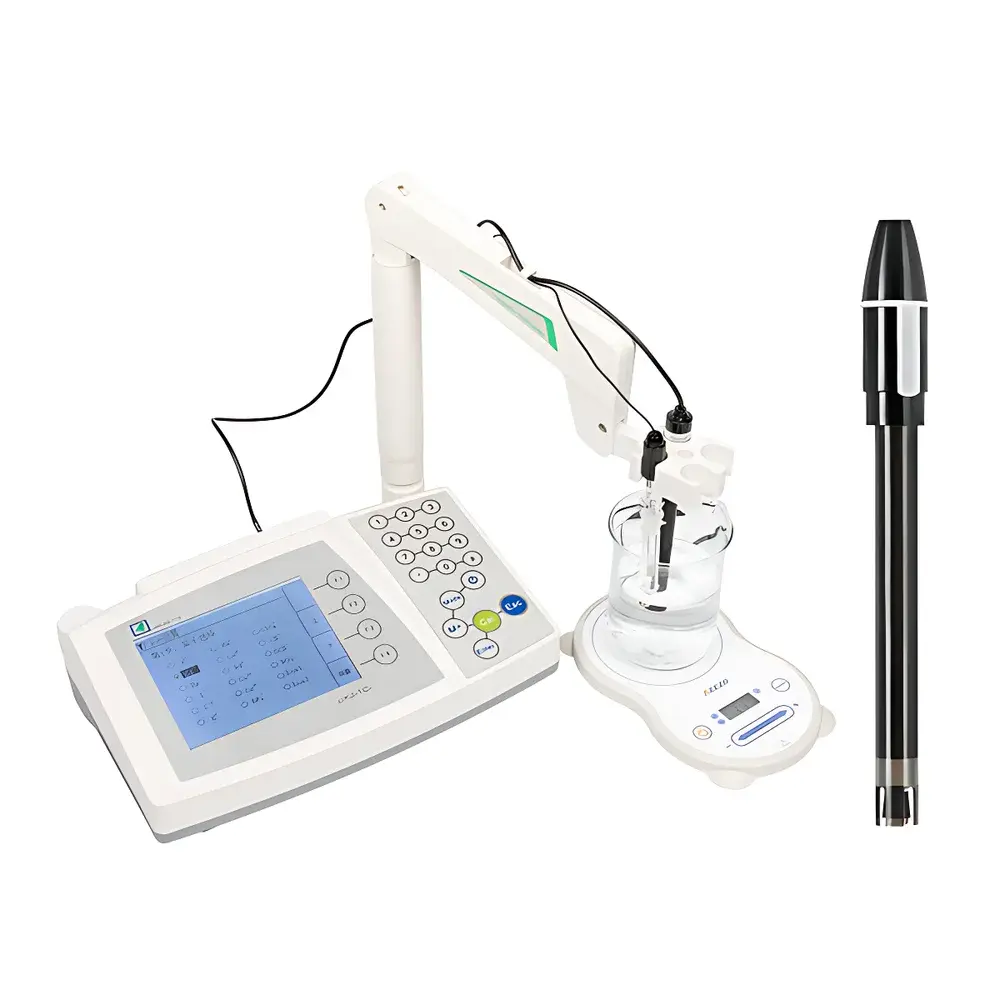
FangZhou PXJ-1C+ Calcium Ion Meter
| Brand | FangZhou |
|---|---|
| Origin | Sichuan, China |
| Manufacturer Type | Authorized Distributor |
| Product Category | Domestic |
| Model | PXJ-1C+ |
| Instrument Type | Benchtop |
| Ion Measurement Range | 0–99,999 ppm |
| Detection Limit | 9,999 ppm |
| Response Time | 3 s |
| Measurement Accuracy | ±0.5% FS ±1 digit |
| Temperature Range | −20.0 to 135.0 °C |
| Resolution | 0.001 pH / 0.01 mV / 0.1 °C |
| Data Storage Capacity | 4,096 sets |
| GLP Compliance | Yes |
| Calibration Points | 2–9 points (ion), up to 5 points (pH) |
| Supported Units | pX, ppm, ppb, ppt, mol/L, mmol/L, µmol/L, nmol/L, %, µg/L, mg/L, g/L, ng/L |
| Temperature Compensation | Automatic (ATC) or Manual |
| Input Impedance | ≥3 × 10¹² Ω |
| Interface | BNC electrode port, Pt1000/NTC temperature input, USB, RS232, 0–20 mV analog output |
Overview
The FangZhou PXJ-1C+ Calcium Ion Meter is a high-precision benchtop ion concentration analyzer engineered for rigorous water quality analysis in environmental monitoring laboratories, municipal water treatment facilities, and industrial process control environments. Operating on the principle of potentiometric measurement via selective ion electrodes (e.g., calcium-selective electrode), the instrument quantifies free Ca²⁺ activity in aqueous solutions by measuring the potential difference between the indicator electrode and a reference electrode—converted to concentration using the Nernst equation. Its design adheres to fundamental electrochemical metrology standards, ensuring traceable, reproducible results under variable ionic strength and temperature conditions. The PXJ-1C+ extends beyond single-ion capability: it functions as a multi-parameter analyzer supporting pH, mV, ORP, and temperature measurements—making it suitable for comprehensive compliance testing against ISO 5667 (water sampling), ASTM D1293 (pH of water), and EPA Method 300.1 (anions/cations in drinking water). Its robust architecture integrates dual-mode temperature compensation (ATC/manual), high-input-impedance circuitry (>3 × 10¹² Ω) to minimize loading errors with high-resistance electrodes, and real-time drift monitoring for electrode health assessment.
Key Features
- Benchtop platform with backlit 5.7-inch LCD graphical display and intuitive menu-driven navigation—optimized for glove-compatible operation in field labs and cleanrooms.
- GLP-compliant data management: time-stamped storage of 4,096 measurement records with user ID tagging, audit trail logging, and export-ready formatting via USB or RS232.
- Multi-point ion calibration (2–9 points) with automatic standard curve generation—enabling precise quantification across wide dynamic ranges (0–99,999 ppm Ca²⁺) without manual slope interpolation.
- Configurable resolution and units: supports 13 concentration formats—including mol/L, mmol/L, µg/L, and %—with seamless in-situ conversion during measurement or post-acquisition review.
- Dual-mode temperature compensation: auto-recognition of Pt1000 or NTC sensors (−20.0 to 135.0 °C), plus manual override for non-aqueous or viscous media where sensor immersion is impractical.
- Integrated electrode interface with universal adapter support (BNC + dedicated converter) for compatibility with industry-standard calcium ISEs (e.g., Orion 93-20, Metrohm 6.0258.100) and third-party pH/ORP probes.
- Self-diagnostic system with real-time error codes, electrode impedance verification, and battery/voltage status alerts—reducing downtime and operator dependency.
Sample Compatibility & Compliance
The PXJ-1C+ is validated for direct analysis of freshwater, wastewater, boiler feedwater, cooling tower effluents, and soil leachates—provided samples are filtered (≤5 µm) and adjusted to appropriate ionic strength (e.g., 0.1 M KNO₃ background electrolyte for low-conductivity matrices). It complies with ISO/IEC 17025 general requirements for competence of testing and calibration laboratories, and its firmware implements data integrity safeguards aligned with FDA 21 CFR Part 11 principles—including electronic signature prompts, immutable record timestamps, and password-protected configuration changes. All calibration and measurement logs include metadata required for ISO 17025 audit readiness: operator ID, electrode serial number, ambient temperature, buffer lot numbers, and deviation flags. The instrument meets CE electromagnetic compatibility (EMC) Directive 2014/30/EU and RoHS 2011/65/EU material restrictions.
Software & Data Management
The included “FangZhou pH-Link” PC software enables secure bidirectional communication via USB or RS232. It supports batch export to CSV, Excel (.xlsx), and PDF report templates compliant with laboratory information management systems (LIMS). Raw data files retain full metadata (calibration history, temperature logs, electrode response curves), facilitating root-cause analysis during method validation or outlier investigation. Software features include automated calibration verification reports, trend charting over time-series datasets, and configurable pass/fail thresholds per parameter—supporting routine QC checks per ISO 9001 Clause 8.2.4. Data encryption (AES-128) and role-based access control (administrator/operator modes) satisfy internal data governance policies and external accreditation body expectations.
Applications
- Regulatory monitoring of calcium hardness in drinking water per WHO Guidelines for Drinking-water Quality (GDWQ) and EU Council Directive 98/83/EC.
- Process control in desalination plants—tracking Ca²⁺ scaling potential in reverse osmosis feed streams.
- Environmental impact assessments: quantifying calcium leaching from limestone quarries or agricultural runoff into surface waters.
- Pharmaceutical water systems (PW/WFI): verifying calcium limits (<1 ppm) in purified water per USP and EP 2.2.42.
- Educational laboratories: teaching potentiometric theory, Nernst equation derivation, and ion-selective electrode characterization protocols.
FAQ
Does the PXJ-1C+ support calibration with non-standard calcium standards?
Yes—custom calibration points can be entered manually using certified reference materials traceable to NIST SRMs; the instrument applies linear or polynomial regression based on user-selected fit type.
Can it measure calcium in high-TDS seawater samples?
Direct measurement requires matrix-matched calibration and optional ionic strength adjuster (ISA) addition; recommended practice follows ASTM D511 for cation analysis in saline waters.
Is the firmware upgradeable in the field?
Yes—updates are delivered via USB flash drive with digital signature verification to ensure integrity and prevent unauthorized modification.
What electrode maintenance protocols are recommended?
Daily rinsing with deionized water, weekly reconditioning in 0.1 M CaCl₂, and quarterly reference junction cleaning per manufacturer guidelines—documented in the included GLP-compliant maintenance log template.
How does the instrument handle temperature-induced drift during extended measurements?
It continuously monitors thermal gradient across the electrode assembly and applies real-time correction using built-in Pt1000 compensation algorithms—validated per ISO 9001 calibration procedures.







