
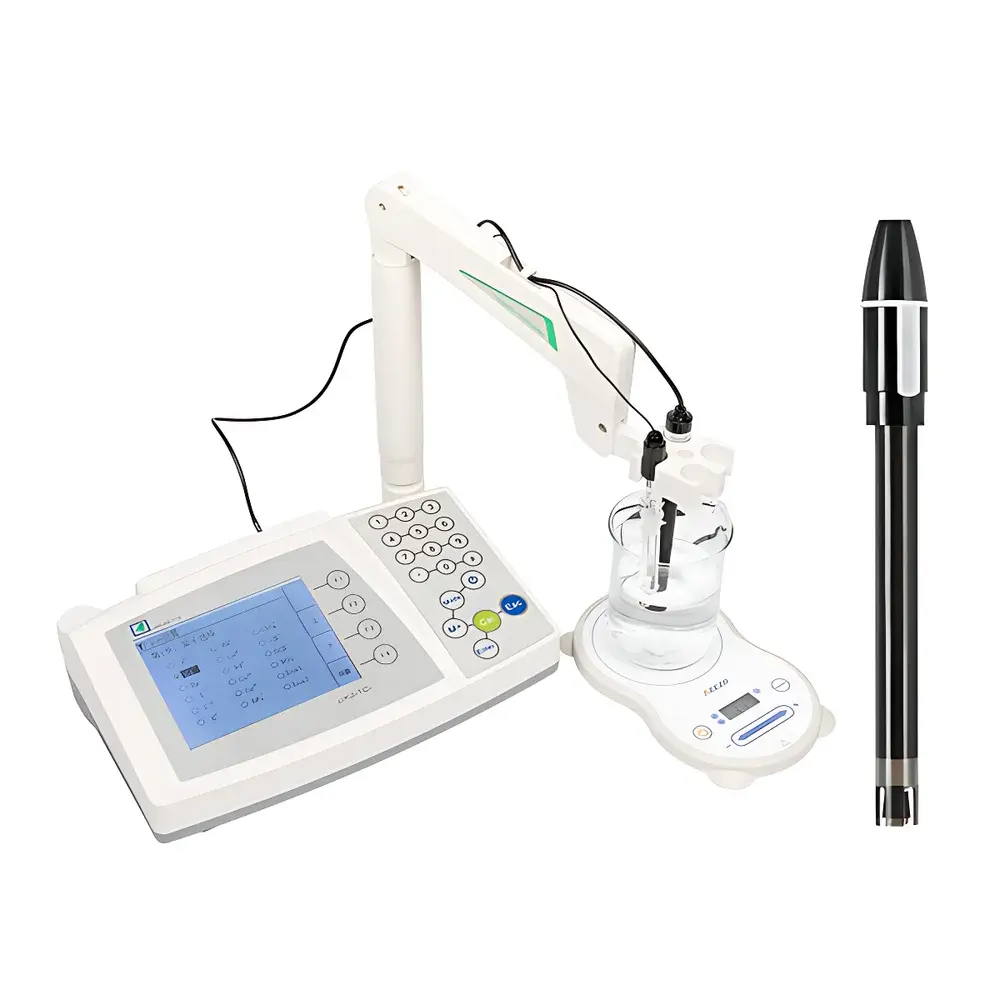
FangZhou PXJ-1C+ Carbon Dioxide Ion Analyzer
| Brand | FangZhou |
|---|---|
| Origin | Sichuan, China |
| Manufacturer Type | Authorized Distributor |
| Product Category | Domestic |
| Model | PXJ-1C+ CO₂ Ion Analyzer |
| Instrument Type | Benchtop |
| Ion Measurement Range | 0–99,999 ppm |
| Detection Limit | 9,999 ppm |
| Response Time | 3 s |
| Measurement Accuracy | ±0.5% FS ±1 digit |
| Temperature Range | −20.0 to 135.0 °C |
| Resolution | 0.001 pH / 0.01 mV / 0.1 °C |
| Input Impedance | ≥3 × 10¹² Ω |
| Data Storage | 4,096 sets |
| GLP Compliance | Yes |
| Calibration Points | 2–9 points (ion), up to 5 points (pH) |
| Temperature Compensation | Automatic (ATC) or Manual |
| Communication Interfaces | USB, RS-232, 0–20 mV analog output |
Overview
The FangZhou PXJ-1C+ Carbon Dioxide Ion Analyzer is a high-precision benchtop ion concentration meter engineered for quantitative determination of dissolved carbon dioxide—typically measured as carbonate/bicarbonate system equivalents—in aqueous environmental and process water samples. While CO₂ itself is not directly measurable via conventional ion-selective electrodes (ISEs), the PXJ-1C+ operates within a well-established electrochemical framework that leverages pH and alkalinity relationships, or—when paired with a dedicated CO₂ gas-sensing electrode (e.g., Severinghaus-type membrane electrode)—enables direct potentiometric quantification of aqueous CO₂ partial pressure (pCO₂). The instrument integrates multi-parameter capability (pH, mV, ORP, temperature, and 16 preconfigured ions including F⁻, Cl⁻, NO₃⁻, NH₄⁺, Na⁺) with rigorous metrological traceability, making it suitable for routine compliance monitoring in municipal wastewater treatment, drinking water distribution systems, aquaculture, and industrial cooling water management.
Key Features
- Benchtop architecture with robust ABS housing and EMI-shielded circuitry for stable operation in laboratory and field-deployable environments.
- Large backlit LCD display with dual time/date stamping—ensuring unambiguous temporal metadata for every stored measurement per GLP requirements.
- Configurable resolution settings: 0.001 pH, 0.01 mV, and 0.1 °C—supporting high-fidelity trend analysis across extended data series.
- Advanced ion calibration protocol: 2–9 point non-linear standard curve generation with real-time R² calculation and outlier detection.
- Integrated ATC (Automatic Temperature Compensation) using Pt1000 or thermistor probes; manual compensation also supported for fixed-point reference applications.
- Multi-interface connectivity: USB host/device, RS-232 serial, and isolated 0–20 mV analog output for PLC integration or continuous logging systems.
- Onboard diagnostics including electrode impedance check, junction potential verification, and memory integrity validation prior to data export.
Sample Compatibility & Compliance
The PXJ-1C+ is validated for use with standard aqueous matrices—including surface water, groundwater, effluent, and treated potable water—within defined ionic strength (0.001–0.1 mol/L KCl equivalent) and turbidity (<5 NTU) limits. It supports ISE-based measurements compliant with ASTM D1293 (pH of water), ASTM D3868 (chloride by ISE), and ISO 10523 (water quality — pH determination). When configured with appropriate CO₂-specific sensing elements, it aligns with EPA Method 365.2 (phosphate) and USGS NWIS protocols requiring pCO₂ estimation from alkalinity–pH titration pairs. The device meets GLP data integrity standards, including full audit trail functionality (user ID, timestamp, calibration history, and parameter change logs), and satisfies foundational requirements for ISO/IEC 17025-accredited laboratories conducting environmental testing under CNAS or UKAS scope.
Software & Data Management
The included “FangZhou pH-Link” PC software provides secure bidirectional communication via USB or RS-232, enabling remote instrument control, batch calibration setup, and automated report generation in PDF or CSV formats. All stored datasets (up to 4,096 records) retain embedded metadata: operator ID, electrode serial number, calibration certificate reference, ambient temperature, and atmospheric pressure (if externally logged). Exported files comply with FDA 21 CFR Part 11 basic requirements—electronic signatures, audit trail export, and read-only archival modes are configurable. Raw data files include checksum validation to ensure integrity during transfer between analytical workstations and LIMS platforms.
Applications
- Regulatory monitoring of CO₂-related corrosion potential in boiler feedwater and closed-loop HVAC systems.
- Alkalinity buffering capacity assessment in freshwater ecosystems and limnological surveys.
- Process control in beverage carbonation lines, where real-time pCO₂ feedback informs dosing accuracy.
- Validation of CO₂ scrubber efficiency in biogas upgrading facilities (measured as dissolved CO₂ depletion).
- Educational use in analytical chemistry labs for teaching ISE theory, Nernst equation derivation, and multi-ion interference correction.
FAQ
Does the PXJ-1C+ measure gaseous CO₂ directly?
No—it measures aqueous CO₂ concentration (or pCO₂) when used with a compatible Severinghaus-type gas-permeable membrane electrode. Standalone operation without such an electrode estimates CO₂ indirectly via pH/alkalinity calculations.
Is the instrument suitable for seawater analysis?
Not without matrix-matched calibration and junction protection; high chloride content causes significant ISE drift and liquid junction potential errors. Use only with dedicated marine-grade electrodes and salinity compensation enabled.
Can calibration curves be imported from external spreadsheets?
Yes—via pH-Link software, users may import .csv-formatted standard concentration tables and assign them to specific ion channels for rapid reconfiguration.
What is the warranty coverage for sensor components?
The main unit carries a three-year limited warranty; ion-selective electrodes and temperature probes are covered for six months against manufacturing defects, consistent with industry-standard ISE lifecycle expectations.
How does the PXJ-1C+ handle ionic strength variation during field measurements?
It supports manual ionic strength input (0.001–1.0 mol/L) for activity coefficient correction using the Davies equation, ensuring thermodynamically accurate concentration reporting across variable sample matrices.







