
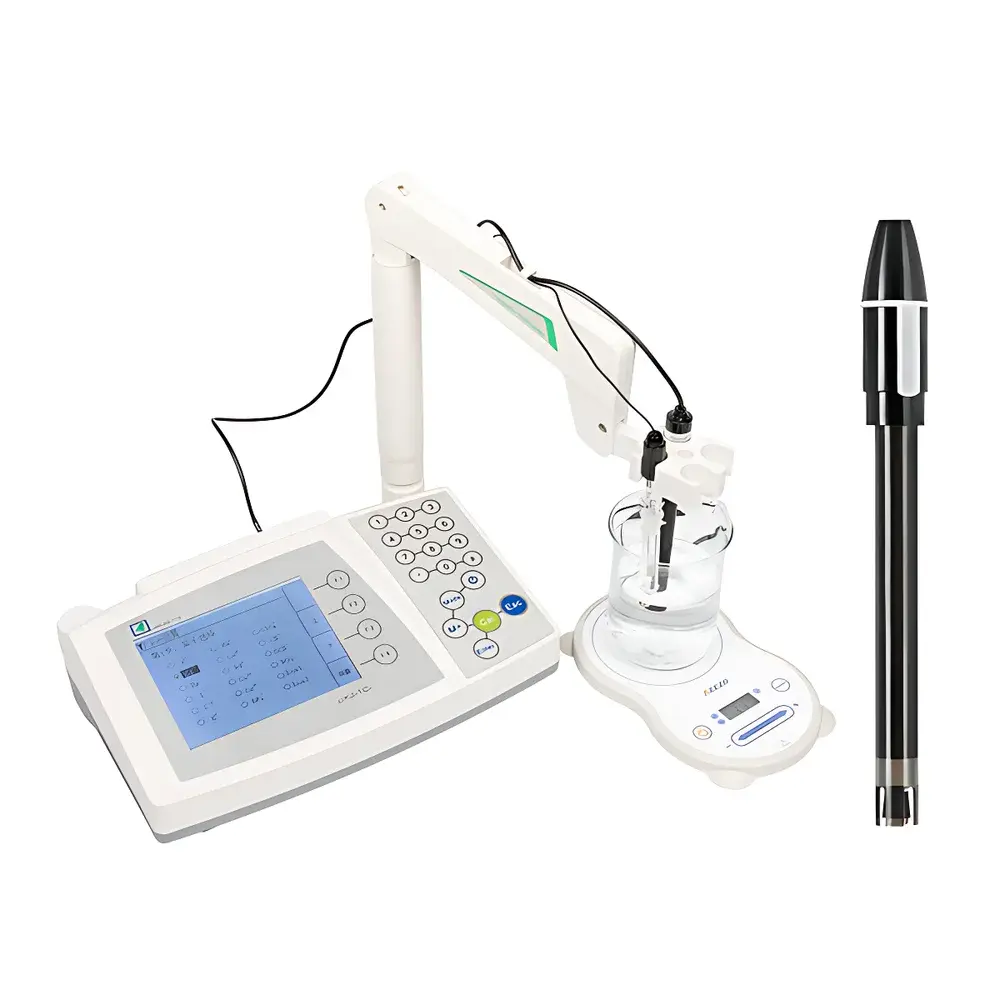
FangZhou PXJ-1C+ Ion Analyzer (Iodide-Specific)
| Brand | FangZhou |
|---|---|
| Origin | Sichuan, China |
| Manufacturer Type | Authorized Distributor |
| Product Category | Domestic |
| Model | PXJ-1C+ |
| Instrument Type | Benchtop |
| Ion Measurement Range | 0–99,999 ppm |
| Detection Limit | 9,999 ppm |
| Response Time | 3 s |
| Measurement Resolution | 0.001 (pH), 0.01 mV, 1–3 significant digits (ion concentration) |
| Temperature Range | −20.0 to 135.0 °C |
| Temperature Resolution | 0.1 °C |
| Input Impedance | ≥3 × 10¹² Ω |
| Data Storage Capacity | 4,096 sets |
| Calibration Points | 2–9-point ion calibration |
| GLP Compliance | Yes |
| Communication Interfaces | USB, RS-232, 0–20 mV analog output |
| Power Supply | DC 9 V / 500 mA (center-positive) |
Overview
The FangZhou PXJ-1C+ Ion Analyzer is a benchtop potentiometric instrument engineered for precise, trace-level quantification of iodide (I⁻) and up to 16 pre-programmed anions and cations—including fluoride (F⁻), chloride (Cl⁻), bromide (Br⁻), ammonium (NH₄⁺), nitrate (NO₃⁻), and sodium (Na⁺)—in aqueous environmental, industrial, and regulatory-compliant water quality applications. It operates on the principle of ion-selective electrode (ISE) potentiometry, measuring the electromotive force (EMF) generated at the interface between a selective membrane and the sample solution, which follows the Nernst equation. The instrument supports both direct concentration measurement (pX mode) and activity-based calculation with automatic temperature compensation (ATC), enabling reliable analysis across diverse matrices—from drinking water and wastewater effluents to brine solutions and leachates. Its 0.001 pH resolution, ±0.002 pH accuracy, and ±0.02% FS mV error meet the performance expectations of ISO 17025-accredited laboratories performing routine ion analysis under EPA Method 300.0, ASTM D6508, and ISO 10304-1.
Key Features
- Benchtop architecture with high-input-impedance circuitry (≥3 × 10¹² Ω) optimized for low-current ISE signals and minimized drift
- Backlit LCD display with dual time/date stamping—enabling GLP-compliant audit trails for all stored measurements
- 9-point customizable ion calibration protocol with real-time slope calculation and standard curve fitting (linear/logarithmic)
- Multi-parameter capability: simultaneous measurement of pX (iodide and other ions), pH, mV/Rel-mV/ORP, and temperature (−20.0 to 135.0 °C)
- 13 selectable concentration units—including ppm, ppb, mol/L, mmol/L, µmol/L, ng/L, and %—with seamless in-device unit conversion
- GLP-enabled data management: 4,096 measurement records with timestamp, electrode ID, calibration history, and operator ID tagging
- Dual-mode temperature compensation: automatic (ATC) or manual, compliant with ISO 7888 and USP
- Integrated diagnostics: electrode impedance check, junction potential warning, and calibration validity flagging
- Expandable ISE compatibility via universal electrode converter—supports DIN, BNC, and proprietary connectors from major electrode manufacturers
Sample Compatibility & Compliance
The PXJ-1C+ is validated for use with iodide-selective electrodes (e.g., AgI-based solid-state or liquid-membrane types) and compatible with standard reference electrodes (e.g., double-junction Ag/AgCl). It accommodates samples with TDS ≤ 100,000 mg/L and turbidity ≤ 100 NTU when filtered or centrifuged per ISO 5667-3. The instrument conforms to GLP documentation requirements per OECD Principles of Good Laboratory Practice and supports FDA 21 CFR Part 11 readiness through secure user access control (via “FangZhou pH-Link” software), electronic signatures, and immutable audit logs. All firmware and calibration routines are traceable to NIST-traceable standards; pH calibration employs 4 pre-loaded buffer sets (including DIN 19266 and USP pH 1.68–12.45), with auto-recognition of up to 5-point calibration sequences.
Software & Data Management
The included “FangZhou pH-Link” PC software enables bidirectional communication via USB or RS-232, supporting real-time data streaming, batch export to CSV/Excel, and customizable report generation (PDF/printed) with embedded metadata (calibration date, electrode lot, ambient temperature). Data files retain full GLP attributes: measurement ID, operator code, instrument serial number, and timestamp with millisecond precision. The software enforces role-based access levels (Admin, Technician, Viewer) and provides built-in validation tools for linearity assessment (R² ≥ 0.999), detection limit verification (3σ of blank), and repeatability evaluation (n = 6 replicates). Raw EMF values and calculated concentrations are archived separately to support method revalidation per ISO/IEC 17025:2017 Clause 7.2.2.
Applications
- Regulatory monitoring of iodide in drinking water per WHO Guidelines for Drinking-water Quality (GDWQ) and EU Directive 98/83/EC
- Environmental assessment of iodine speciation in seawater, groundwater, and nuclear waste leachates
- Pharmaceutical excipient testing (e.g., potassium iodide content in antiseptics) per USP
- Industrial process control in salt production, dairy processing, and iodized salt manufacturing
- Academic research on halogen cycling in biogeochemical systems and redox-sensitive aquifers
- Calibration and verification of online iodide sensors used in continuous emission monitoring systems (CEMS)
FAQ
Does the PXJ-1C+ support iodide-specific calibration using standard addition methods?
Yes—the instrument’s manual measurement mode allows incremental standard addition, with automatic concentration increment tracking and slope-based recovery calculation.
Can the device store calibration data for multiple ion electrodes independently?
Yes—each electrode is assigned a unique ID; calibration curves, slopes, intercepts, and expiry dates are saved per electrode profile.
Is the temperature sensor integrated or external?
Both options are supported: a built-in Pt1000 RTD (for general use) and optional external thermistor probes (e.g., IP68-rated for field immersion).
What is the minimum detectable iodide concentration when using a high-sensitivity AgI electrode?
Detection limit is electrode-dependent; with a certified low-noise solid-contact iodide ISE, sub-ppb (≤0.5 µg/L) detection is achievable under controlled lab conditions.
Does the instrument comply with ISO/IEC 17025 method validation requirements?
Yes—its documented uncertainty budget, calibration traceability, and software audit trail functionality align with ISO/IEC 17025:2017 Clauses 7.6 and 7.7 for method verification and equipment qualification.
Related Products







