
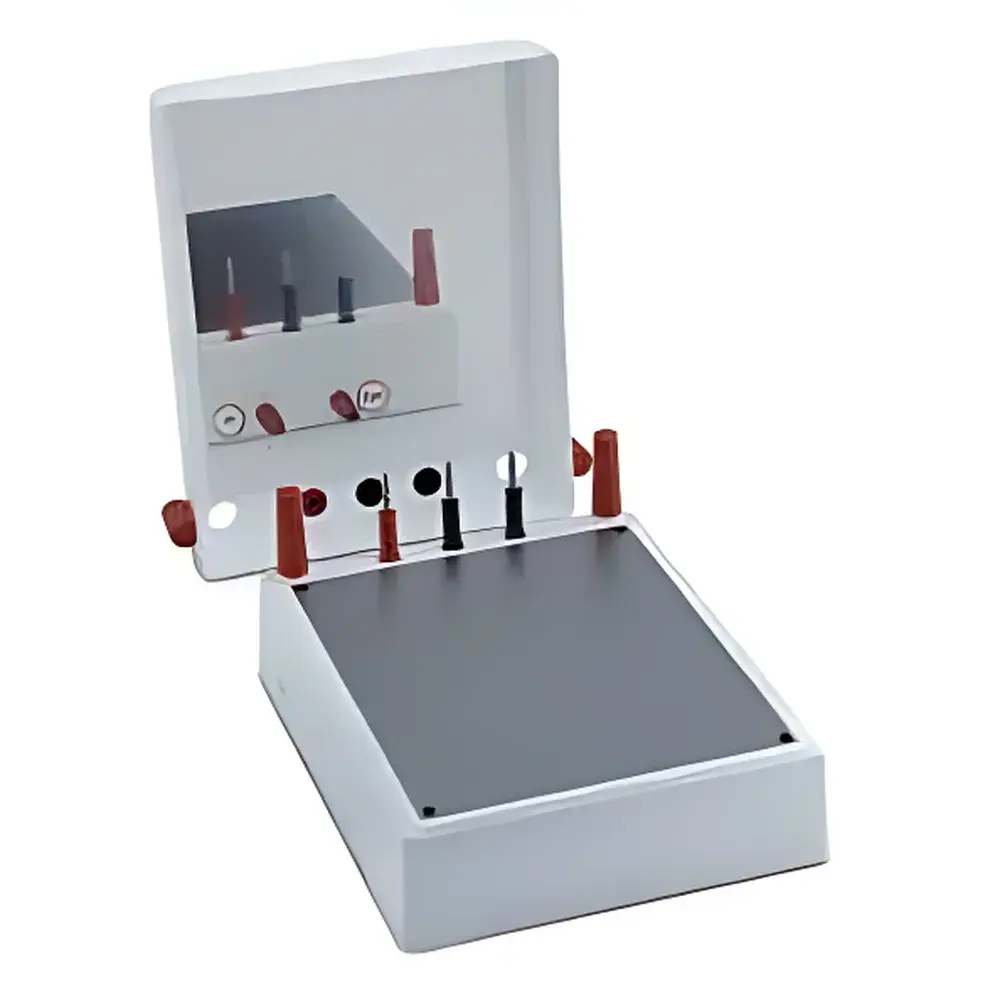
Fastblot B44 Semi-Dry Electrophoretic Transfer System
| Origin | Germany |
|---|---|
| Manufacturer Type | Authorized Distributor |
| Origin Category | Imported |
| Model | Fastblot B44 |
| Pricing | Available Upon Request |
Overview
The Fastblot B44 Semi-Dry Electrophoretic Transfer System is a precision-engineered instrument designed for rapid, high-efficiency protein transfer from polyacrylamide gels to solid supports—including nitrocellulose and PVDF membranes—using the semi-dry electroblotting principle. Unlike traditional wet transfer systems, the Fastblot B44 employs direct electrode contact with filter paper–sandwiched gel-membrane assemblies, enabling efficient ion migration under low-resistance conditions. This architecture leverages constant-voltage or constant-current operation to drive proteins electrophoretically across the gel matrix and onto the membrane with minimal diffusion or degradation. Engineered for reproducibility and throughput, the system is validated for reliable transfer of proteins up to 150 kDa—critical for structural biology, post-translational modification analysis, and western blot validation workflows in academic, clinical, and biopharmaceutical laboratories.
Key Features
- Optimized electrode configuration: Anode composed of titanium alloy coated with platinum (Pt/Ti), ensuring exceptional corrosion resistance, stable current distribution, and long-term conductivity without oxidation or pitting—even during extended high-current runs.
- Cathode constructed from medical-grade stainless steel (AISI 316), offering mechanical robustness, uniform electron sink behavior, and compatibility with standard transfer buffers (e.g., Tris-glycine/methanol or CAPS-based systems).
- Active electrode surface area of 16 × 20 cm—sufficient to accommodate standard mini- and midi-format gels while maintaining field homogeneity across the entire transfer zone.
- No integrated recirculating coolant system; thermal management relies on passive heat dissipation and optimized buffer volume—reducing complexity, maintenance overhead, and footprint while remaining compatible with standard laboratory benchtop environments.
- Patented corner-spacing mechanism: Four precisely dimensioned insulating spacers at each corner prevent lateral electrode contact between anode and cathode plates, eliminating short-circuit risk during assembly and ensuring consistent voltage gradient across the gel stack.
- Maximum supported gel dimensions: 15.5 × 19.5 cm—aligned with common pre-cast and hand-cast SDS-PAGE formats used in proteomic profiling and quality control assays.
Sample Compatibility & Compliance
The Fastblot B44 supports standard electrophoretic transfer protocols compliant with widely adopted biochemical standards, including those referenced in ISO/IEC 17025-accredited laboratories performing analytical method validation. It accommodates both native and denatured protein samples resolved on acrylamide gels (8–20% T), as well as agarose-based nucleic acid gels when adapted with appropriate membrane types. Buffer compatibility includes standard Tris-glycine-methanol, CAPS-methanol, and low-pH glycine-based systems—enabling optimization for basic, acidic, or hydrophobic proteins. While the device itself does not require regulatory certification, its operational parameters align with GLP-compliant documentation practices when integrated into validated western blot workflows per FDA 21 CFR Part 11 requirements for electronic records and signatures.
Software & Data Management
The Fastblot B44 operates as a standalone hardware platform without embedded microprocessor control or digital interface. All parameter setting—including voltage (typically 10–25 V), current limit (up to 2.0 A), and run time (10–30 min)—is performed manually via external power supply units commonly found in molecular biology labs (e.g., Bio-Rad PowerPac Basic, Thermo Fisher Ettan Power Supply). No proprietary software, drivers, or firmware updates are required. Users maintain full traceability through lab notebook entries or LIMS-integrated protocol logs specifying buffer composition, gel thickness, membrane type, and applied electrical parameters—supporting audit readiness in regulated environments.
Applications
- Routine western blotting for monoclonal antibody characterization and host cell protein (HCP) detection in biologics development.
- High-throughput screening of phosphorylation states, ubiquitination, or cleavage fragments in signal transduction studies.
- Transfer of large-molecular-weight complexes (>100 kDa) such as laminin, dystrophin, or multimeric receptors where diffusion-limited wet transfer often results in incomplete recovery.
- Teaching laboratories requiring rapid, visual confirmation of electrophoretic separation and transfer efficiency within single lab sessions.
- Resource-constrained settings where buffer economy, equipment simplicity, and absence of pump or chiller infrastructure are operational priorities.
FAQ
What is the recommended buffer volume for optimal transfer performance?
Typical usage requires 100–150 mL total buffer volume distributed evenly across the filter paper layers—significantly less than wet transfer systems (which often consume >500 mL).
Can the Fastblot B44 be used with pre-cast gradient gels?
Yes—provided the gel dimensions do not exceed 15.5 × 19.5 cm and the acrylamide concentration falls within standard SDS-PAGE ranges (8–20%).
Is cooling necessary during operation?
No active cooling is required; however, ambient temperature should remain ≤25 °C, and transfer duration should be limited to ≤30 min to mitigate Joule heating effects in high-conductivity buffers.
How frequently must electrodes be cleaned or replaced?
Platinum-coated titanium anodes and stainless steel cathodes require no routine cleaning or replacement under normal use; wipe with deionized water after each run to remove residual buffer salts.
Does the system support constant-current mode?
Yes—when paired with a programmable power supply capable of constant-current output, the Fastblot B44 maintains stable amperage throughout the run, improving reproducibility across variable gel resistances.




