
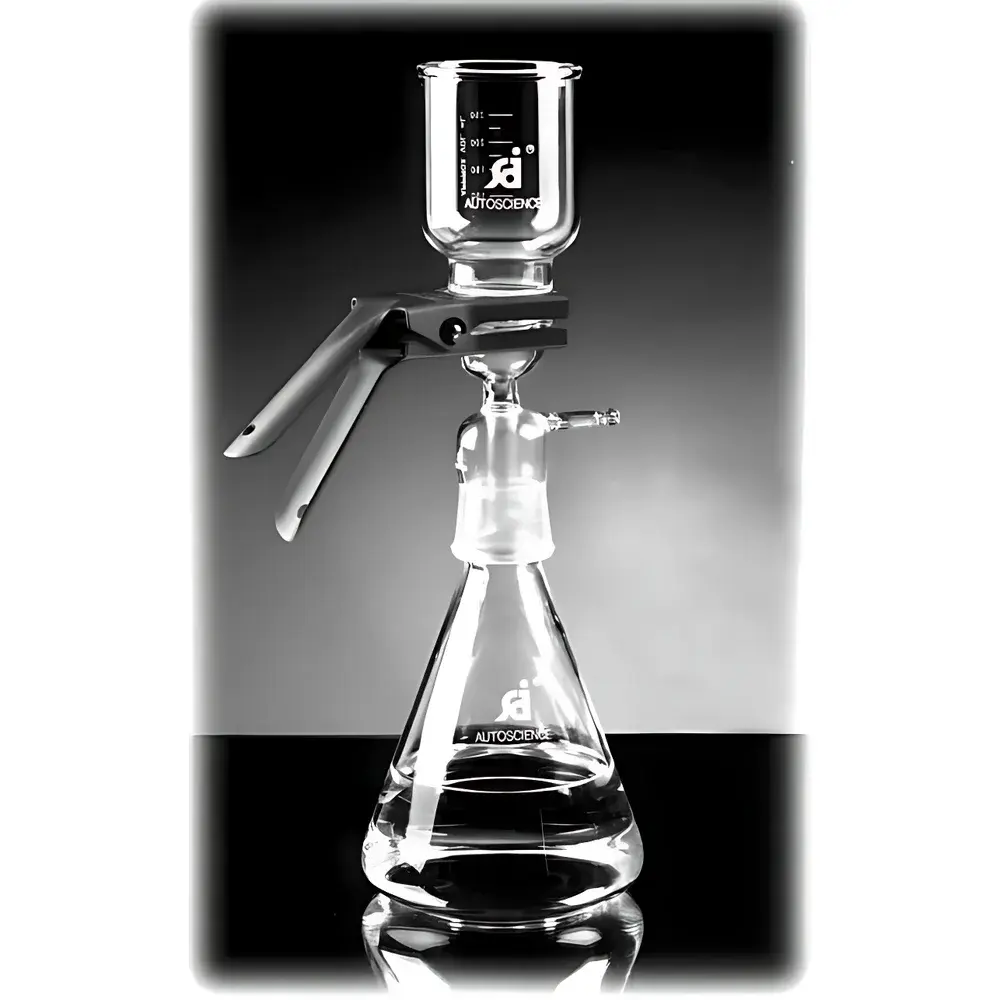
FB-20T Filtration Bottle System by Autoscience
| Brand | Autoscience |
|---|---|
| Origin | Tianjin, China |
| Model | FB-20T |
| Capacity | 2000 mL |
| Components | Filter Funnel (with Standard 47 mm or 90 mm Filter Support), Sintered Stainless Steel Fritted Disc (Porosity Grade: G3 or G4, Optional), Anodized Aluminum Clamp Assembly, Heavy-Wall Borosilicate Glass Collection Bottle (Class A, ASTM E438 Type I, Class B Thermal Shock Resistance) |
| Material Compliance | USP <661.1> Compliant Glass & FDA-Approved Anodized Aluminum |
| Sterilization Compatibility | Autoclavable (121°C, 20 min, 15 psi) |
Overview
The FB-20T Filtration Bottle System is a precision-engineered, gravity- and vacuum-assisted laboratory filtration platform designed for routine and high-throughput sample preparation in life science, pharmaceutical, and bioprocessing laboratories. Built upon the fundamental principle of pressure-driven membrane separation, the system enables rapid, particulate-free clarification of aqueous and organic solutions, cell lysates, culture supernatants, and buffer preparations. Its modular architecture—comprising a borosilicate glass filter funnel with integrated sintered stainless steel frit, anodized aluminum universal clamp, and a calibrated 2000 mL collection vessel—ensures mechanical stability under vacuum (up to –0.1 MPa), thermal resilience during steam sterilization, and chemical inertness across pH 1–14 and common solvents (e.g., ethanol, isopropanol, acetone, 0.5 M NaOH). Unlike single-use plastic alternatives, the FB-20T supports repeated autoclaving and rigorous cleaning validation, making it suitable for GLP-compliant environments where traceability, residue control, and equipment qualification are mandatory.
Key Features
- Heavy-wall borosilicate glass construction (ASTM E438 Type I, Class B) with nominal thermal shock resistance up to 120°C differential, minimizing fracture risk during rapid temperature transitions.
- Sintered stainless steel fritted disc (standard G3 porosity: 15–40 µm; optional G4: 4–9 µm) providing uniform flow distribution, low extractables, and compatibility with both membrane filters (e.g., PVDF, nylon, PES) and direct frit-based particulate retention.
- Anodized aluminum clamp assembly featuring dual-spring tensioning mechanism and ergonomic lever actuation—ensuring leak-tight sealing between funnel and bottle without over-torqueing or gasket deformation.
- Calibrated 2000 mL collection bottle with Class A volumetric accuracy (±5 mL at 20°C per ISO 1042), engraved scale marks, and reinforced base geometry for stable placement on vacuum manifolds or benchtops.
- Interchangeable filter support options: accommodates standard 47 mm or 90 mm diameter membranes via threaded or bayonet-style retention rings (accessories sold separately).
- Fully autoclavable design validated for 20 cycles at 121°C / 15 psi saturated steam per ISO 17665-1, supporting reuse in sterile process development and QC microbiology workflows.
Sample Compatibility & Compliance
The FB-20T is routinely deployed in applications requiring ISO 8573-1 Class 2 compressed air filtration, USP particulate matter testing, and ASTM D2974 turbidity reduction protocols. It complies with material safety requirements outlined in USP for glass components and FDA 21 CFR 175.300 for anodized aluminum surfaces in contact with biological fluids. The system meets the mechanical integrity criteria specified in ISO 7208 for vacuum filtration apparatus and is compatible with IQ/OQ/PQ documentation frameworks used in regulated pharmaceutical manufacturing. When paired with certified low-protein-binding membranes, it satisfies ICH Q5A recommendations for removal of adventitious agents from biologics intermediates.
Software & Data Management
While the FB-20T operates as a standalone manual or vacuum-assisted unit without embedded electronics, its design integrates seamlessly into digital lab infrastructure. Each unit carries a permanent laser-etched serial number enabling asset tracking within LIMS platforms (e.g., LabWare, Thermo Fisher SampleManager). Process parameters—including vacuum level (monitored externally via analog or digital gauges), filtration duration, and batch ID—are manually logged or captured via connected vacuum controllers with RS-485/Modbus output. The system supports 21 CFR Part 11–compliant audit trails when used in conjunction with validated electronic notebooks (e.g., Benchling, LabArchives) and calibrated vacuum sensors traceable to NIST standards.
Applications
- Pretreatment of HPLC mobile phases and LC-MS solvents to eliminate sub-5 µm particulates that cause column clogging and backpressure spikes.
- Clarification of mammalian cell culture harvests prior to depth filtration or chromatography loading.
- Buffer exchange and desalting of protein samples using tangential flow ultrafiltration (TFF) pre-filtration stages.
- Environmental water analysis per EPA Method 160.1, including suspended solids quantification and microplastic pre-concentration.
- Preparation of sterile-filtered media and reagents for stem cell expansion and organoid culture systems under aseptic hood conditions.
- Quality control of vaccine adjuvants and nanoparticle suspensions where particle size distribution and aggregate content must be monitored post-filtration.
FAQ
Is the FB-20T compatible with aggressive solvents such as chloroform or DMF?
Yes—the borosilicate glass body and anodized aluminum clamp exhibit excellent resistance to chloroform, dimethylformamide (DMF), and tetrahydrofuran (THF); however, prolonged exposure to concentrated hydrofluoric acid or hot phosphoric acid is not recommended.
Can I use polyethersulfone (PES) membranes with this system?
Absolutely. The standard 47 mm or 90 mm support configurations accept all commercially available PES, PVDF, nylon, and mixed cellulose ester membranes with appropriate pore ratings (0.1–5.0 µm).
What is the maximum vacuum pressure the FB-20T can withstand?
The system maintains structural integrity and seal integrity under continuous vacuum down to –0.1 MPa (–760 Torr), verified per ISO 7208 Annex C mechanical stress testing.
Does the sintered frit require periodic replacement?
Under normal use and proper cleaning (e.g., sonication in 1% SDS followed by 70% ethanol rinse), the stainless steel frit demonstrates >500 autoclave cycles without measurable porosity shift or metal leaching (ICP-MS validated).
Is technical documentation available for regulatory submission?
Yes—Autoscience provides a full Equipment Qualification Package (EQP), including dimensional drawings, material certifications (RoHS, REACH), autoclave validation reports, and USP test summaries upon request for GMP-regulated users.



