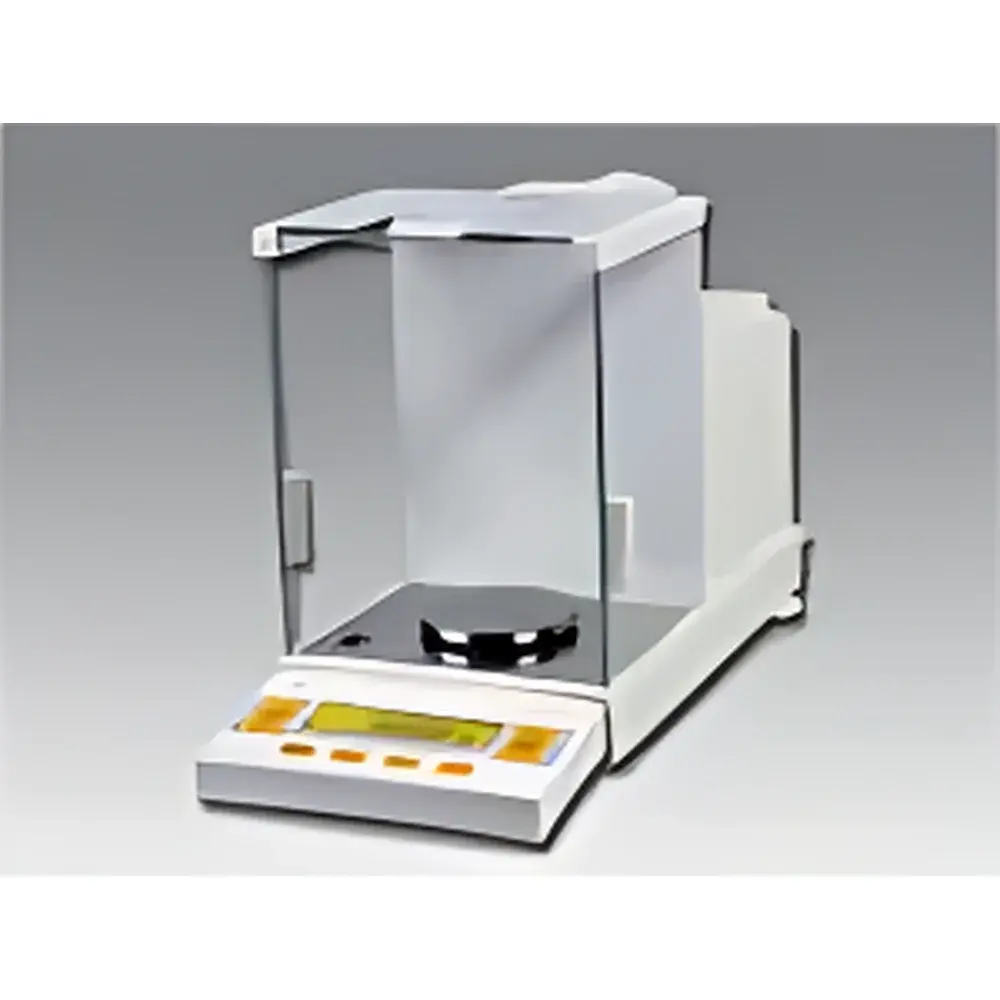
FB423 Automatic Internal Calibration Precision Analytical Balance / FB323 Internal Calibration 0.001 g Analytical Balance
| Origin | Shanghai, China |
|---|---|
| Manufacturer Type | Authorized Distributor |
| Regional Origin | Domestic (PRC) |
| Model | FB423 |
| Price | USD 1,120 (FOB Shanghai) |
| Capacity | 420 g |
| Readability | 1 mg |
| Repeatability | ≤1 mg |
| Linearity | ≤±2 mg |
| Draft Shield Dimensions | 195 × 160 × 235 mm |
| Overall Dimensions | 195 × 445 × 300 mm |
| Pan Diameter | Φ90 mm |
| Sensor Technology | High-Stability Electromagnetic Force Compensation |
| Interface | RS232 Serial Port |
| Power Options | AC Adapter (100–240 VAC) or 9 V DC Battery |
| Display | Backlit LCD |
| Compliance | ISO 9001–certified manufacturing environment |
Overview
The FB423 Automatic Internal Calibration Precision Analytical Balance and its sibling model FB323 are high-reliability electromagnetic force compensation balances engineered for routine laboratory mass measurement with traceable accuracy and operational robustness. Unlike strain-gauge-based systems prone to creep and thermal drift, these instruments employ a rear-mounted electromagnetic force restoration sensor architecture—delivering stable, linear response across the full weighing range. The core design principle centers on closed-loop feedback control: when mass is placed on the pan, displacement of the load receptor is detected by an optical sensor; a precisely regulated current is then applied to a coil within a permanent magnetic field to restore equilibrium. The magnitude of this current is directly proportional to the applied mass and forms the basis of digital mass readout. With 1 mg readability and internal dual-weight calibration capability, the FB423 meets the performance requirements for general analytical tasks in quality control laboratories, educational institutions, and R&D environments where reproducibility—not ultra-micro precision—is the primary objective.
Key Features
- Automatic internal calibration using two built-in reference weights—eliminates manual handling of external standards and reduces calibration-induced uncertainty.
- Digital multi-point linearization algorithm corrects nonlinearity across the entire weighing range, enhancing accuracy without user intervention.
- Full-height transparent front-access draft shield (195 × 160 × 235 mm) with pillar-free design maximizes workspace accessibility while maintaining ISO 17025-compliant environmental isolation.
- Integrated RS232 serial interface enables direct connection to PCs, label printers, or LIMS systems for automated data logging and audit-trail generation.
- 6-key intuitive front panel with backlit LCD display supports tare, unit conversion (g, oz, ct, etc.), piece counting, and memory recall functions.
- Dual power operation: compatible with universal AC input (100–240 VAC) or optional 9 V DC battery—ideal for mobile lab setups or locations with unstable mains supply.
- Stainless steel weighing pan (Φ90 mm) and reinforced composite housing ensure long-term mechanical stability and resistance to chemical splash exposure.
Sample Compatibility & Compliance
The FB423 accommodates standard laboratory sample containers—including glass vials, aluminum weighing boats, and plastic centrifuge tubes—within its unobstructed pan geometry. Its 420 g capacity and 1 mg resolution suit volumetric flask calibration, reagent dispensing verification, tablet weight uniformity testing (per USP ), and raw material lot reconciliation. While not certified to OIML R76 or NIST Handbook 44 for legal-for-trade applications, the balance is manufactured under ISO 9001 quality management systems and supports Good Laboratory Practice (GLP) and Good Manufacturing Practice (GMP) workflows through configurable print/log outputs and user-accessible calibration history. Internal calibration traceability aligns with ISO/IEC 17025 Clause 6.4.6 for equipment verification, provided periodic verification against accredited external standards is maintained.
Software & Data Management
Data output follows standard ASCII protocol via RS232, supporting seamless integration with third-party software such as LabX (Mettler Toledo), WinWedge (TAL Technologies), or custom Python/Excel automation scripts. Each transmission includes timestamp, net weight, tare status, and unit identifier—enabling structured database ingestion. The balance stores up to 99 calibration events locally, including date, operator ID (if entered), and deviation values—facilitating internal audit readiness. No proprietary drivers or cloud dependencies are required; configuration is performed entirely via front-panel navigation. For regulated environments, the system supports 21 CFR Part 11–compatible electronic signatures when paired with validated host software that implements audit trails, role-based access, and electronic record retention.
Applications
- Pharmaceutical QC labs: excipient batch release testing, capsule fill weight checks, and dissolution sample preparation.
- Academic teaching labs: stoichiometric calculations, solution preparation, and density determination experiments.
- Materials science facilities: powder blending homogeneity assessment and catalyst loading verification.
- Food safety laboratories: moisture content determination (via loss-on-drying protocols) and nutritional labeling compliance checks.
- Environmental testing centers: filter paper mass differential analysis for particulate matter (PM2.5/PM10) quantification.
FAQ
Does the FB423 require external calibration weights?
No—the FB423 performs automatic internal calibration using two factory-installed, temperature-compensated stainless steel reference masses. External calibration is only required for metrological verification or after physical shock or relocation.
Can the balance operate on battery power during extended outages?
Yes—when equipped with a fresh 9 V alkaline battery, the FB423 delivers up to 8 hours of continuous operation with backlight enabled, making it suitable for field deployment or emergency backup use.
Is the RS232 interface compatible with modern Windows/macOS systems?
Yes—using a standard USB-to-serial adapter (e.g., FTDI chipset), the balance communicates reliably with contemporary operating systems without driver conflicts. Output format is fixed-width ASCII, ensuring parsing compatibility across platforms.
What is the recommended recalibration frequency?
Per ISO/IEC 17025 guidance, internal calibration should be performed before first use each day and after any significant ambient temperature shift (>5 °C). Full external verification against traceable standards is advised every 3–6 months, depending on usage intensity and criticality of measurements.
Does the balance support statistical calculation functions (e.g., mean, SD)?
No—the FB423 does not embed statistical processing; however, real-time streaming via RS232 allows external software to compute descriptive statistics, generate histograms, or export to CSV for further analysis in Excel or R.