
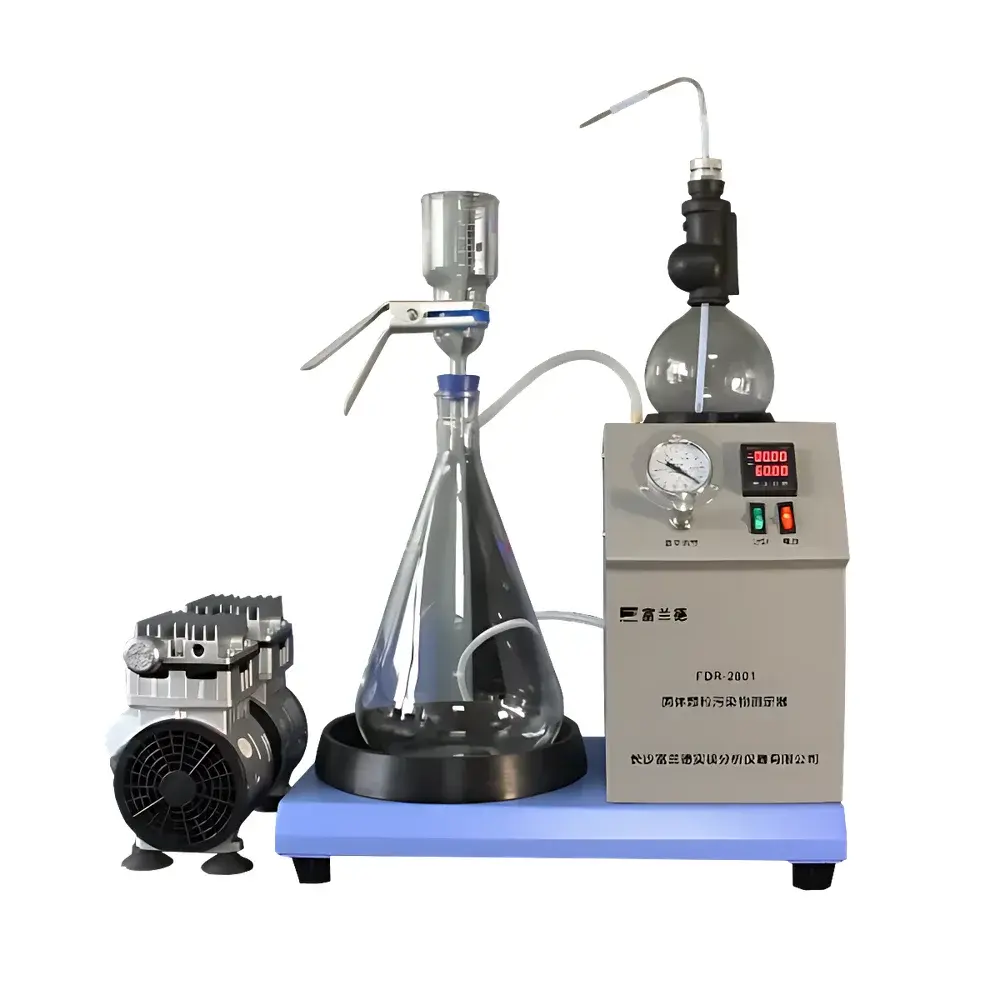
FDR-2801 Jet Fuel Solid Particulate Contaminant Analyzer (CSFriend / Fuland)
| Brand | CSFriend / Fuland |
|---|---|
| Origin | Hunan, China |
| Manufacturer Type | Authorized Distributor |
| Product Origin | Domestic (China) |
| Model | FDR-2801 |
| Vacuum Degree | 80 kPa |
| Filtration Method | Vacuum-assisted suction |
| Power Consumption | 500 W |
| Power Supply | AC 220 V / 50 Hz |
| Timer | Digital display with audible alarm |
| Noise Level | Low-noise vacuum pump |
| Construction | Stainless steel chassis with ceramic-coated control panel |
| Clamping Mechanism | Precision die-stamped metal clamps |
| Glassware Set | ASTM-compliant standard filtration glassware |
| Configuration | Single-station benchtop filtration system |
Overview
The FDR-2801 Jet Fuel Solid Particulate Contaminant Analyzer is a dedicated benchtop instrument engineered for the quantitative assessment of suspended solid particulates in aviation turbine fuels—specifically jet fuel (e.g., Jet A, Jet A-1, JP-8). It operates on the principle of standardized vacuum-assisted membrane filtration, in strict accordance with ASTM D2276 (“Standard Test Method for Particulate Contamination in Aviation Fuel by Line Sampling”) and aligned with supporting protocols in ASTM D4057 and IP 219. The system draws a defined volume of fuel through a pre-weighed, 0.8 µm pore-size mixed cellulose ester (MCE) membrane under controlled vacuum pressure (80 kPa), capturing all non-dissolved solids ≥0.8 µm. Following filtration, the membrane is dried, re-weighed gravimetrically, and particle mass concentration (mg/L or mg/100 mL) is calculated per ASTM-defined procedures. Designed for QC laboratories in refineries, fuel depots, military logistics centers, and MRO facilities, the FDR-2801 delivers repeatable, auditable results essential for fuel acceptance testing and compliance verification.
Key Features
- Benchtop architecture with robust stainless steel frame and ceramic-coated control panel—resistant to hydrocarbon exposure, corrosion, and mechanical abrasion in industrial lab environments.
- Digital electronic timer with adjustable setpoint (0–99 min 59 s) and integrated audible buzzer alert—ensures precise adherence to ASTM-specified filtration durations (typically 5–15 min depending on fuel viscosity and contaminant load).
- Integrated low-noise vacuum pump (≤62 dB(A) at 1 m) with stable 80 kPa operating vacuum—optimized to prevent membrane rupture while maintaining consistent flow rate across varying fuel viscosities (0.8–2.5 cSt at 20 °C).
- Full set of borosilicate glass components—including funnel, filter holder, and receiving flask—manufactured to dimensional and thermal tolerance specifications outlined in ASTM D2276 Annex A1; all glassware supplied with traceable calibration documentation.
- Precision die-stamped stainless steel clamps—designed for uniform sealing force distribution across the membrane gasket interface, minimizing bypass leakage and ensuring >99.9% filtration integrity.
- Single-station configuration with centralized power management (AC 220 V / 50 Hz, 500 W)—facilitates rapid deployment in ISO/IEC 17025-accredited labs without requiring auxiliary infrastructure.
Sample Compatibility & Compliance
The FDR-2801 is validated for use with aviation turbine fuels meeting ASTM D1655, DEF STAN 91-91, and MIL-DTL-83133 specifications. It accommodates sample volumes from 100 mL to 1,000 mL, with optional adapter kits available for integration with inline sampling manifolds per API RP 1172. All wetted parts are chemically inert to hydrocarbons, alcohols, and common fuel additives (e.g., static dissipater, antioxidant, corrosion inhibitor). The system supports GLP and GMP-aligned workflows: filtration records—including start/stop time, vacuum pressure confirmation, operator ID, and environmental conditions (temperature/humidity)—can be manually logged in accordance with 21 CFR Part 11–ready documentation templates. While the base unit does not include electronic audit trail functionality, its mechanical design enables full traceability when used with laboratory notebooks compliant with ISO/IEC 17025 clause 7.10.
Software & Data Management
The FDR-2801 is a hardware-only, non-computerized analyzer. No embedded firmware, touchscreen interface, or proprietary software is included—consistent with ASTM D2276’s requirement for operator-controlled, manual endpoint determination. This architecture eliminates validation overhead associated with electronic records, simplifying regulatory qualification in FDA-audited or defense-contracted facilities. Users maintain full control over data capture via standardized log sheets (e.g., ASTM Form D2276-23 Annex B), which may be digitized using LIMS-compatible templates. Optional accessories include certified reference membranes (NIST-traceable weight certificates) and calibrated volumetric flasks (Class A, ISO 1042), supporting metrological traceability to national standards.
Applications
- Acceptance testing of bulk jet fuel deliveries at airport fuel farms and naval air stations.
- In-process monitoring during fuel polishing and filtration maintenance cycles.
- Root cause analysis of filter plugging incidents in aircraft fuel systems (e.g., IDG, HMU, servo valves).
- Supporting root cause investigations following engine performance anomalies linked to particulate ingress.
- Training and proficiency testing for fuel quality assurance personnel under IATA AHM 530 or FAA Advisory Circular 150/5200-37.
- Contractual compliance verification per OEM fuel specification clauses (e.g., Rolls-Royce RRES 90001, GEK 32439).
FAQ
Does the FDR-2801 meet ASTM D2276 requirements for vacuum level and timing accuracy?
Yes—the system maintains 80 kPa ±2 kPa vacuum via pressure-regulated pumping and employs a NIST-traceable digital timer with ±0.5 s accuracy over 10-minute intervals.
Can it be used for diesel or marine fuel particulate testing?
No. The FDR-2801 is specifically configured for low-viscosity, low-solvent aviation fuels. Diesel (EN 590) and marine fuels (ISO 8217) require higher vacuum stability and alternative membrane chemistries, addressed by separate analyzers such as the FDR-2803 series.
Is the vacuum pump serviceable onsite?
Yes—pump oil replacement and diaphragm inspection follow manufacturer-recommended intervals (every 500 operating hours); spare parts kits and service manuals are supplied with each unit.
What membrane specifications are recommended?
ASTM D2276 mandates 0.8 µm pore size, mixed cellulose ester (MCE), 47 mm diameter, low-binding surface; catalog numbers from Sartorius (SMWP04700) or Pall (4184) are verified compatible.
How is calibration verified?
Vacuum sensor calibration is performed annually using a deadweight tester (±0.5% FS); timer calibration uses a GPS-synchronized stopwatch. Certificate of Conformance and initial verification report are provided at shipment.





