
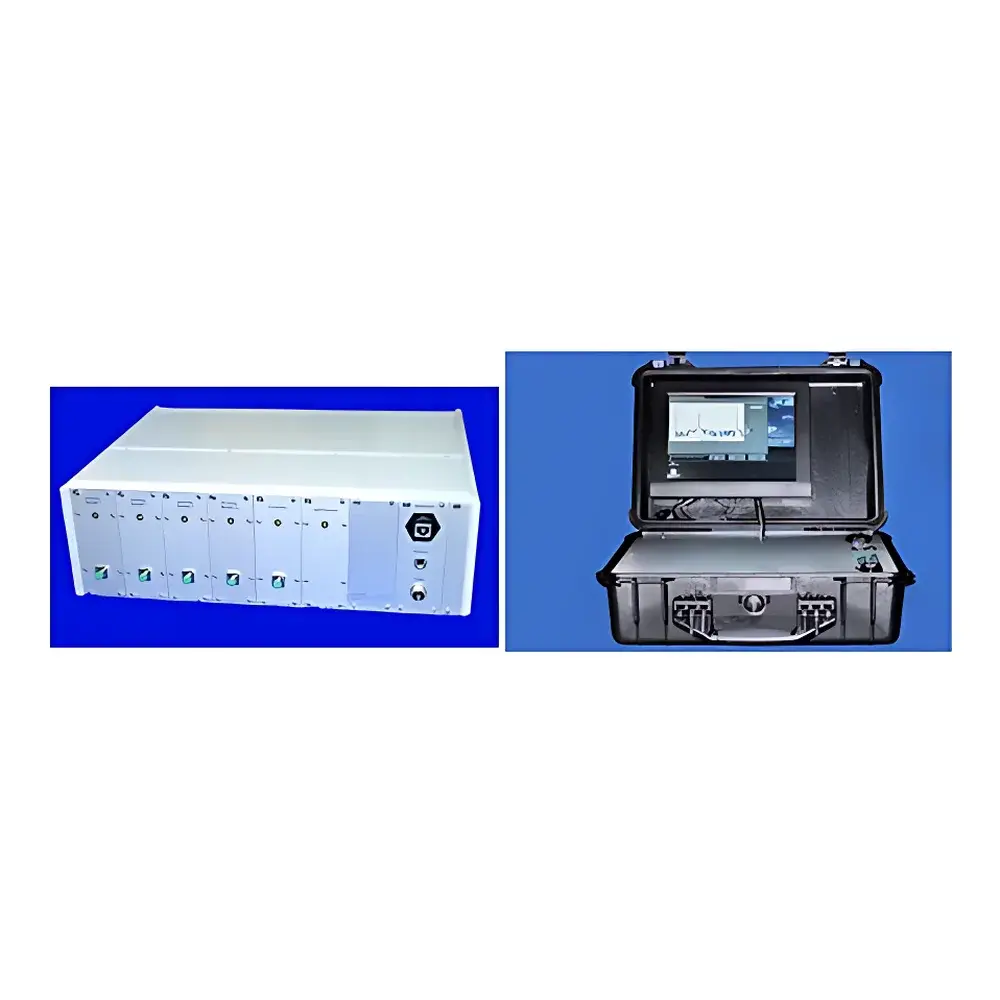
Fiber Bragg Grating Monitoring Unit – AOS DV-1000 Single-Channel High-Speed Interrogator
| Key | Brand: AOS / Advanced Optics Solutions |
|---|---|
| Origin | Germany |
| Manufacturer Type | Authorized Distributor |
| Origin Category | Imported |
| Model | DV-1000 Monitoring Unit for Single FBG |
| Pricing | Available Upon Request |
Overview
The AOS DV-1000 is a high-performance, single-channel fiber Bragg grating (FBG) interrogation unit engineered for precision dynamic strain, temperature, and displacement sensing in demanding structural health monitoring (SHM) and industrial process environments. Based on tunable laser scanning and high-resolution wavelength demodulation, the DV-1000 operates on the fundamental principle of detecting minute shifts in the Bragg wavelength (ΔλB) induced by axial strain or thermal expansion in photosensitive silica fiber. Its architecture supports real-time, high-fidelity acquisition with sampling rates up to 2 kHz—enabling resolution of transient mechanical events such as blast-induced vibrations, seismic waveforms, and micro-crack propagation. Designed for long-term stability, the unit integrates factory-calibrated, thermally compensated FBG sensors with traceable NIST-traceable reference channels, ensuring measurement repeatability better than ±1 pm over 12 months under controlled environmental conditions.
Key Features
- Single-input channel dedicated to one FBG sensor—optimized for signal integrity and minimal crosstalk in high-dynamic-range applications
- High-speed interrogation: configurable sampling rates from 10 Hz to 2,000 Hz, supporting both quasi-static and transient event capture
- Wavelength resolution: ≤1 pm (typical), enabling sub-microstrain strain resolution when paired with standard 1550 nm FBGs (gauge factor ~0.78)
- Integrated thermal stabilization and internal reference channel for drift compensation across operating temperatures (−10 °C to +60 °C)
- Modular mechanical design: compact 19″ rack-mountable chassis (3U height) with optional field-deployable enclosure (IP65-rated)
- Independent power supply options: 24 V DC (standard), 110/230 V AC input, or vehicle-mounted battery interface for mobile deployments
Sample Compatibility & Compliance
The DV-1000 is compatible with all standard telecom-grade FBG sensors operating in the C-band (1525–1565 nm), including bare, polyimide-coated, stainless steel–encapsulated, and embeddable ceramic-packaged variants. It supports FBGs written in hydrogen-loaded or femtosecond-inscribed fibers, accommodating reflectivity ranges from 30% to 95% and bandwidths from 0.2 nm to 1.2 nm. The system complies with IEC 61757-1:2018 (Fiber optic sensors — Part 1: Generic specification) and meets electromagnetic compatibility requirements per EN 61326-1:2013 (Laboratory equipment). For regulated industries, firmware supports audit-trail logging and user-access control aligned with GLP and GMP documentation workflows; full traceability of calibration certificates and sensor metadata is maintained in accordance with ISO/IEC 17025:2017 requirements.
Software & Data Management
The DV-1000 ships with AOS FiberSense Studio—a Windows-based acquisition and analysis suite compliant with FDA 21 CFR Part 11 for electronic records and signatures. The software provides real-time spectrum visualization, automatic peak detection, wavelength-to-physical-unit conversion (strain, °C, µm), and time-series export in CSV, HDF5, and MATLAB .mat formats. Batch processing tools support baseline subtraction, moving-average filtering, FFT spectral analysis, and event-triggered recording. All configuration parameters, raw spectra, and processed datasets are stored with embedded timestamps, sensor IDs, and operator metadata. Remote operation is enabled via TCP/IP Ethernet (Modbus TCP and custom API available); integration with SCADA systems (e.g., Ignition, Siemens Desigo) and cloud platforms (AWS IoT Core, Azure IoT Hub) is supported through documented RESTful endpoints.
Applications
- Seismic and blast monitoring: Real-time capture of P- and S-wave arrival times in geotechnical arrays, tunnel linings, and mine shafts
- Civil infrastructure SHM: Crack width evolution tracking in historic masonry, settlement-induced displacement in bridge piers, and thermal expansion profiling in cable-stayed decks
- Energy sector monitoring: Temperature gradient mapping across nuclear reactor containment walls, turbine blade thermal stress profiling, and transformer hotspot detection
- Industrial process safety: Overheat detection in high-voltage busbars, pressure-induced strain in composite LNG storage tanks, and vibration fatigue assessment in rotating machinery foundations
- Environmental compliance: Long-term groundwater level correlation using FBG-based piezometric sensors in landfill leachate monitoring wells
FAQ
Can the DV-1000 interrogate multiple FBGs on a single fiber?
No—the DV-1000 is strictly a single-FBG, single-channel interrogator. For multiplexed arrays, AOS recommends the DW-4000 series (up to 40 FBGs per fiber).
Is the unit suitable for outdoor deployment without climate control?
Yes—when equipped with the optional IP65 field enclosure and wide-temperature-range FBG sensors, it operates reliably in unconditioned environments from −20 °C to +70 °C.
Does the system support third-party sensor calibration certificates?
Yes—user-uploaded calibration matrices (wavelength-to-strain/temperature polynomials) can be imported and applied during post-processing.
What is the maximum fiber length supported between the unit and the FBG sensor?
Up to 10 km with standard single-mode fiber (G.652.D), assuming ≤0.2 dB/km attenuation and use of an optical circulator or directional coupler for reflection-mode operation.
Is firmware update capability available remotely?
Yes—secure OTA updates are delivered via encrypted HTTPS connection with SHA-256 signature verification and rollback protection.




