
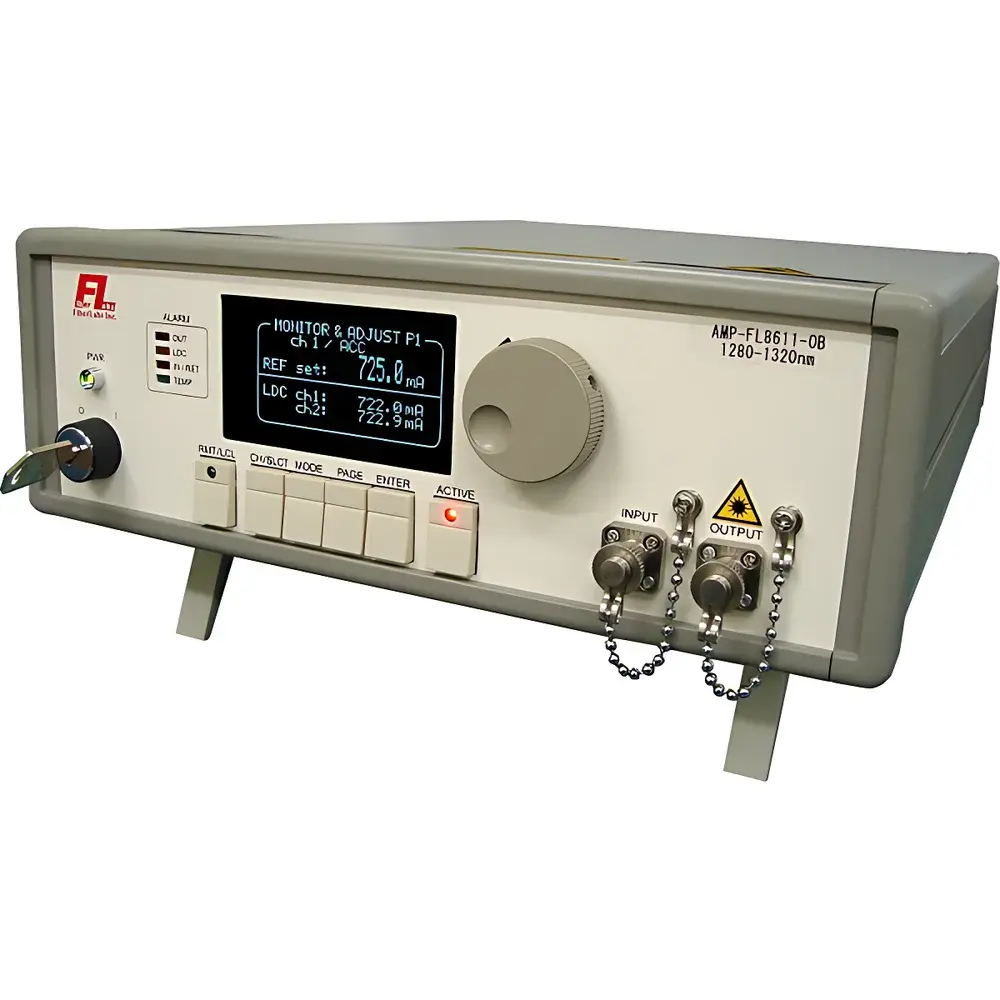
Fiberlabs AMP-FL8011-CB-22 Erbium-Doped Fiber Amplifier (EDFA)
| Brand | Fiberlabs |
|---|---|
| Origin | Japan |
| Model | AMP-FL8011-CB-22 |
| Form Factor | Benchtop |
| Control Interface | RS-232C and IEEE-488.2 (GPIB) standard |
| Operating Band | C-band (1525–1565 nm) |
| Application Domain | Telecom & Non-Telecom R&D, Optical Sensing, Pulsed Laser Amplification, Metrology |
Overview
The Fiberlabs AMP-FL8011-CB-22 is a benchtop erbium-doped fiber amplifier (EDFA) engineered for high-stability, low-noise optical signal amplification in the C-band (1525–1565 nm). Designed and manufactured in Japan, this amplifier leverages Fiberlabs’ proprietary double-clad fiber design and optimized pump laser coupling architecture to deliver consistent small-signal gain, high saturation output power, and excellent noise figure performance—critical parameters for both telecommunication system validation and demanding non-telecom applications such as ultrafast laser seeding, interferometric sensing, and low-light-level optical metrology. Unlike modular or OEM-grade amplifiers, the AMP-FL8011-CB-22 integrates front-panel analog and digital controls with factory-calibrated gain flatness across its operational bandwidth, enabling rapid deployment in laboratory environments where repeatability and traceable optical power management are essential.
Key Features
- Stable C-band amplification with typical small-signal gain >30 dB and noise figure <5.0 dB (measured at 1550 nm, 0 dBm input)
- Benchtop form factor with integrated pump lasers, isolators, and gain-flattening filters—no external alignment or thermal stabilization required
- Front-panel adjustable controls for gain, output power limit, and pump current—enabling real-time optimization during experimental setup
- Standard dual-control interface: RS-232C for serial command scripting and IEEE-488.2 (GPIB) for integration into automated test systems compliant with SCPI command sets
- Internal monitoring of pump diode temperature, photodiode feedback signals, and output power via embedded microcontroller—supports self-diagnostic logging
- Designed for continuous operation under ambient laboratory conditions (15–30 °C, non-condensing), with thermal management optimized for long-term gain stability (±0.1 dB over 8 hours)
Sample Compatibility & Compliance
The AMP-FL8011-CB-22 accepts free-space or fiber-pigtailed input signals with standard SMF-28 or PM1550 fiber interfaces (FC/APC or FC/PC connectors optional). It is compatible with CW, modulated (NRZ, PAM4), and pulsed inputs (pulse widths ≥10 ns, repetition rates up to 10 GHz), provided peak power remains within safe operating limits (<+10 dBm). The unit complies with IEC 60825-1:2014 (Class 1M laser product) and meets CE marking requirements for electromagnetic compatibility (EN 61326-1) and safety (EN 61010-1). While not certified for carrier-grade deployment, its design adheres to key elements of Telcordia GR-1312-CORE for reliability testing—particularly thermal cycling and vibration endurance—making it suitable for pre-compliance evaluation in next-generation optical subsystem development.
Software & Data Management
Fiberlabs provides a Windows-compatible configuration utility supporting remote gain calibration, firmware updates, and real-time parameter logging (gain, output power, pump current, case temperature). All communication follows industry-standard SCPI syntax over GPIB or virtual COM port, enabling seamless integration with LabVIEW, Python (PyVISA), MATLAB, or custom-built test automation frameworks. Audit trails—including timestamped configuration changes and hardware status events—are stored internally and exportable as CSV for GLP-aligned documentation. Though not FDA 21 CFR Part 11 compliant out-of-the-box, the system supports third-party validation protocols for regulated R&D environments requiring electronic record integrity.
Applications
- Characterization of optical components (e.g., modulators, filters, receivers) in lab-based link budget analysis
- Amplification of weak signals from fiber Bragg grating (FBG) sensors, distributed acoustic sensing (DAS), or coherent LIDAR receivers
- Seed-stage amplification for femtosecond fiber laser systems prior to chirped-pulse amplification (CPA)
- Development and stress-testing of forward-error-correction (FEC) schemes under controlled OSNR degradation
- Calibration reference source generation for optical power meters and optical spectrum analyzers (OSAs)
- Education and training platforms for photonics engineering curricula requiring hands-on EDFA operation and noise analysis
FAQ
Is the AMP-FL8011-CB-22 suitable for DWDM system testing?
Yes—its C-band gain profile and built-in gain flattening support multi-channel operation; however, channel spacing and total span loss must be validated per ITU-T G.694.1 to ensure uniform channel power distribution.
Can the amplifier be operated in constant-gain mode with automatic input power compensation?
Yes—the internal control loop supports AGC (Automatic Gain Control) mode when enabled via GPIB command, maintaining set gain ±0.2 dB across input power variations from –30 dBm to –10 dBm.
Does Fiberlabs provide calibration certificates traceable to NMIJ?
Upon request, accredited calibration reports (NMIJ-traceable optical power and wavelength standards) are available for an additional service fee.
What is the maximum permissible input polarization extinction ratio (PER) for stable operation?
The amplifier maintains specified performance for PER ≥20 dB; for polarization-sensitive experiments, optional polarization-diversity input modules can be integrated.
Is firmware upgrade support available beyond initial delivery?
Yes—Fiberlabs releases periodic firmware updates addressing thermal drift compensation algorithms and extended SCPI command sets, accessible through registered user portal download.



