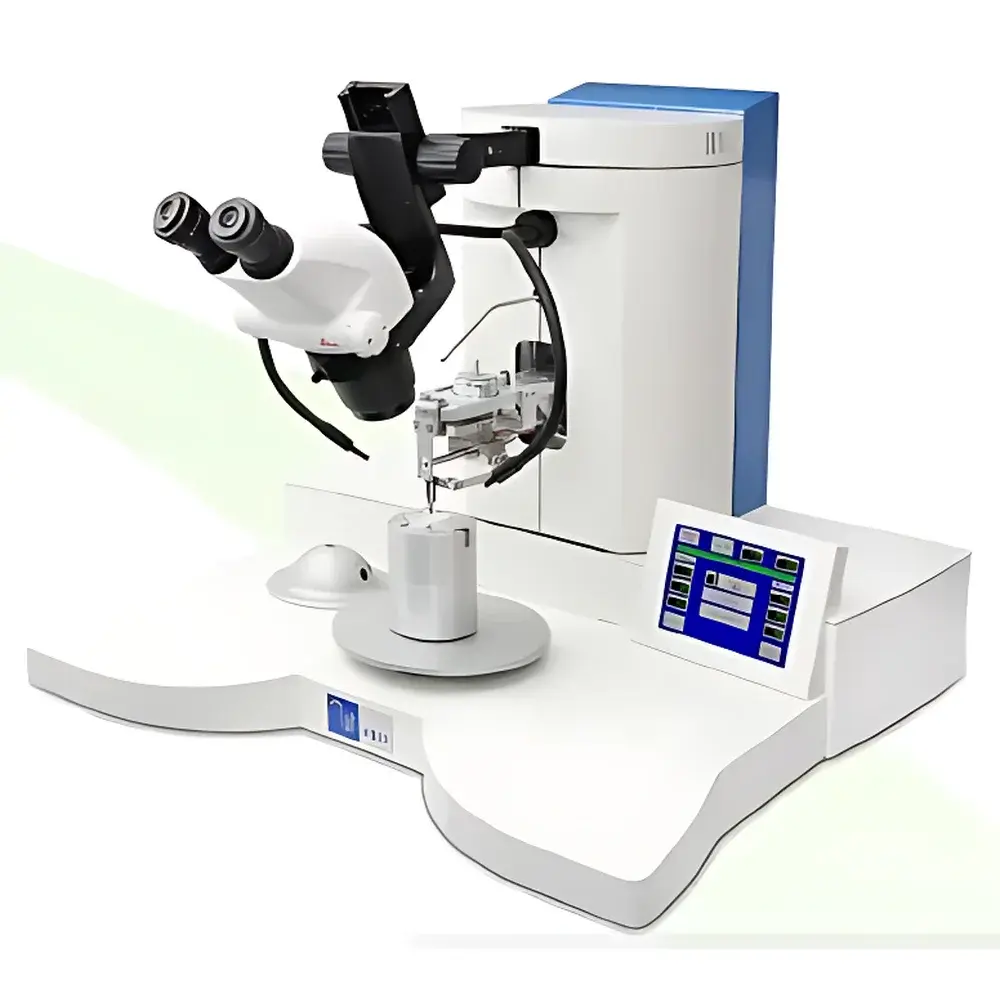
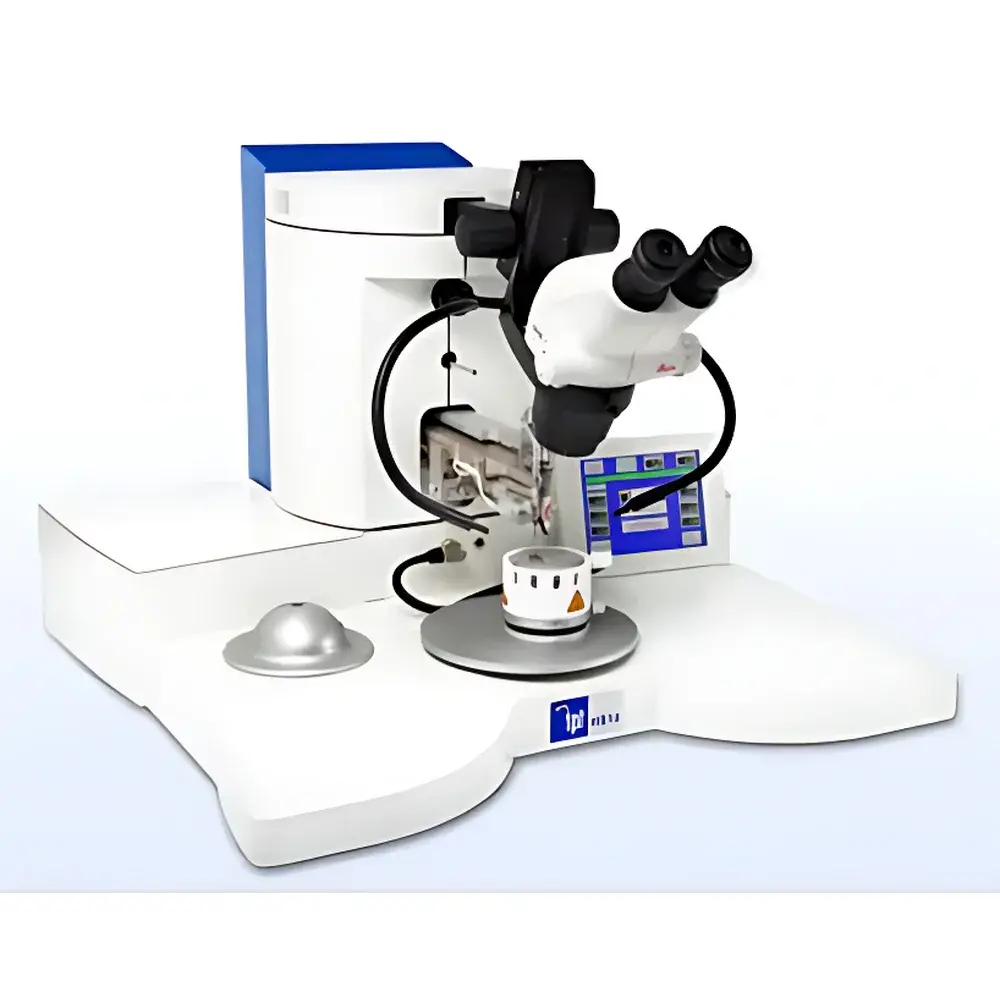
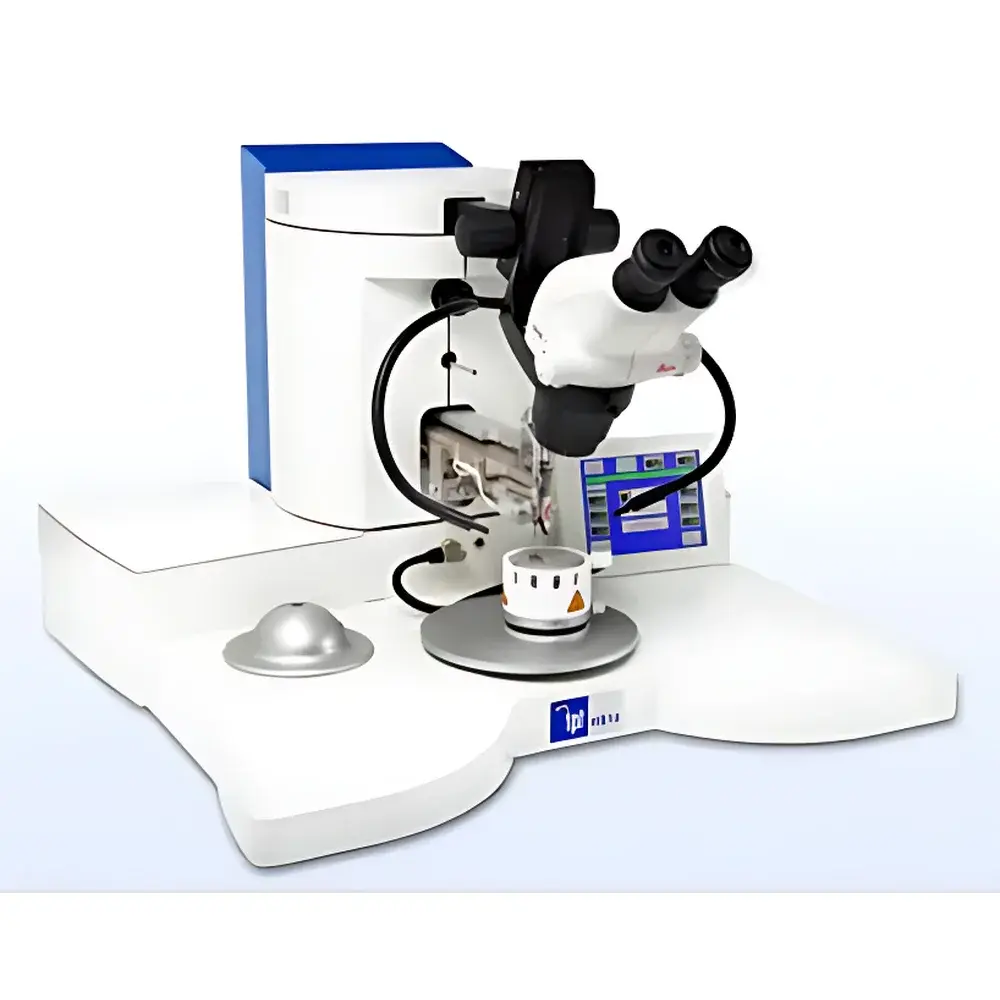
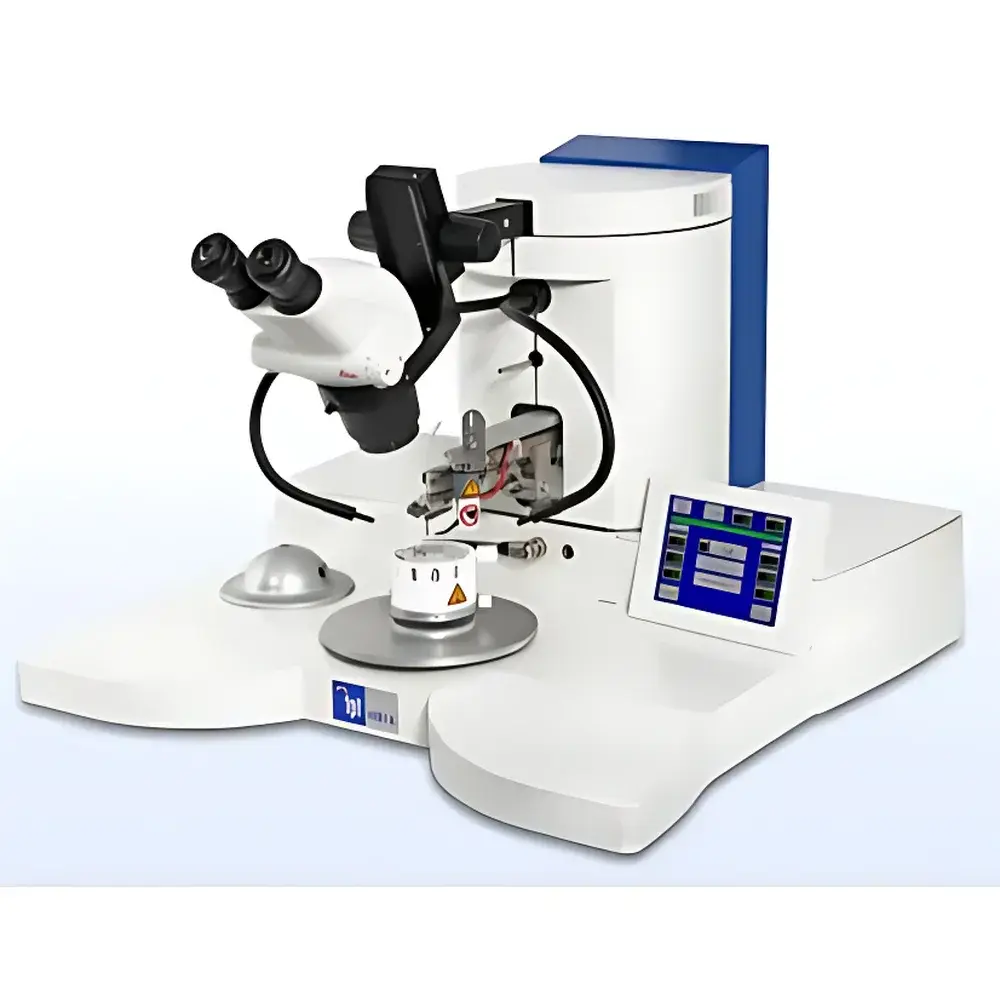
TPT HB30 Heavy Wire Bonding Machine
| Brand | TPT |
|---|---|
| Origin | Germany |
| Manufacturer Type | Authorized Distributor |
| Origin Category | Imported |
| Model | HB30 |
| Pricing | Upon Request |
| Ultrasonic Power | 50 W |
| Bond Time Range | 0–10 s |
| Bond Force Range | 50–1500 cN |
| Wire Diameter Compatibility | 100–500 µm (Al) |
| Wire Cut Position | Front-cut |
| Wire Feed Angle | 90° |
| Motorized Y-Axis Travel | up to 17 mm (for loop height control) |
| Motorized Z-Axis Travel | 20 mm |
| Manual X-Y Stage Travel | 15 mm |
| Mechanical Reduction Ratio | 6:1 (3:1 optional) |
| Input Voltage | 100–240 V ±10%, 50/60 Hz, max. 10 A |
| Dimensions (W×D×H) | 680 × 640 × 490 mm |
| Net Weight | 50 kg |
Overview
The TPT HB30 Heavy Wire Bonding Machine is a precision-engineered, benchtop ultrasonic wire bonder designed for reliable aluminum wire interconnection in semiconductor packaging, power device assembly, and high-current applications. It operates on the principle of ultrasonic wedge-wedge bonding—where high-frequency mechanical vibrations (typically 60 kHz) are coupled with controlled normal force and thermal energy to disrupt surface oxides and form solid-state metallurgical bonds between aluminum wire and substrate metallization (e.g., Al, Au, or Cu pads). Unlike thermosonic or thermocompression methods, the HB30 relies primarily on ultrasonic energy without requiring elevated substrate temperatures, making it suitable for temperature-sensitive substrates and low-thermal-budget processes. Its compact footprint and modular architecture support integration into R&D labs, pilot lines, and low-volume production environments where flexibility, repeatability, and process traceability are critical.
Key Features
- Motorized Z-axis bond head with 20 mm travel range for precise bond force application and vertical positioning control.
- Motorized Y-axis (17 mm travel) dedicated to dynamic loop height adjustment—enabling consistent arc geometry across varying die-to-substrate height differentials.
- High-resolution 6.5-inch capacitive touchscreen interface with intuitive graphical workflow navigation and real-time parameter feedback.
- Onboard storage for up to 100 user-defined bonding programs, each supporting independent settings for ultrasonic power, bond time, force profile, and loop trajectory.
- Dual-fiber LED illumination system providing shadow-free, uniform coaxial lighting for enhanced optical alignment and bond inspection.
- Programmable wire arc editing capability—including start/end point definition, apex height, and curvature interpolation—ensuring compatibility with complex package layouts and multi-tier interconnect schemes.
- Three operational modes: semi-automatic (step-by-step execution), fully automatic (batch sequence), and manual (direct joystick control) for maximum process adaptability.
- Integrated front-cut wire severing mechanism with fixed 90° feed angle—optimized for stable wire delivery and minimal kinking during heavy-gauge aluminum wire handling (100–500 µm).
Sample Compatibility & Compliance
The HB30 is validated for bonding 100–500 µm diameter aluminum wire onto standard semiconductor substrates including leadframes, DBC (Direct Bonded Copper) ceramics, and insulated metal substrates (IMS). It supports both single-point and stitch bonding configurations, as well as seam welding for extended metallurgical interfaces. The system meets CE marking requirements per Directive 2006/42/EC (Machinery Directive) and 2014/30/EU (EMC Directive). While not certified to ISO 9001 or IATF 16949 out-of-the-box, its programmable parameters, audit-ready event logging, and repeatable mechanical architecture facilitate compliance with internal quality management systems aligned with ISO/IEC 17025 and automotive AEC-Q200 qualification workflows. Optional documentation packages support GLP/GMP-aligned validation protocols for regulated environments.
Software & Data Management
The HB30 runs on proprietary firmware with embedded parameter logging and timestamped event tracking—including bond start/end timestamps, ultrasonic energy delivery, applied force, and error codes. All programs and logs are exportable via USB 2.0 port in CSV format for offline analysis in MATLAB, Python, or statistical process control (SPC) platforms. No cloud connectivity or remote access functionality is included by default; data residency remains fully local unless integrated into customer-specific MES or factory automation systems via RS-232 or Ethernet (optional add-on). Audit trail integrity is maintained through immutable log entries and password-protected administrator access levels—supporting foundational requirements for FDA 21 CFR Part 11 adherence when deployed in regulated development contexts.
Applications
- Power module interconnection (IGBTs, SiC MOSFETs, GaN HEMTs) requiring high-current carrying capacity and thermal cycling robustness.
- R&D prototyping of advanced packaging architectures—including chip-on-board (COB), hybrid power modules, and high-voltage discrete assemblies.
- Qualification testing of new wire alloys, pad metallizations, or underfill materials under controlled ultrasonic energy regimes.
- Low-volume manufacturing of medical-grade power electronics, aerospace avionics, and industrial motor drives where lot traceability and process stability are mandated.
- Educational use in microelectronics packaging courses, providing hands-on exposure to wire bonding physics, parameter optimization, and failure mode analysis (e.g., lift-off, cratering, poor adhesion).
FAQ
What wire diameters does the HB30 support?
The HB30 is calibrated and mechanically optimized for aluminum wire ranging from 100 µm to 500 µm in diameter. Use outside this range may compromise bond consistency or require hardware modifications.
Is thermal assistance available on this model?
No—the HB30 is a pure ultrasonic wedge-wedge bonder and does not incorporate heated stages or thermosonic transducers. Substrate heating must be externally managed if required.
Can the machine be integrated into an automated production line?
Yes—via optional I/O expansion modules supporting digital handshaking (e.g., Start/Complete signals), RS-232 serial command sets, and Ethernet-based remote control (subject to firmware version and licensing).
What maintenance intervals are recommended?
Daily visual inspection of wedge tips and wire guides; bi-weekly torque verification of Z/Y-axis drive couplings; quarterly calibration of force sensor and ultrasonic transducer output using traceable reference standards.
Does the system support gold or copper wire bonding?
Not natively—the HB30’s ultrasonic stack, tooling geometry, and process algorithms are tuned for aluminum wire. Bonding other metals requires full requalification and is not covered under warranty or technical support.