
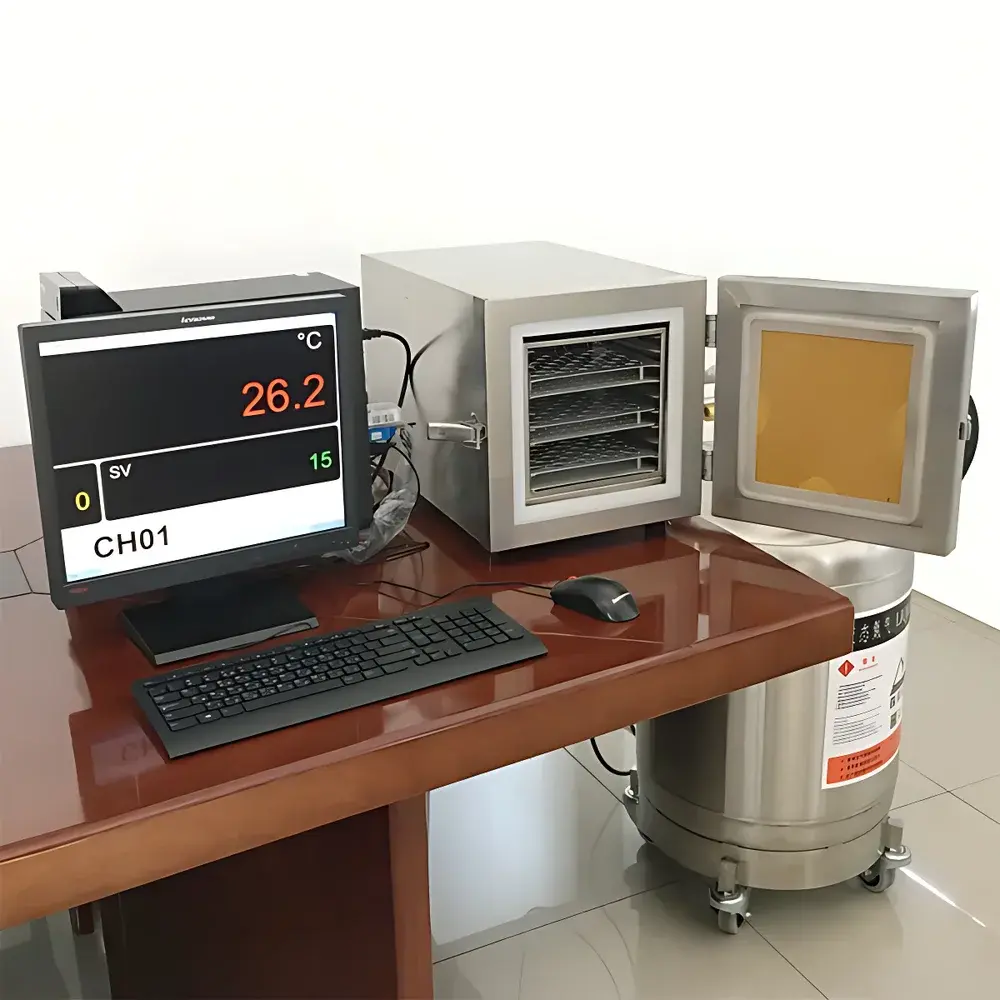
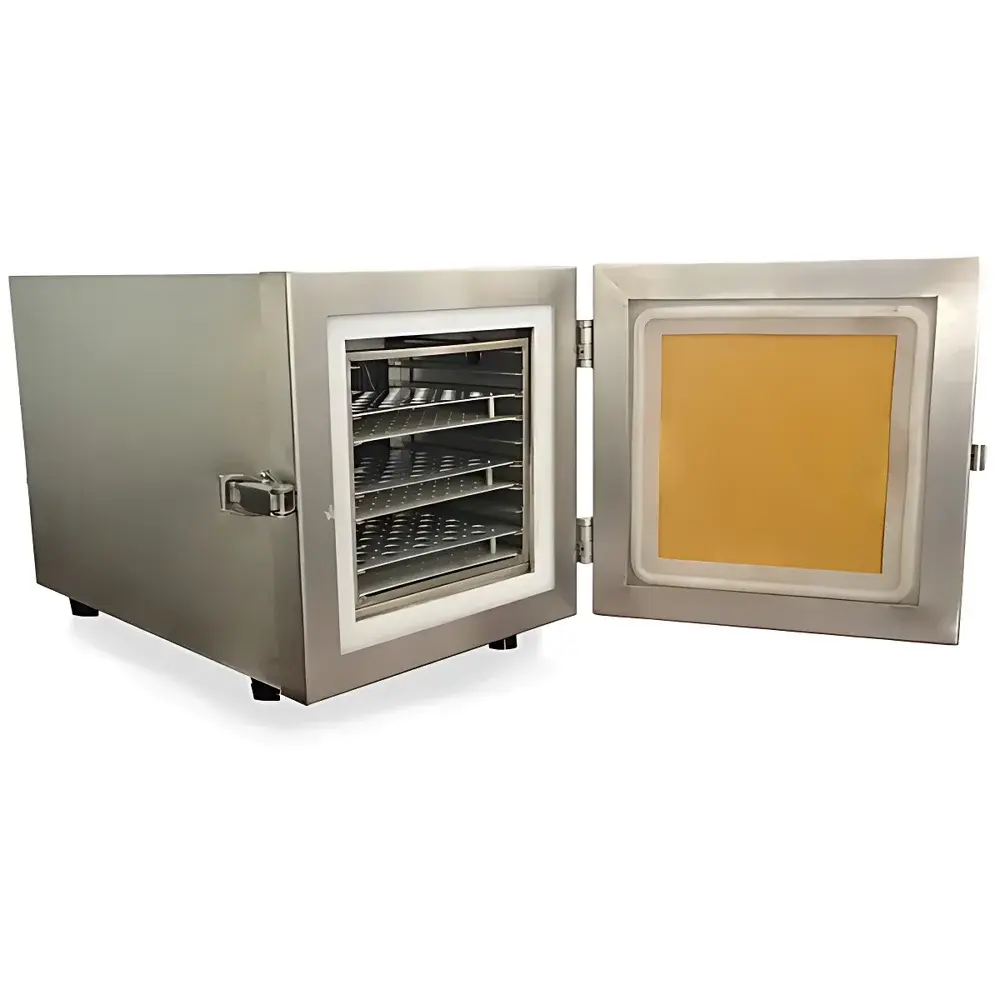
Fielding TF-PA-I Controlled-Rate Freezer for Cryopreservation
| Temperature Range | 40°C to –90°C |
|---|---|
| Temperature Accuracy | ±0.5°C |
| Cooling Rate | 0.1–30°C/min (adjustable) |
| Heating Rate | 0.1–30°C/min (adjustable) |
| Chamber Dimensions | ≥200 × 200 × 200 mm |
| Sample Capacity | 160 cryovials or 8 blood bags |
| Construction | Fully stainless steel interior and exterior |
| Integrated Liquid Nitrogen Dewar | 30 L with auto-pressure regulation system |
Overview
The Fielding TF-PA-I Controlled-Rate Freezer is an engineered solution for reproducible, protocol-driven cryopreservation of sensitive biological specimens—including primary cells, stem cells, hybridomas, peripheral blood mononuclear cells (PBMCs), and tissue-derived samples. It operates on the principle of precisely regulated conductive heat transfer using vapor-phase liquid nitrogen as the cooling medium, eliminating direct immersion while maintaining thermal uniformity and minimizing ice nucleation variability. Unlike passive freezing methods (e.g., “Mr. Frosty” isopropanol containers), this instrument delivers programmable linear or multi-segmented cooling profiles with closed-loop feedback control, ensuring compliance with established cryobiological standards such as ISO 20387:2018 (Biobanking) and best practices outlined in the American Association of Blood Banks (AABB) and European Society for Blood and Marrow Transplantation (EBMT) guidelines.
Key Features
- Microprocessor-based control architecture with embedded cryo-control card and real-time PID temperature regulation
- Vapor-phase cooling system utilizing a 30 L liquid nitrogen dewar equipped with integrated auto-pressurization and pressure-stabilizing valve—ensuring consistent nitrogen vapor flow without manual pressure adjustment
- Stainless steel chamber (≥200 × 200 × 200 mm) designed for corrosion resistance, ease of decontamination, and long-term thermal stability
- Programmable cooling/heating rates from 0.1°C/min to 30°C/min in 0.1°C/min increments, supporting both linear and multi-step ramp-hold protocols
- Three-channel independent temperature monitoring with real-time display of chamber setpoint, actual chamber temperature, and optional sample probe temperature
- Onboard data logging: all thermal events, rate changes, alarms, and user actions are timestamped and stored in non-volatile memory
Sample Compatibility & Compliance
The TF-PA-I accommodates standard cryogenic formats including 0.5 mL, 1.0 mL, and 2.0 mL externally threaded cryovials (Nunc, Corning, Thermo Fisher), as well as whole-blood and platelet storage bags (up to 8 units). Its chamber geometry supports uniform thermal exposure across full rack loads, validated per ASTM F2652–22 (Standard Practice for Characterization of Controlled-Rate Freezers). The system meets essential requirements for GLP-compliant biobanking operations and aligns with critical elements of FDA 21 CFR Part 11 when paired with audit-trail-enabled software configurations (available via optional upgrade). All materials contacting the chamber interior conform to USP Class VI biocompatibility standards.
Software & Data Management
The proprietary Windows-based control software provides full lifecycle management of cryopreservation protocols. Users define multi-segment programs—including ramp rates, hold durations, final soak temperatures, and termination conditions—with intuitive drag-and-drop logic. Real-time graphical visualization includes dual-axis plotting (time vs. temperature; time vs. rate), with zoom, overlay, and coordinate transformation functions for comparative analysis. Each freeze cycle generates a self-contained data file (.crf) containing raw sensor readings, control outputs, operator ID, and system event logs. Files support bidirectional search by date, protocol name, or sample ID, and export to CSV or PDF for integration into LIMS or electronic lab notebooks (ELN). Software updates are delivered free-of-charge and maintain backward compatibility with legacy protocol libraries.
Applications
- Cryopreservation of hematopoietic stem/progenitor cells (HSPCs) prior to autologous or allogeneic transplantation
- Long-term banking of induced pluripotent stem cells (iPSCs) and embryonic stem cell (ESC) lines under GMP-aligned conditions
- Controlled freezing of primary human hepatocytes, pancreatic islets, and corneal tissues for functional assay consistency
- Process development and validation of freezing protocols for cell therapy manufacturing (e.g., CAR-T, TCR-T products)
- Quality control freezing of reference standards used in flow cytometry, viability assays, and genomic stability testing
- Academic research requiring high inter-experiment reproducibility in cold shock response studies or cryo-injury modeling
FAQ
What cooling medium does the TF-PA-I use, and is liquid nitrogen supplied with the instrument?
The system uses vapor-phase liquid nitrogen delivered from an externally connected 30 L dewar. Liquid nitrogen is not included; users must arrange local supply and handling per OSHA and institutional safety protocols.
Can the instrument operate without a computer connection?
Yes—the embedded microcontroller supports standalone operation using preloaded protocols. USB or RS-232 connectivity is required only for programming, data retrieval, or remote monitoring.
Is the temperature accuracy verified and traceable to national standards?
Temperature sensors are factory-calibrated against NIST-traceable references. Certificate of Calibration (CoC) is provided with each unit; annual recalibration services are available through Fielding’s authorized service centers.
Does the system support 21 CFR Part 11 compliance for regulated environments?
The base configuration supports audit trails and electronic signatures when deployed with the optional Part 11 Module, which enforces role-based access control, secure login, and immutable record archiving.
How is chamber temperature uniformity validated across the full load?
Uniformity mapping per ASTM F2652–22 is performed at three representative load conditions (empty, half-loaded, fully loaded) and documented in the Installation Qualification (IQ) report shipped with each unit.



