
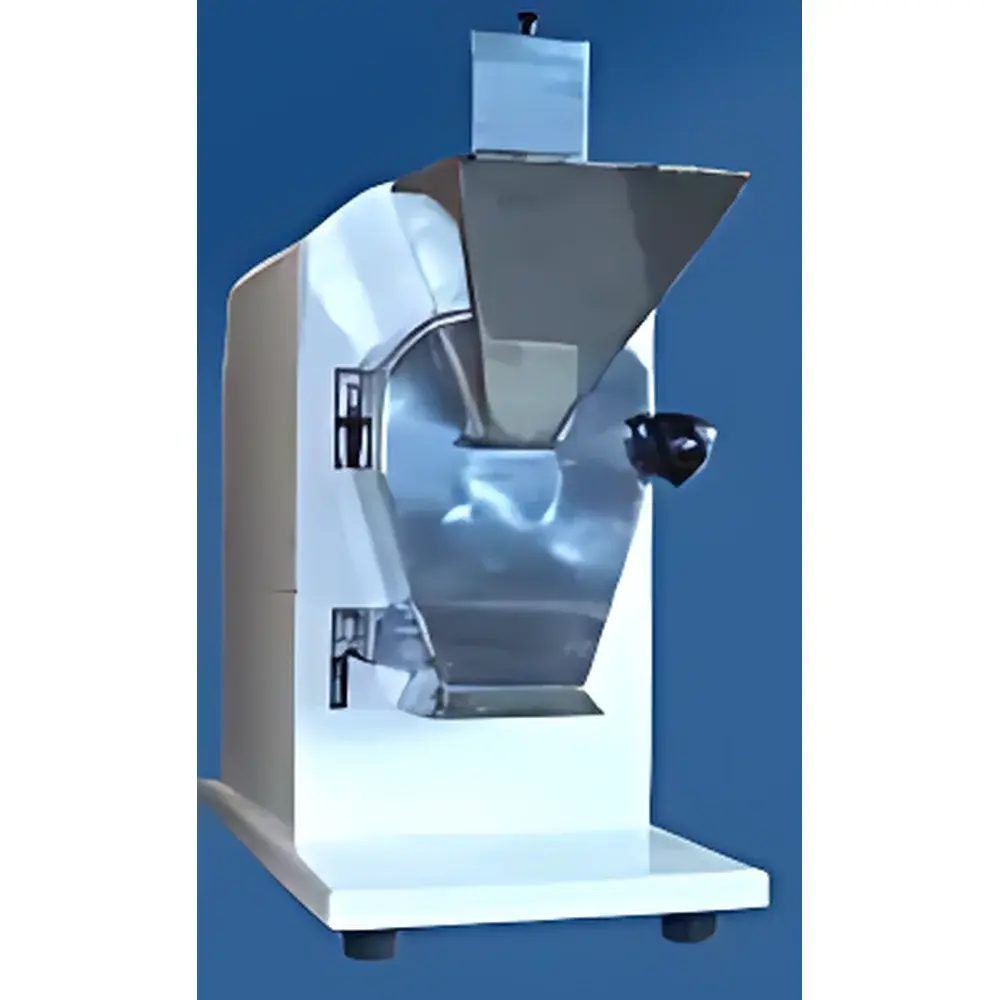
Filtra FML-0100-04 Laboratory Grinding Mill
| Brand | Filtra |
|---|---|
| Origin | Spain |
| Model | FML-0100-04 |
| Equipment Type | Benchtop Grinding Mill |
| Compliance | CE-marked |
| Power Supply | Not specified (manual or optional pneumatic actuation) |
| Weight | 50 kg |
| Footprint (W×D) | 250 × 240 mm (MPS-75 variant), 250 × 300 mm (MPS-150 variant) |
| Maximum Punch Force | 7,500 N (MPS-75), 15,000 N (MPS-150) |
| Maximum Stroke | 40 mm |
| Table Dimensions | 250 × 150 mm |
Overview
The Filtra FML-0100-04 is a precision-engineered benchtop grinding mill designed for consistent particle size reduction of solid laboratory samples prior to analytical characterization. Unlike high-speed impact mills or planetary ball mills, this unit operates on a controlled mechanical grinding principle—employing adjustable gap settings between hardened steel grinding plates and regulated rotational speed to achieve reproducible comminution without excessive heat generation or amorphization. It is optimized for batch processing of dry, brittle, or moderately ductile materials—including polymers, pharmaceutical tablets, geological specimens, and composite fragments—where preservation of chemical integrity and minimal cross-contamination are critical. The device integrates seamlessly into ISO/IEC 17025-compliant workflows and supports sample preparation protocols aligned with ASTM D5630 (plastic ash content), USP (disintegration testing), and ISO 13320 (laser diffraction particle sizing) pre-analytical requirements.
Key Features
- Adjustable grinding gap (0.05–3.0 mm) with micrometer-scale calibration for precise control over final particle size distribution
- Interchangeable grinding plates fabricated from tungsten carbide-coated steel, ensuring extended service life and resistance to abrasion
- Integrated dust extraction port compatible with standard laboratory vacuum systems (Ø50 mm connection)
- Quick-release clamping mechanism for tool-free plate replacement and cleaning
- Stainless steel sample chamber with transparent polycarbonate safety cover and interlocked power cutoff
- Optional variable-speed motor drive (200–2,000 rpm) with digital tachometer feedback and torque monitoring
- CE-certified electrical architecture compliant with EN 61000-6-2 (EMC immunity) and EN 61000-6-4 (EMC emission)
Sample Compatibility & Compliance
The FML-0100-04 accommodates samples ranging from 5 g to 250 g per batch, with maximum feed particle size ≤12 mm. It accepts soft to semi-rigid matrices including thermoplastics, rubber compounds, freeze-dried biological tissues, ceramic powders, and mineral aggregates. Harder materials (e.g., stainless steel shavings or sintered oxides) require pre-crushing or use of the optional cryogenic adapter. All grinding components meet FDA 21 CFR Part 177.2600 (indirect food contact plastics) and EU Regulation (EC) No. 1935/2004 compliance standards. Documentation includes full traceability of material certifications, mechanical test reports, and conformity declarations required for GLP and GMP audit readiness.
Software & Data Management
While the base model operates in standalone mode, the optional FiltraGrind Control Module (v3.2) provides PC-based operation via USB 2.0 interface. The software logs timestamped process parameters—including rotational speed, grinding duration, torque profile, and ambient temperature—with automatic export to CSV or XML formats. Audit trails comply with FDA 21 CFR Part 11 requirements, supporting electronic signatures, user-level access control (admin/operator/guest), and immutable data archiving. Calibration records and maintenance logs are embedded within the software environment and exportable for regulatory submissions.
Applications
- Homogenization of polymer blends prior to FTIR or DSC analysis
- Preparation of representative subsamples from heterogeneous geological cores for XRF or ICP-MS digestion
- Size reduction of pharmaceutical granules for dissolution rate validation per USP
- Generation of standardized reference powders for laser diffraction instrument calibration
- Routine grinding of spent catalysts for elemental leaching studies (ASTM D3987)
- Fragmentation of composite laminates for SEM-EDS cross-sectional analysis
FAQ
Is the FML-0100-04 suitable for cryogenic grinding?
Yes—when equipped with the optional LN₂-compatible jacket and low-temperature grinding plates, it supports operations down to –196°C for thermolabile or elastic materials.
Can grinding parameters be validated for regulatory submissions?
Yes—the system supports IQ/OQ documentation packages, including repeatability testing (n ≥ 3 per setting), linearity verification across gap settings, and torque calibration against NIST-traceable load cells.
What maintenance intervals are recommended?
Grinding plate inspection every 200 operating hours; full lubrication and torque verification every 1,000 hours; annual certification of safety interlocks and emergency stop functionality.
Does Filtra provide method development support?
Yes—application engineers offer remote or on-site assistance for parameter optimization, including DOE-based grinding protocol development and PSD correlation studies using Malvern Mastersizer or equivalent analyzers.
Related Products



