
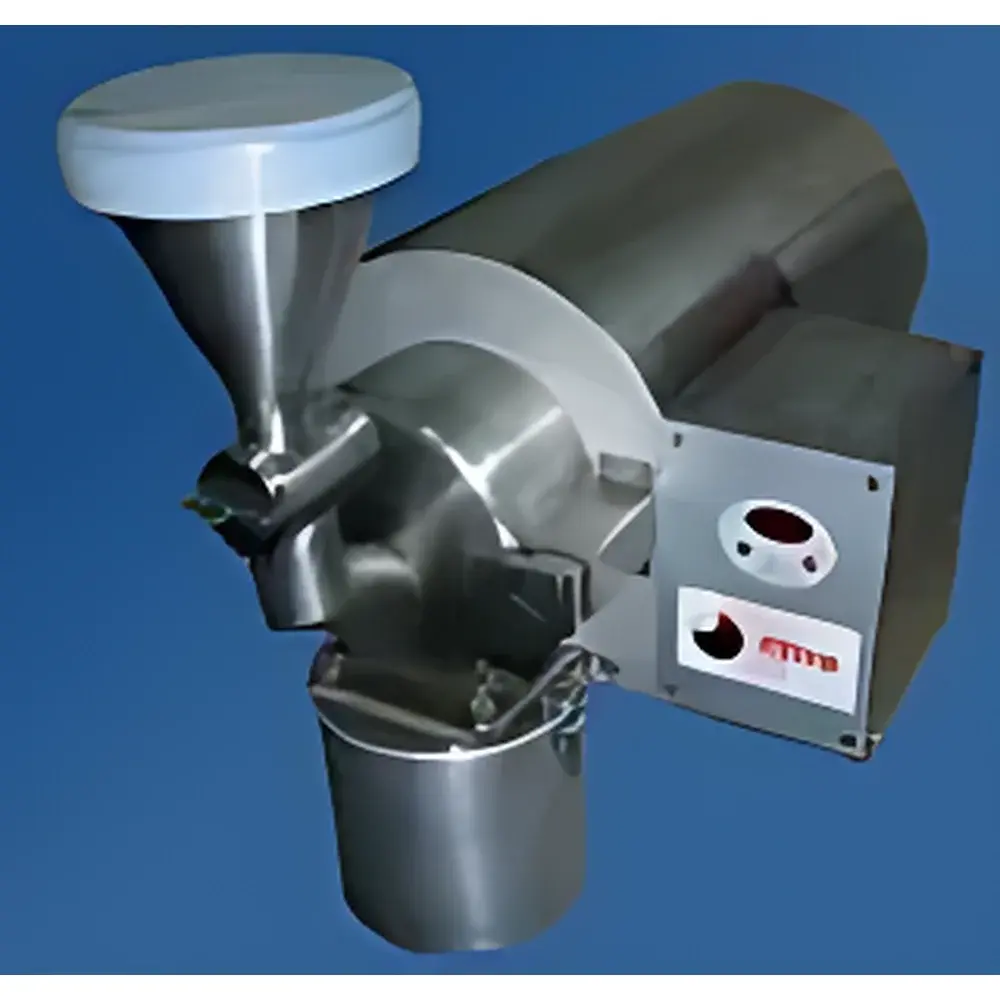
Filtra FML2000 Laboratory Hammer Mill
| Brand | Filtra |
|---|---|
| Origin | Spain |
| Model | FML2000 |
| Motor Power | 0.75 kW |
| Voltage/Frequency | 220–240 V, 50–60 Hz |
| Max Speed | 3000 rpm |
| Input Sample Size | ≤ 2 mm (recommended) |
| Output Particle Size Range | 0.01–0.5 mm |
| Sieve Options | Interchangeable round-hole stainless steel sieves (2, 3, 4, and 5 mm aperture) |
| Blade Material | AISI 304 stainless steel |
| Blade Quantity | 3 replaceable blades |
| Milling Chamber & Rotor | AISI 304 stainless steel |
| Dimensions (W×D×H) | 375 × 250 × 550 mm |
| Net Weight | 30 kg |
| Compliance | CE-marked, conforms to IEC 61000-6-2/6-4 EMC standards |
| Software Interface | None (standalone mechanical unit) |
Overview
The Filtra FML2000 Laboratory Hammer Mill is a precision-engineered benchtop size-reduction instrument designed for controlled, reproducible comminution of small-batch solid samples in research, quality control, and method development laboratories. Operating on the principle of high-speed impact attrition, the device employs a rotating rotor equipped with three hardened AISI 304 stainless steel hammers that strike feed material against a fixed perforated sieve surface. This mechanical energy transfer induces brittle fracture, shearing, and particle-on-particle collision—enabling efficient size reduction of hard, friable, or moderately fibrous materials without thermal degradation. Unlike cryogenic or ball-milling systems, the FML2000 delivers rapid throughput with minimal operator intervention and no solvent requirement, making it ideal for pre-analytical sample homogenization prior to elemental analysis (e.g., XRF, ICP-OES), moisture determination (ASTM D4442), or botanical extraction protocols.
Key Features
- Variable-speed motor drive via integrated frequency inverter (0–3000 rpm), enabling precise control over impact energy and final particle distribution.
- Three replaceable AISI 304 stainless steel hammers mounted on a dynamically balanced rotor shaft—designed for consistent wear resistance and minimal metal leaching.
- Interchangeable stainless steel sieve inserts (2 mm, 3 mm, 4 mm, and 5 mm round apertures) housed in a quick-release chamber; all components accessible without tools for cleaning or cross-contamination mitigation.
- Full AISI 304 construction of milling chamber, rotor housing, and feed hopper—ensuring corrosion resistance, compatibility with acidic or saline samples, and compliance with ISO 8573-1 for particulate cleanliness in analytical workflows.
- Benchtop footprint (375 × 250 × 550 mm) and 30 kg mass optimized for stability during operation; CE-certified electrical architecture compliant with IEC 61000-6-2 (immunity) and IEC 61000-6-4 (emission) standards.
Sample Compatibility & Compliance
The FML2000 accommodates dry, non-sticky, low-moisture (<12% w/w) solid matrices including pharmaceutical excipients, mineral ores, cereal grains, botanical seeds, polymer granules, ceramic powders, and soil aggregates. It is not suitable for viscous, oily, fibrous (e.g., cellulose-rich plant stems), or heat-sensitive compounds requiring <40 °C processing. All contact surfaces meet FDA 21 CFR Part 11 traceability prerequisites when used within validated SOPs, and the unit supports GLP-compliant documentation through manual logbook entries (batch ID, sieve code, speed setting, run duration). While the mill itself carries no intrinsic regulatory certification for GMP manufacturing, its design facilitates audit-ready cleaning validation per ASTM E3107-19 (Standard Guide for Cleaning Validation in Pharmaceutical Facilities).
Software & Data Management
The FML2000 is a standalone electromechanical instrument with no embedded microprocessor, touchscreen interface, or digital data output. Operational parameters—including rotational speed—are set manually via front-panel potentiometer and displayed on an analog tachometer. No firmware, cloud connectivity, or exportable logs are provided. For laboratories requiring electronic recordkeeping, external USB tachometers or time-lapse video logging (with timestamp overlay) may be deployed in conjunction with standard operating procedures to satisfy ALCOA+ data integrity principles.
Applications
- Preparation of homogeneous sub-samples for X-ray fluorescence (XRF) spectroscopy (ASTM C114, ISO 21068-2).
- Particle size conditioning of reference materials prior to laser diffraction analysis (ISO 13320).
- Routine grinding of agricultural seeds (e.g., soybean, wheat) for proximate analysis (AOAC 984.27, AOAC 991.42).
- Size reduction of geological core fragments for geochemical assay preparation (USGS Open-File Report 2006-1198).
- Homogenization of tablet formulations prior to dissolution testing (USP <711>).
FAQ
What types of materials are incompatible with the FML2000?
Materials exhibiting high elasticity (e.g., rubber, thermoplastic polymers above Tg), excessive moisture content (>15% w/w), or strong cohesive/adhesive properties (e.g., lactose monohydrate under humid conditions) may cause clogging or incomplete discharge.
Can the mill be used for sterile or aseptic applications?
No—this unit lacks HEPA filtration, autoclavable components, or ISO Class 5 enclosure options; it is intended for general laboratory use only.
Is calibration required before each use?
No routine calibration is specified by the manufacturer; however, users must verify rotor speed accuracy annually using a certified optical tachometer per ISO/IEC 17025 requirements if used in accredited testing environments.
How often should the hammers and sieve be replaced?
Replacement frequency depends on cumulative operating hours and sample abrasivity; typical service life exceeds 500 hours for silica sand and 1200+ hours for botanical seeds under recommended load conditions.
Does Filtra provide IQ/OQ documentation support?
Yes—upon request, Filtra’s EU-based technical support team supplies template Installation Qualification (IQ) and Operational Qualification (OQ) protocols aligned with Annex 15 of the EU GMP Guidelines, though execution remains the user’s responsibility.
Related Products



