
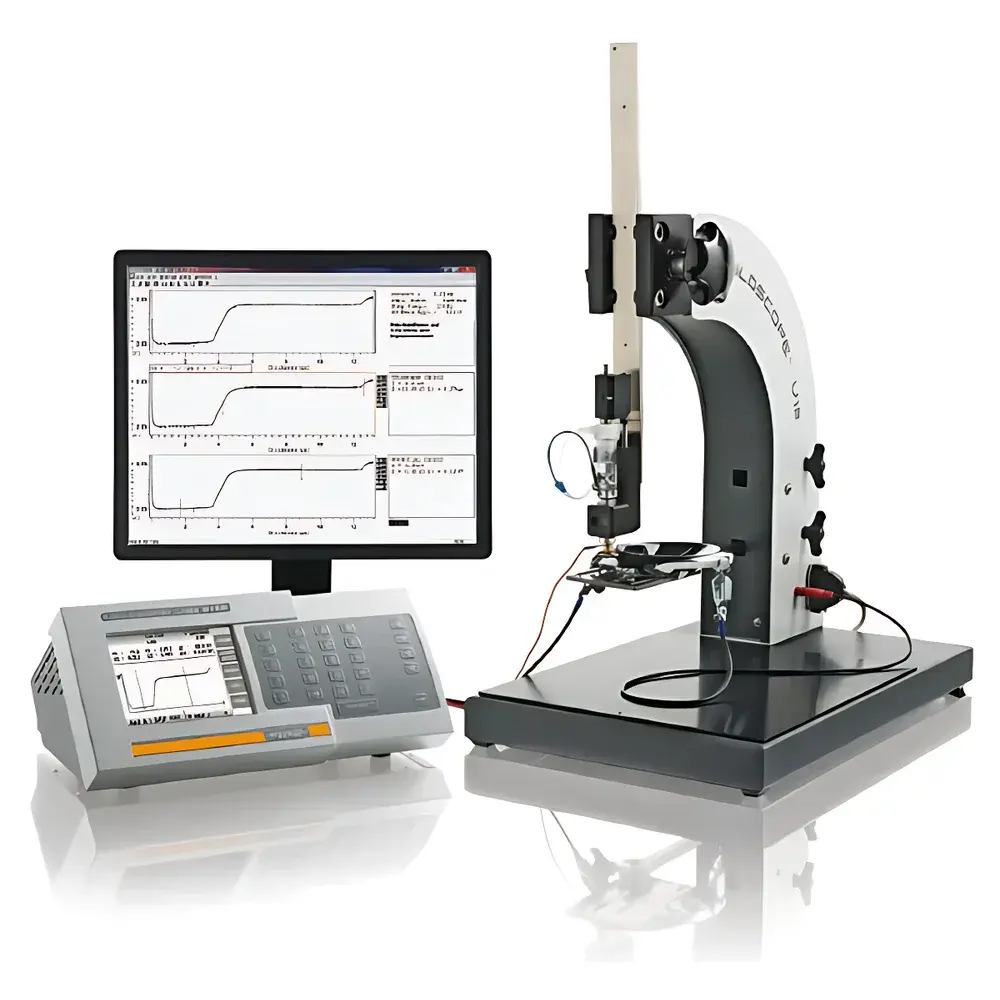
Fischer CMS2/STEP Coulometric Thickness Analyzer
| Brand | Fischer |
|---|---|
| Origin | Germany |
| Model | CMS2/STEP |
| Measurement Principle | Coulometric (Anodic Dissolution) per DIN EN ISO 2177 & ASTM B764-94 |
| Application Scope | Single/Multi-layer Metallic Coatings on Conductive or Non-conductive Substrates (e.g., Fe, Cu, ABS, PCB) |
| Thickness Range | 0.05–50 µm |
| Electrolytic Rate Selection | 0.1–10 µm/min |
| Measured Area | 0.6–3.2 mm² (via interchangeable O-rings) |
| STEP Function | Simultaneous Thickness & Potential Difference Measurement (Ni multilayer systems) |
| Display | High-resolution color LCD |
| Software Features | Graphical voltage curve display, statistical analysis, multi-language UI, configurable units |
| Compliance | DIN EN ISO 2177, ASTM B764-94, DIN 50022 |
| Accessories | V18 semi-automated stand with spherical support & rotating sample plate, 3-position electrolyte bottle holder (100 mL each) |
Overview
The Fischer CMS2/STEP is a precision coulometric thickness analyzer engineered for quantitative, destructive measurement of metallic coatings on conductive and non-conductive substrates. Operating on the principle of controlled anodic dissolution—essentially the reverse of electroplating—it complies strictly with DIN EN ISO 2177 for coulometric coating thickness determination and extends functionality to standardized STEP (Simultaneous Thickness and Electrochemical Potential) testing per ASTM B764-94 and DIN 50022. During measurement, a precisely regulated current drives electrolytic removal of the coating within a defined micro-electrolytic cell. The total charge passed (Q = I × t) is directly proportional to the mass—and therefore thickness—of the dissolved metal layer, provided constant current, known electrode area, and stoichiometric dissolution efficiency are maintained. This fundamental electrochemical relationship enables traceable, calibration-free thickness quantification without reliance on substrate composition, geometry, or prior knowledge of coating density—making it especially robust for complex geometries such as printed circuit board (PCB) pads, fasteners, or automotive trim components.
Key Features
- True dual-mode operation: Standard coulometric thickness measurement (CMS2 mode) and integrated STEP testing (CMS2/STEP mode) for simultaneous thickness and interlayer potential difference assessment in Ni-based multilayer systems.
- High-resolution color LCD interface with intuitive graphical menu navigation, real-time voltage curve visualization, and on-screen statistical summaries (mean, std. dev., min/max, n-value).
- V18 semi-automated positioning stand featuring spherical support and motorized rotating sample plate—enabling reproducible alignment and consistent electrolyte contact across curved or irregular surfaces.
- Modular electrolyte management: Dedicated 3-position rack accommodates up to three 100 mL reagent bottles; integrated peristaltic pump ensures uniform electrolyte flow and optimal mass transport at the dissolution interface.
- Pre-configured application library with ~100 validated methods—including Zn/Fe, Ni/Cu, Sn/Cu, Cr/Ni/Cu/ABS, and Ni/Ni/Cu/Fe—each optimized for electrolyte composition, current density, and dissolution rate (0.1–10 µm/min).
- Flexible measurement area selection via precision-machined O-rings (0.6–3.2 mm²), enabling high spatial resolution for fine-pitch PCB features or localized quality verification on large components.
Sample Compatibility & Compliance
The CMS2/STEP supports a broad spectrum of substrate-coating combinations, including but not limited to: Zn on steel, Ni on copper, Sn on PCB copper traces, Cr/Ni/Cu on ABS plastic, and multi-nickel stacks (e.g., semi-bright/bright duplex or triple-layer Ni) on ferrous or non-ferrous bases. Its coulometric method is insensitive to substrate conductivity—non-conductive substrates (e.g., plastics) require only a conductive undercoat or edge-contact plating for valid measurement. All procedures adhere to internationally recognized standards: thickness determinations conform to DIN EN ISO 2177 (Coulometric method for metallic coatings), while STEP testing satisfies ASTM B764-94 (Standard Test Method for Local Electrochemical Characterization of Multilayer Nickel Deposits) and DIN 50022 (STEP test for nickel plating). Instrument firmware and data handling support audit-ready operation in regulated environments, with timestamped measurement logs and user-accessible calibration history—facilitating GLP/GMP-aligned documentation where required.
Software & Data Management
The embedded operating system delivers full local data autonomy: all measurements—including raw current/time profiles, derived thickness values, voltage curves, and statistical aggregates—are stored internally with date/time stamps and operator ID fields. Export is supported via USB to CSV or PDF report formats compatible with LIMS integration. No cloud dependency or proprietary software installation is required for basic operation; advanced reporting (e.g., SPC charts, trend analysis across shifts or batches) can be performed using standard spreadsheet tools. Language localization includes English, German, French, Spanish, Chinese, and Japanese; unit systems support µm, mg/dm², and % composition modes depending on analytical objective. Firmware updates are delivered via encrypted USB stick, ensuring version control and traceability in production-critical settings.
Applications
Primary use cases span quality assurance and process validation in electroplating facilities, PCB manufacturing, automotive component suppliers, and contract coating services. Typical applications include: verification of solderable tin thickness on OSP- or ENIG-finished PCBs (critical for lead-free assembly reliability); thickness profiling of decorative chromium over multi-nickel layers on bathroom fixtures; quantification of zinc coating mass on fasteners per ISO 4042; and rapid in-line verification of functional nickel coatings on aerospace aluminum alloys. In high-reliability sectors—particularly automotive—STEP testing enables immediate post-plating evaluation of corrosion resistance in multilayer Ni systems, where potential difference between bright and semi-bright nickel layers correlates directly with sacrificial protection performance. The instrument’s rugged mechanical design, sealed electronics, and chemical-resistant fluid path make it suitable for shop-floor deployment near plating lines without environmental conditioning.
FAQ
What standards does the CMS2/STEP comply with for coulometric thickness measurement?
DIN EN ISO 2177 for general coulometric coating thickness determination.
Can the CMS2/STEP measure coatings on non-conductive substrates like plastics?
Yes—provided the substrate has a conductive base layer (e.g., electroless Ni or Cu) or accessible edge plating to complete the electrical circuit.
How many electrolyte types are supported out-of-the-box?
Over 90 pre-validated electrolyte formulations are embedded in the application library, covering common metal pairs including Zn, Ni, Cu, Sn, Cr, Au, Ag, and Pb.
Is STEP testing limited to nickel multilayers?
While optimized for Ni/Ni and Ni/Cu/Ni systems per ASTM B764-94, the potential difference measurement function can be adapted to other galvanically coupled multilayer structures with appropriate reference electrode selection and method development.
Does the instrument require annual recalibration by Fischer service engineers?
No—coulometric measurement is inherently absolute and traceable to fundamental electrical units (coulombs); routine verification using certified reference standards is sufficient for ISO/IEC 17025 compliance.



