
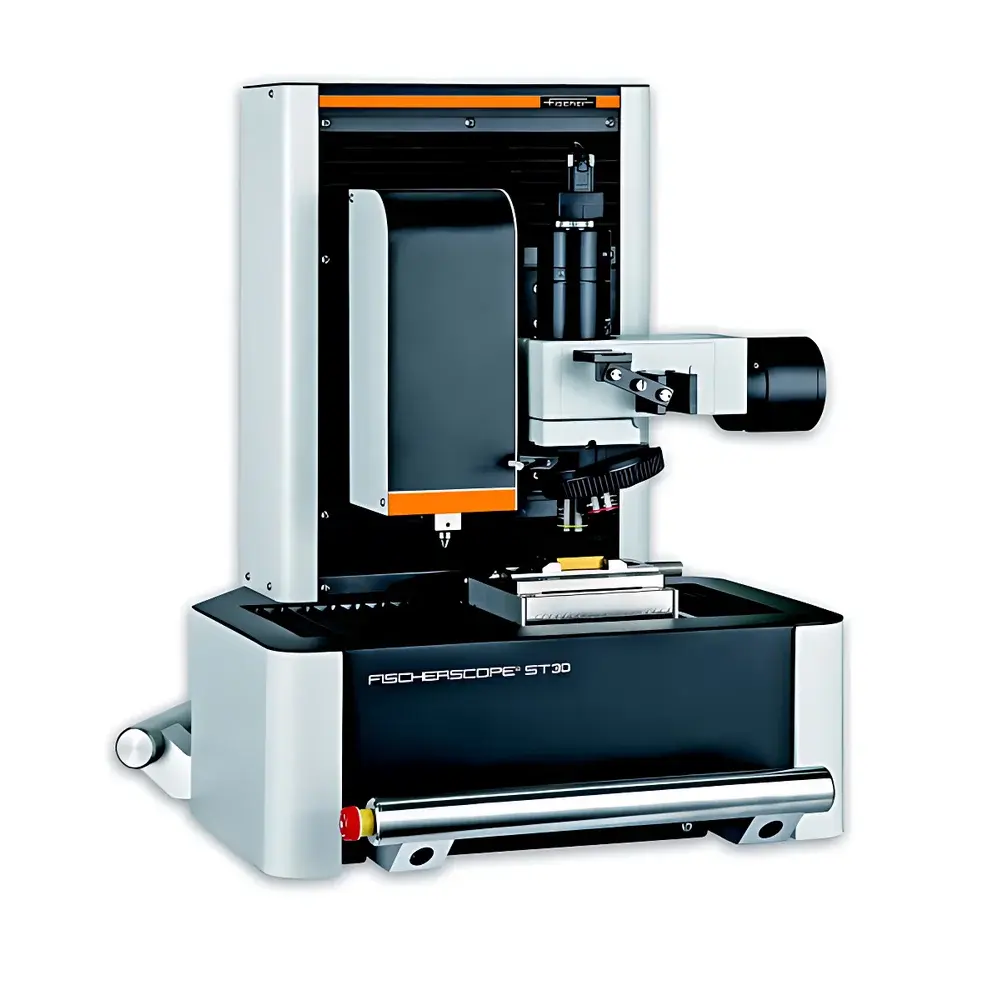
Fischer ST30 Micro-Scratch Tester
| Brand | Fischer |
|---|---|
| Origin | Germany |
| Model | ST30 |
| Instrument Type | Micro/Nano Scratch Tester |
| Maximum Indentation Depth | 1000 µm |
| Effective Load Range | 0.01–30 N |
| Load Resolution | 0.7 µN |
| Displacement Range | 100 mm |
| Displacement Resolution | 0.01 nm |
| Maximum Friction Force | 50 N |
| Indenter Type | Rockwell Indenter |
Overview
The Fischer ST30 Micro-Scratch Tester is an automated, load-increasing scratch testing system engineered for quantitative evaluation of interfacial adhesion and cohesive integrity in thin films and functional coatings. Based on the fundamental principle of controlled mechanical loading under real-time monitoring, the ST30 applies a precisely calibrated normal force while dragging a Rockwell-type indenter across the sample surface at defined kinematic parameters. Simultaneously, it records critical response signals—including acoustic emission (AE), frictional force, vertical displacement (depth), and high-resolution optical imaging—to identify onset points of coating failure such as cracking, chipping, buckling, and interfacial delamination. Unlike conventional fixed-load scratch or cross-cut methods (e.g., ASTM D3359), which require iterative trials and subjective visual interpretation, the ST30 enables deterministic determination of multiple critical loads—Lc1 (first crack), Lc2 (cohesive failure), and Lc3 (adhesive failure)—within a single, reproducible test sequence. Its design adheres to international standards for tribomechanical characterization, including ISO 20502 (coating adhesion by scratch testing) and ASTM C1624 (critical load determination for hard coatings), ensuring data traceability and regulatory acceptability in R&D, quality assurance, and supplier qualification workflows.
Key Features
- High-fidelity load control with 0.01–30 N range and <0.02% nonlinearity across full scale, enabling sub-micron resolution in critical load identification
- Ultra-high displacement resolution of 0.01 nm, supported by differential interferometric depth sensing for accurate penetration profiling
- Integrated acoustic emission sensor with broadband frequency response (100 kHz–1 MHz) for real-time detection of micro-fracture events
- Motorized XYZ stage driven by brushless DC servomotors—offering 4× higher torsional stiffness than stepper-based systems, improved positional repeatability (<±50 nm), and programmable multi-scan trajectories over 100 mm travel range
- Optical module featuring high-magnification telecentric lens, polarized illumination, and interference contrast mode for unambiguous differentiation of failure mechanisms (e.g., radial vs. lateral cracking, ploughing vs. spalling)
- Robust mechanical architecture with 500% overload protection, minimizing downtime and calibration drift during high-force testing
- Energy-efficient enclosure design with minimal external cabling, reducing electromagnetic interference and ambient noise below 45 dB(A)
Sample Compatibility & Compliance
The ST30 accommodates substrates ranging from soft polymers and elastomers to hardened steels, sintered ceramics, semiconductor wafers, optical glasses, and mineral composites. Sample thickness is unrestricted within the Z-stage travel envelope; clamping fixtures support flat, curved, and irregular geometries up to Ø150 mm diameter. All measurement protocols comply with GLP-aligned audit trails, supporting FDA 21 CFR Part 11 requirements through secure user authentication, electronic signatures, and immutable test log archiving. Data export formats include CSV, XML, and HDF5 for integration into LIMS and statistical process control (SPC) platforms. The system meets CE marking requirements per Machinery Directive 2006/42/EC and EMC Directive 2014/30/EU.
Software & Data Management
Fischer’s proprietary WinTest software provides intuitive workflow navigation—from method setup and real-time signal overlay to post-test failure classification and report generation. Users define load ramp profiles (linear, logarithmic, stepwise), scan velocity (0.1–100 mm/min), and dwell times with sub-second timing resolution. Synchronized acquisition captures AE bursts, friction coefficient (µ = Ff/Fn), depth-vs.-distance curves, and time-stamped video frames at up to 120 fps. Advanced analysis tools include automatic Lc thresholding based on AE energy thresholds, friction derivative inflection detection, and depth deviation mapping. All raw and processed datasets are stored with metadata (operator ID, environmental conditions, calibration certificate IDs) in a relational database compliant with ISO/IEC 17025 documentation requirements.
Applications
- Hard coating development and validation for cutting tools (TiN, CrN, DLC) per ISO 23805
- Adhesion assessment of thermal barrier coatings (TBCs) on turbine blades under simulated thermal-mechanical cycling
- Biocompatible layer evaluation on orthopedic/dental implants (e.g., hydroxyapatite, TiO2, diamond-like carbon)
- Automotive component QC: piston ring DLC coatings, cylinder bore plasma electrolytic oxidation (PEO), and brake caliper decorative chrome
- Microelectronics: adhesion strength of Cu/Ta diffusion barriers on Si wafers and low-k dielectric stacks
- Optical thin films: stress-induced delamination in AR/HR multilayer stacks on fused silica or BK7 substrates
FAQ
What standards does the ST30 comply with for scratch testing?
The ST30 implements test methodologies aligned with ISO 20502, ASTM C1624, and VDI 3822, and supports custom protocol definition for internal or industry-specific specifications.
Can the ST30 perform combined nanoindentation and scratch tests?
While primarily optimized for micro-scratch analysis, the ST30 may be configured with optional indentation modules for sequential hardness/adhesion correlation studies—but it is not a hybrid nanoindenter.
Is operator training required before routine use?
Yes; Fischer provides a standardized 30-minute hands-on orientation covering safety protocols, sample mounting, method creation, and basic failure interpretation—sufficient for supervised independent operation.
How is calibration maintained over time?
The system includes automated self-check routines for load cell linearity and displacement encoder accuracy, with annual traceable calibration available via Fischer-certified service engineers using NIST-traceable reference standards.
Does the ST30 support automated batch testing for incoming inspection?
Yes—WinTest allows full scripting of multi-sample sequences, including auto-focusing, coordinate-based positioning, pass/fail logic based on Lc thresholds, and PDF report generation per sample.



