
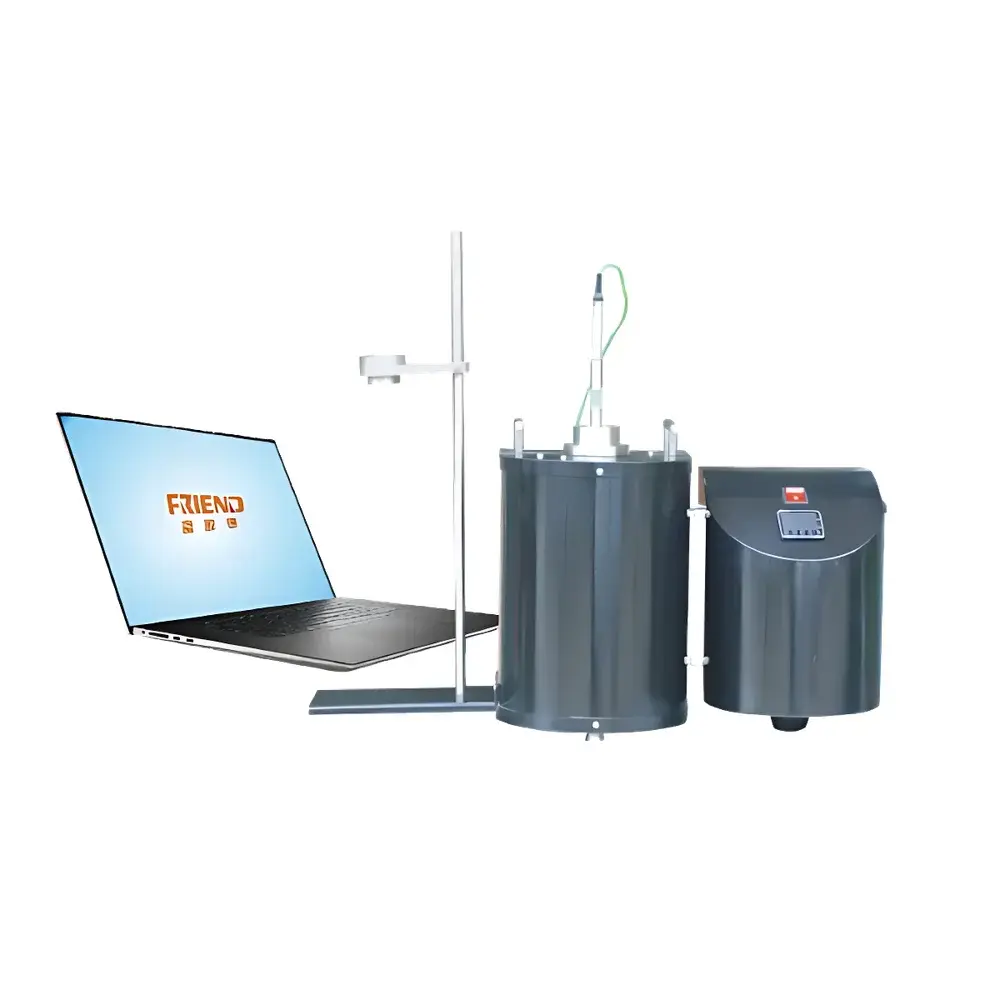
FlanD FDH-2801 Quench Media Cooling Characteristics Analyzer
| Brand | FlanD / csfriend |
|---|---|
| Origin | Hunan, China |
| Manufacturer Type | Authorized Distributor |
| Country of Origin | China |
| Model | FDH-2801 |
| Pricing | Upon Request |
| Standard Compliance | ISO 9950, JB/T 7951, SH/T 0220 |
| Temperature Range | 0–900 °C |
| Sampling Rate | 260 Hz |
| Probe Material | Inconel 600 (Ni–Cr–Fe alloy) |
| Probe Dimensions | Ø12.5 mm × 60 mm |
| Data Output | Dual-curve display (cooling curve + cooling rate curve), 5-group comparative analysis |
| Interface | USB, RS-232, LIMS-compatible |
| Control System | Integrated FlanD Automatic Control Module |
| Software Environment | Windows XP and later (32-bit) |
| Data Management | Folder-based archival with auto-timestamped files (date/time embedded in metadata) |
| Correction | User-configurable probe correction coefficient (based on peak cooling rate or full-curve fitting) |
| Reporting | A4/B5 formatted printouts including cooling parameters (e.g., time to 700 °C, 300 °C |
Overview
The FlanD FDH-2801 Quench Media Cooling Characteristics Analyzer is a precision thermal metrology instrument engineered for standardized evaluation of heat transfer behavior in industrial quenching media—including polymer solutions, mineral oils, aqueous salts, and molten salts—under controlled immersion conditions. It operates on the principle of inverse heat conduction analysis using a calibrated Inconel 600 spherical probe (Ø12.5 mm), whose transient temperature response during immersion into a heated medium is recorded at high temporal resolution (260 Hz). By solving the one-dimensional heat conduction equation with known boundary conditions, the system derives the local heat transfer coefficient (HTC) as a function of surface temperature, thereby generating both the cooling curve (T vs. t) and the derivative cooling rate curve (dT/dt vs. T). This dual-curve output enables quantitative assessment of critical quench severity parameters defined in ISO 9950, JB/T 7951, and SH/T 0220—such as vapor phase duration, maximum cooling rate, temperature at maximum rate, and characteristic transition temperatures (e.g., 700 °C and 300 °C). The FDH-2801 is designed for metallurgical laboratories, heat treatment process validation teams, and quench medium R&D facilities requiring traceable, repeatable, and standards-compliant thermal characterization.
Key Features
- Compliance-ready measurement architecture aligned with ISO 9950, JB/T 7951, and SH/T 0220—ensuring interoperability with global quality audits and regulatory submissions.
- Inconel 600 probe (Ø12.5 mm × 60 mm) with certified thermal mass and emissivity characteristics, minimizing convective distortion and enabling stable calibration across 0–900 °C.
- Probe correction coefficient module allowing empirical adjustment based on either peak cooling rate or full-curve least-squares fitting—mitigating inter-probe variability without recalibration.
- Real-time voice-guided operation with audible alerts for probe immersion initiation, thermal equilibrium detection, and data acquisition completion—reducing operator dependency and procedural error.
- Integrated FlanD automatic control system supporting single-button sequence execution: preheat → immersion → data capture → curve generation → report export.
- Dual-curve visualization engine enabling side-by-side overlay of up to five independent tests for comparative thermal performance analysis.
- Timestamp-embedded data archiving: each test file stores acquisition time, operator ID, ambient conditions (if logged externally), and user-defined 60-character medium descriptor—supporting GLP-compliant record retention.
Sample Compatibility & Compliance
The FDH-2801 accommodates all common quench media used in ferrous and non-ferrous metallurgy, including but not limited to: petroleum-based quench oils (ISO VG 10–150), polyalkylene glycol (PAG) and polyvinylpyrrolidone (PVP) aqueous solutions, sodium nitrate–potassium nitrate eutectics, and water–salt mixtures. Probe immersion depth and medium volume are maintained per ISO 9950 specifications (minimum 300 mL, probe center ≥50 mm from container walls). All generated reports include explicit references to applicable clauses of ISO 9950:1995 (Annex A), JB/T 7951–2014 (Section 5.3), and SH/T 0220–1992 (Clause 4.2), facilitating direct traceability during internal QA reviews or third-party certification audits. The system supports audit trail generation for data integrity verification under GLP and GMP frameworks.
Software & Data Management
The FDH-2801 runs on a dedicated Windows-based application (compatible with Windows XP SP3 through Windows 10 32-bit) featuring a fully localized Chinese GUI—designed for rapid operator training and minimal syntax barriers. Data is stored in structured binary files with embedded XML metadata headers, enabling programmatic access via COM interface for integration into enterprise LIMS environments (e.g., Thermo Fisher SampleManager, LabVantage). USB and RS-232 interfaces support legacy instrumentation linkage and offline data migration. Folder-based project organization allows hierarchical archiving by customer, batch, or medium type, with no proprietary database lock-in. Export options include CSV (for statistical analysis in JMP or Minitab), EMF vector graphics (for inclusion in technical reports), and printer-optimized PDF/A-1a compliant documents meeting ISO 19005–1 archival requirements.
Applications
- Qualification and requalification of quench media in aerospace component heat treatment (per AMS 2750E and NADCAP AC7102/7).
- Comparative evaluation of new polymer formulations against OEM-specified baseline oils.
- Root-cause analysis of distortion or cracking incidents linked to anomalous cooling kinetics.
- Development of quench severity maps for complex geometries using multi-point probe arrays (with optional accessory kit).
- Supporting ISO/IEC 17025 accreditation documentation for testing laboratories performing ASTM D6470 or equivalent methods.
- Process FMEA inputs—quantifying sensitivity of microstructure development to cooling rate deviations at critical temperature bands (e.g., 550–400 °C for bainite suppression).
FAQ
Does the FDH-2801 require annual recalibration by an accredited lab?
No—probe calibration is factory-performed using NIST-traceable blackbody furnaces and verified per ISO/IEC 17025 procedures. Users perform daily verification using the built-in reference check routine; full recalibration is recommended only after physical probe damage or every 24 months under continuous operation.
Can raw temperature-time data be exported for custom modeling?
Yes—each test generates a .dat file containing unprocessed thermocouple voltage readings (mV), converted temperature (°C), and elapsed time (ms) at 260 Hz resolution. Conversion coefficients are embedded in the header for reverse engineering.
Is the software compatible with Windows 11 or 64-bit systems?
The current release is optimized for 32-bit Windows platforms (XP–10). A native 64-bit version with updated drivers is scheduled for Q2 2025; interim compatibility is achievable via Windows Subsystem for Linux (WSL) virtualization with serial port passthrough.
How is probe-to-probe variation addressed beyond the correction coefficient?
Each probe ships with a unique serial-numbered calibration certificate listing its individual thermal diffusivity, density, and specific heat values—parameters ingested by the software during setup to refine the inverse heat conduction algorithm.
Does the system meet FDA 21 CFR Part 11 requirements for electronic records?
While the FDH-2801 supports audit trails and user authentication, full Part 11 compliance requires supplemental IT infrastructure (e.g., electronic signatures, secure network logging, and periodic validation protocols)—which must be implemented at the site level per organizational SOPs.




