
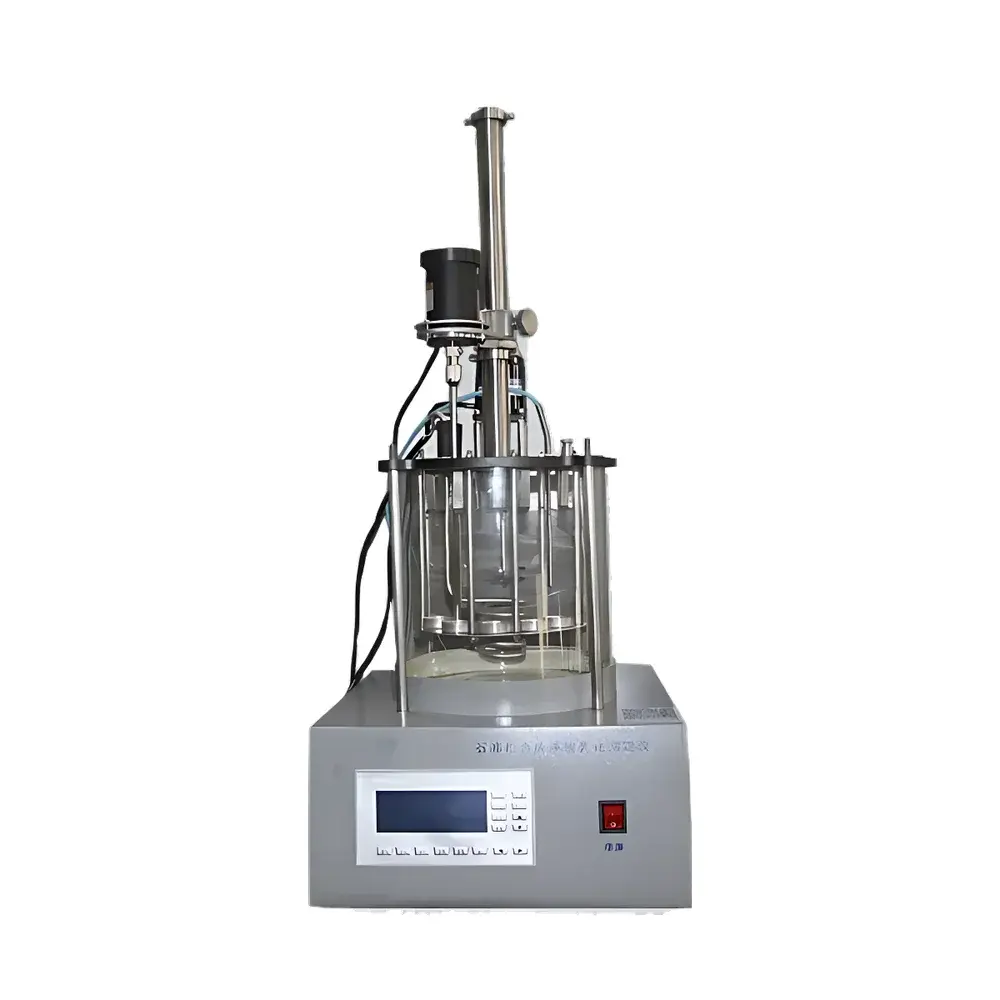
Fland FDT-0802 Petroleum Demulsibility Tester
| Brand | Fland |
|---|---|
| Origin | Hunan, China |
| Model | FDT-0802 |
| Power Supply | AC 220 V ±10%, 50 Hz |
| Temperature Control Range | Ambient to 99.9 °C |
| Temperature Accuracy | ±1 °C |
| Temperature Resolution | 0.1 °C |
| Temperature Display | Digital |
| Timing Range | 1 s to 9 min 59 s |
| Timing Setting | Rotary dial |
| Timing Display | Digital |
| Stirring Speed | 1500 ±15 rpm |
| Heating Power | 1000 W |
| Stirring Mechanism | Magnet-driven, infinitely variable speed |
| Bath Agitation | Magnetic stirrer with adjustable rotation |
| Sample Tube Configuration | Three vertically aligned cylindrical test ports on rotating cover plate |
| Positioning System | Dual-height locking rings on vertical column for repeatable blade positioning |
| Safety & Operation | Audible buzzer alarm at end of timing cycle |
| Compliance Context | Designed to support ASTM D1401, ISO 6614, and GB/T 7305 test protocols |
Overview
The Fland FDT-0802 Petroleum Demulsibility Tester is a purpose-built instrument engineered for the quantitative evaluation of demulsification performance in petroleum-based lubricants, turbine oils, hydraulic fluids, and synthetic industrial oils. It operates on the principle of controlled thermal agitation and phase separation kinetics—subjecting a precisely defined oil–water mixture (typically 40 mL oil + 40 mL distilled water) to standardized temperature and mechanical stirring conditions, followed by timed observation of emulsion layer breakdown. The device replicates real-world field conditions where water ingress compromises lubricant integrity, enabling laboratories to assess additive package efficacy, base oil stability, and formulation robustness against emulsion formation. Its design adheres to the procedural frameworks of ASTM D1401 (“Standard Test Method for Determining the Demulsibility Characteristics of Turbine Oils”), ISO 6614 (“Petroleum Products — Determination of Demulsibility”), and the Chinese national standard GB/T 7305, ensuring methodological consistency across global quality control and R&D environments.
Key Features
- Triple-test-tube configuration: Rotatable cover plate with three precisely spaced cylindrical sample ports enables parallel testing under identical thermal and agitation conditions—improving throughput and inter-sample comparability.
- High-stability temperature-controlled bath: Digital PID temperature controller maintains setpoint accuracy within ±1 °C across the full range (ambient to 99.9 °C), with 0.1 °C resolution and real-time digital display for traceable thermal validation.
- Magnetic drive stirring system: Integrated magnetic stirrer provides smooth, maintenance-free agitation with infinitely variable speed adjustment—eliminating mechanical seal wear and contamination risks associated with direct-drive shafts.
- Precision timing architecture: Rotary-dial time setter coupled with digital countdown display and audible end-of-cycle alarm ensures strict adherence to standardized test durations (1 s to 9 min 59 s), supporting GLP-compliant documentation workflows.
- Repeatable mechanical positioning: Dual-height locking rings mounted on a rigid vertical column allow precise, reproducible vertical alignment of the stirring blade—critical for consistent shear input across sequential runs without manual re-calibration.
- Robust thermal architecture: 1000 W heating element integrated into the stainless-steel bath reservoir delivers rapid thermal equilibration and stable soak performance, even under ambient fluctuations or multi-sample duty cycles.
Sample Compatibility & Compliance
The FDT-0802 accommodates standard 100 mL graduated glass test cylinders (ASTM D1401-compliant dimensions) and supports both mineral-based and synthetically formulated oils—including polyalphaolefins (PAOs), phosphate esters, and polyglycols—provided they fall within typical viscosity ranges (ISO VG 32 to VG 100). Water content is introduced as ASTM D1193 Type IV distilled water or equivalent. The instrument’s operational envelope satisfies the physical parameter requirements of ASTM D1401 (e.g., 54 °C or 82 °C test temperatures, 1500 rpm stirring speed, 5-minute agitation duration), while its digital controls facilitate audit-ready data capture for laboratories operating under ISO/IEC 17025, FDA 21 CFR Part 11 (when paired with compliant LIMS), or internal GMP/GLP quality systems.
Software & Data Management
While the FDT-0802 operates as a standalone benchtop instrument with analog/digital hybrid controls, its modular architecture supports integration into automated laboratory ecosystems. Time and temperature setpoints are manually entered via rotary dials and verified on independent digital displays—ensuring operator transparency and minimizing input error. For regulated environments, external data loggers (e.g., certified thermocouple arrays and programmable timers) may be deployed to record bath temperature profiles and agitation cycles, generating timestamped CSV or PDF reports compatible with electronic lab notebooks (ELNs) and audit trails. Optional firmware upgrades (available through authorized Fland service channels) can enable RS-232 or USB output for direct PC logging—supporting long-term trending analysis of demulsibility degradation in aging oil samples.
Applications
- Quality assurance of new turbine and hydraulic oils prior to commissioning or bulk delivery.
- Formulation development of demulsifier additives and compatibility screening with base stocks.
- Condition monitoring of in-service oils—tracking demulsibility loss as an early indicator of oxidation, hydrolysis, or additive depletion.
- Comparative benchmarking of alternative lubricants in power generation, marine propulsion, and steel mill applications where water contamination is prevalent.
- Educational use in university tribology and petrochemical engineering labs for hands-on instruction in interfacial phenomena and colloidal stability theory.
FAQ
What standards does the FDT-0802 comply with?
It is designed to execute test procedures specified in ASTM D1401, ISO 6614, and GB/T 7305—with hardware parameters (temperature accuracy, stirring speed, timing resolution) validated against those methods’ acceptance criteria.
Can the instrument test synthetic ester-based lubricants?
Yes—provided the fluid’s viscosity and density remain within the operational envelope of standard 100 mL test cylinders and do not compromise magnetic coupling efficiency at elevated temperatures.
Is calibration traceability available?
Temperature sensors and timers may be externally calibrated using NIST-traceable reference instruments; Fland provides calibration certificate templates and verification checklists upon request.
How is repeatability ensured between operators?
Mechanical positioning rings, fixed blade geometry, and standardized cylinder placement minimize operator-dependent variability—key for multi-shift or multi-user QC labs.
Does the unit include sample tubes or accessories?
Standard configuration includes the main tester, magnetic stir bar, three 100 mL graduated glass cylinders, and user manual; optional accessories include calibrated thermometer kits and water bath covers to reduce evaporation drift.




