
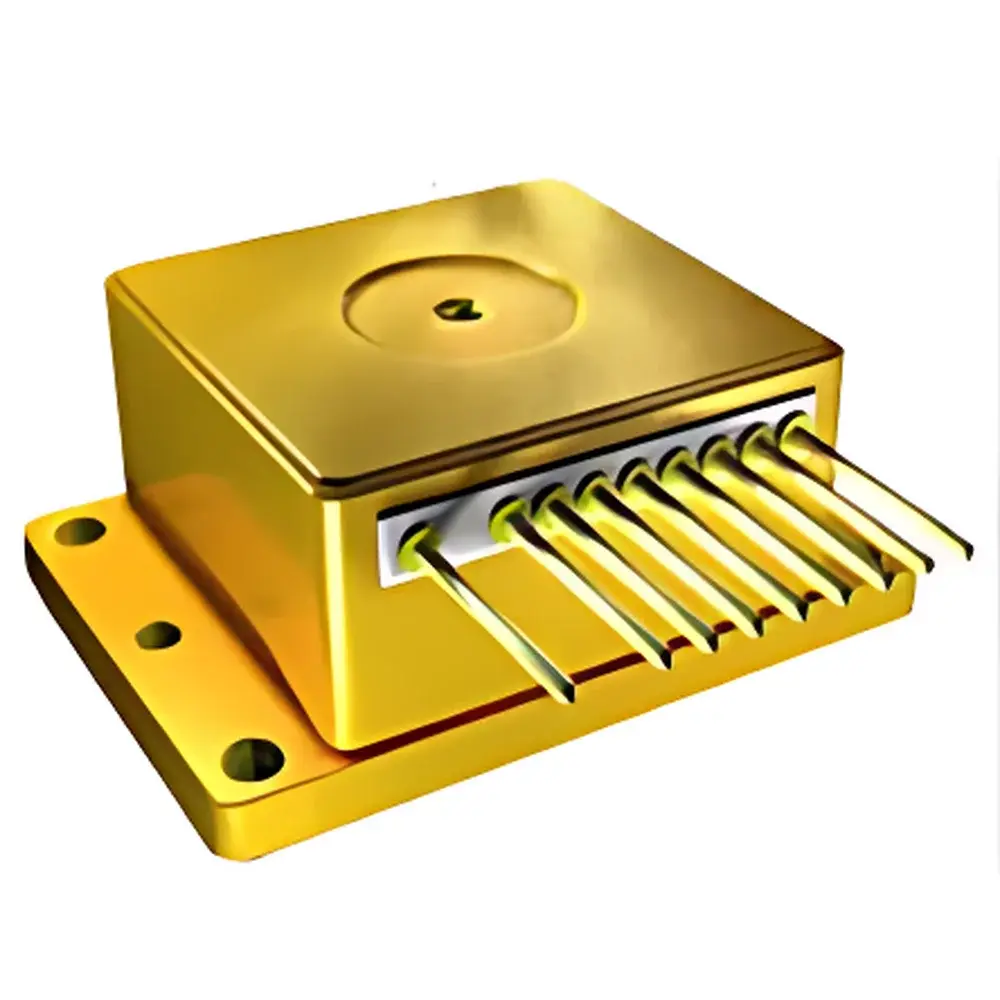
FLC FVLD Pulsed Laser Diode Module
| Brand | FLC |
|---|---|
| Origin | USA |
| Manufacturer Type | Authorized Distributor |
| Import Status | Imported |
| Model | FVLD |
| Core Technology | Solid-State Pulsed Laser Diode Source |
| Wavelength Options (nm) | 808, 850, 905, 1060, 1550 |
| Peak Output Power Range | 2–375 W |
| Application Domains | Solid-State Laser Pumping, IR Illumination, Medical Systems, Copier/Imaging Engines, Industrial & Military Sensors, LIDAR, Weapon Simulation |
Overview
The FLC FVLD Pulsed Laser Diode Module is a high-reliability, solid-state optical source engineered for precise temporal and spectral control in demanding pulsed laser applications. Operating on the principle of current-driven semiconductor gain switching, the FVLD delivers nanosecond-scale optical pulses with low jitter, high peak power, and excellent pulse-to-pulse stability. Unlike continuous-wave (CW) diodes, its pulsed architecture enables efficient energy deposition without thermal saturation—critical for applications requiring high peak irradiance at controlled duty cycles. Designed for integration into OEM systems, the module features hermetically sealed TO-can or butterfly packaging with integrated thermoelectric cooling (TEC) and monitor photodiode feedback. Its wavelength options span key atmospheric transmission windows and material absorption bands—808 nm and 905 nm for Nd:YAG/Yb-doped fiber pumping and short-range LIDAR; 1060 nm for eye-safe industrial sensing; and 1550 nm for long-range, eye-safe LIDAR and free-space optical communication where MPE (Maximum Permissible Exposure) limits are significantly relaxed per ANSI Z136.1 and IEC 60825-1.
Key Features
- Multiple standardized wavelength options: 808 nm, 850 nm, 905 nm, 1060 nm, and 1550 nm—each optimized for specific gain media absorption or atmospheric transmission characteristics
- Adjustable peak output power from 2 W to 375 W, scalable via drive current and pulse width tuning (typical pulse widths: 10 ns–200 ns)
- Integrated thermistor and TEC for active temperature stabilization (±0.1 °C), ensuring wavelength drift < ±0.3 nm over operating ambient range (−10 °C to +60 °C)
- Monitor photodiode with calibrated responsivity for real-time pulse energy feedback and closed-loop system integration
- Ruggedized mechanical design compliant with MIL-STD-810G for shock, vibration, and thermal cycling durability
- RoHS-compliant construction with industry-standard electrical interfaces (SMA or LEMO for trigger/sync; 2-pin or 4-pin for power/TEC control)
Sample Compatibility & Compliance
The FVLD module is compatible with standard optical bench mounting, fiber-coupled integration (via optional collimation or coupling optics), and direct free-space beam delivery. It supports synchronization with external TTL or LVDS triggers (500 mW average power variants). Full compliance documentation—including test reports per IEC 60825-1:2014 Ed.3 and EN 60825-1:2014—is provided for end-system certification. For medical device integration (e.g., dermatology or surgical guidance systems), the module meets essential requirements under ISO 13485–certified supply chain controls and supports traceability per UDI standards.
Software & Data Management
While the FVLD is a hardware module—not a standalone instrument—it is fully supported by FLC’s open-architecture driver SDK (Windows/Linux/macOS), enabling programmable control of pulse width, delay, PRF, and TEC setpoint via USB, RS-232, or analog voltage input. The SDK includes LabVIEW VIs, Python bindings (PySerial/NumPy compatible), and C/C++ libraries with detailed API documentation. All operational parameters are logged with timestamp resolution ≤1 µs when used with FLC’s optional data acquisition add-on board, supporting audit-trail generation required under GLP and GMP environments. Firmware updates preserve calibration coefficients and maintain traceability to NIST-traceable reference standards used during factory characterization.
Applications
- Solid-State Laser Pumping: High-efficiency optical pumping of Nd:YAG, Yb:fiber, and Er:glass gain media with minimized thermal lensing
- LIDAR Systems: Time-of-flight (ToF) and flash LIDAR transmitters for autonomous vehicles, UAV navigation, and terrain mapping
- IR Illumination: Covert active illumination for SWIR imaging cameras in defense surveillance and low-light machine vision
- Medical Systems: Pulse-controlled tissue ablation, photodynamic therapy (PDT) light sources, and optical coherence tomography (OCT) swept-source seeding
- Industrial Sensing: Distance measurement, triangulation-based displacement sensors, and laser-induced breakdown spectroscopy (LIBS) excitation
- Weapon Simulation: Realistic infrared signature generation for hardware-in-the-loop (HWIL) testing of missile warning systems and countermeasure evaluation
FAQ
What is the typical lifetime rating for the FVLD module under rated operating conditions?
Rated mean time to failure (MTTF) exceeds 20,000 hours at 25 °C case temperature and 50% duty cycle, per Telcordia GR-468-CORE reliability testing.
Can the FVLD be fiber-coupled, and what connector types are supported?
Yes—standard configurations support FC/PC, FC/APC, or SMA905 fiber pigtails with core diameters from 105 µm to 600 µm; custom NA and numerical aperture matching available upon request.
Is electrostatic discharge (ESD) protection built into the module?
All FVLD variants include on-board ESD suppression circuits rated to ±8 kV (HBM) and comply with ANSI/ESDA/JEDEC JS-001 Class 2A requirements.
Does FLC provide application-specific optical alignment fixtures or thermal interface solutions?
Yes—mechanical mounting kits, cold-plate adapters, and collimation lens mounts are available as configurable accessories with full mechanical drawings and thermal resistance specifications.
Are calibration certificates traceable to national metrology institutes included with shipment?
NIST-traceable calibration reports (wavelength, peak power, pulse width) are provided for all production units; uncertainty budgets conform to ISO/IEC 17025 requirements.






