
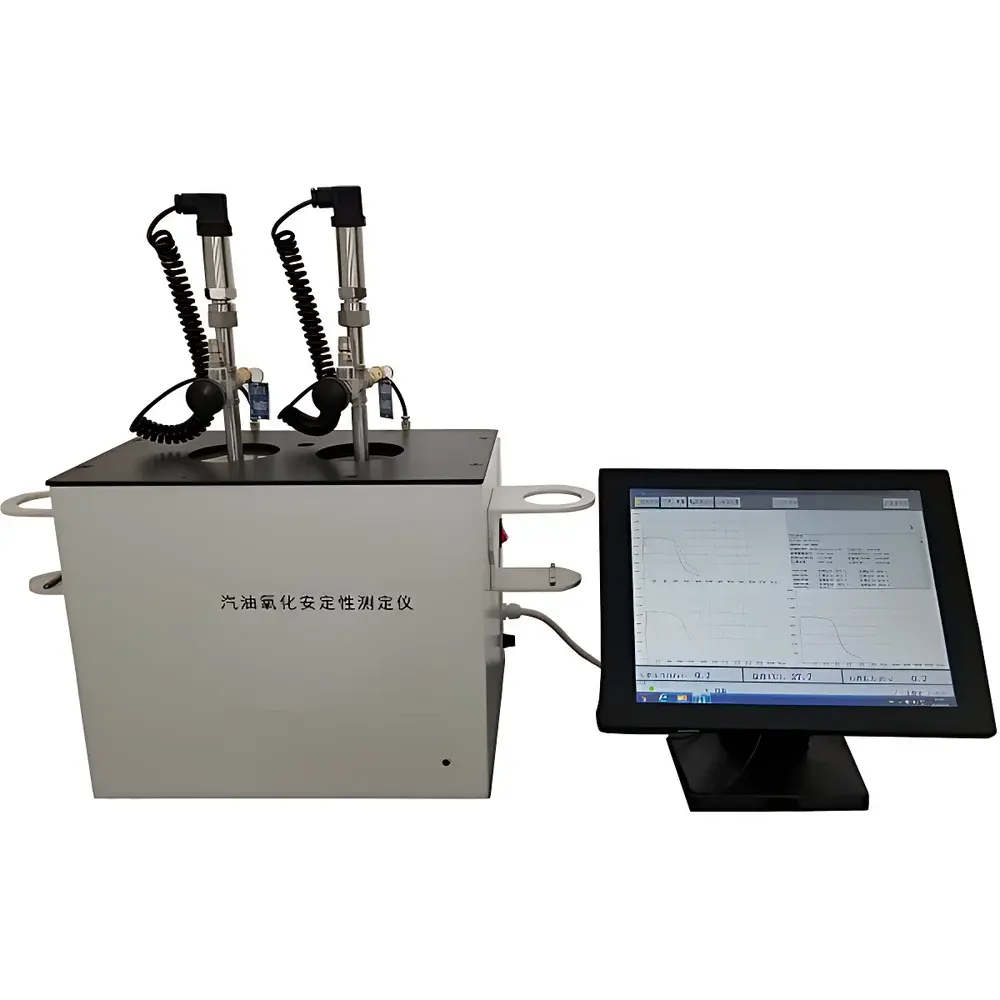
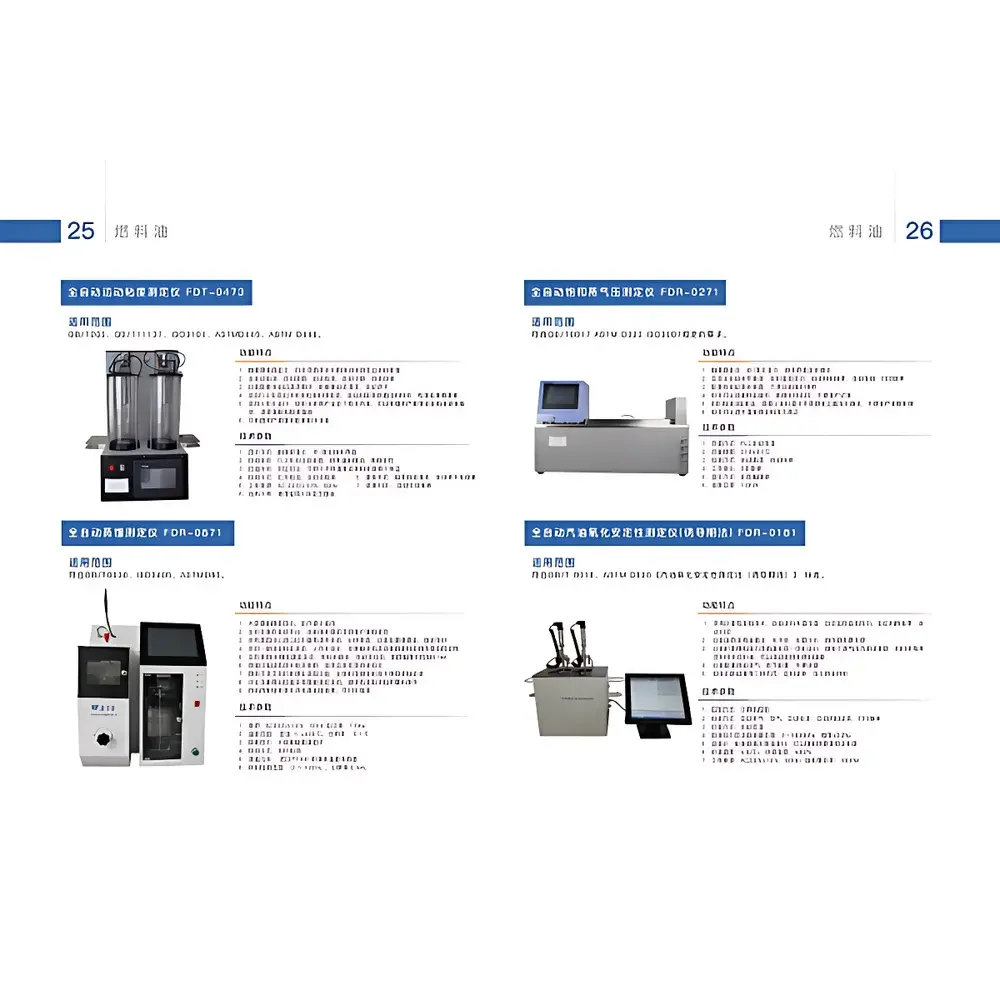
Flender FDR-0181 Fully Automated Gasoline Oxidation Stability Tester (Induction Period Method)
| Brand | Flender |
|---|---|
| Model | FDR-0181 |
| Standard Compliance | GB/T 8018–1987, ASTM D525 |
| Temperature Control | 100 °C ±1 °C |
| Pressure Measurement Range | 0–1600 kPa (Accuracy: ±0.2 ‰ FS) |
| Heating Power | 1600 W |
| Interface | USB |
| Bath Type | Heated Metal Block (No Water Refill Required) |
| Ambient Operating Conditions | ≤30 °C, ≤80 % RH |
| Power Supply | AC 220 V ±10 %, 50 Hz |
Overview
The Flender FDR-0181 Fully Automated Gasoline Oxidation Stability Tester is an engineered solution for quantitative assessment of gasoline resistance to oxidative degradation under accelerated conditions, in strict accordance with the induction period method defined in GB/T 8018–1987 and ASTM D525. This instrument operates on the principle of pressurized oxygen exposure at controlled elevated temperature (100 °C), monitoring pressure decay over time within a sealed oxygen bomb assembly. The onset of rapid pressure drop—indicative of hydroperoxide accumulation and subsequent autoxidation chain propagation—is detected as the inflection point in the real-time P–t curve, defining the oxidation induction period (OIP). This metric serves as a critical quality control parameter for refinery blending, fuel storage stability evaluation, and regulatory compliance verification across downstream petroleum operations.
Key Features
- Integrated metal-block heating bath eliminates water-based thermal media, ensuring zero evaporation loss, no maintenance refills, and consistent thermal uniformity across all test positions.
- Automated oxygen handling system performs precise initial pressurization (typically to 700 kPa), real-time leak detection prior to test initiation, and dynamic pressure compensation during extended runs—minimizing operator intervention and procedural variability.
- High-fidelity pressure transducer (0–1600 kPa, ±0.2 ‰ full-scale accuracy) coupled with calibrated reference mercury-in-glass thermometer enables traceable, NIST-aligned calibration verification per ASTM D525 Annex A1.
- Optimized oxygen bomb assembly features monolithic construction with integrated high-integrity needle valve sealing—reducing internal dead volume by >40% versus legacy designs and improving pressure response fidelity and repeatability (RSD <1.2% for certified reference fuels).
- Intelligent thermal insulation architecture maintains external surface temperature below 45 °C during continuous operation, satisfying IEC 61010-1 requirements for operator safety and laboratory ergonomics.
- USB-connected PC interface supports deterministic command-response protocol, enabling full remote control, synchronized data acquisition at 1 Hz resolution, and timestamped raw signal logging compliant with ALCOA+ data integrity principles.
Sample Compatibility & Compliance
The FDR-0181 accommodates standard 500 mL oxygen bombs per ASTM D525 specifications and accepts undiluted gasoline samples—including reformulated, ethanol-blended (E10/E15), and oxygenated variants—without modification. All hardware and firmware components comply with electromagnetic compatibility (EMC) requirements per EN 61326-1 and electrical safety standards per EN 61010-1. Data acquisition and reporting workflows support audit-ready documentation aligned with GLP and GMP environments; optional software configuration enables 21 CFR Part 11-compliant electronic signatures, audit trails, and user access controls. Test reports include metadata such as ambient lab conditions (temperature/humidity), calibration certificate IDs, operator credentials, and raw pressure/temperature time-series exports in CSV and PDF formats.
Software & Data Management
The dedicated Windows-based application provides real-time visualization of dual-channel signals (pressure and bath temperature), with dynamic curve annotation of inflection points using second-derivative thresholding algorithms. Automated result interpretation applies ASTM D525 Section 10 criteria for OIP determination, including minimum pressure decay rate validation (≥14 kPa/min) and plateau confirmation prior to inflection. All acquired data are stored in a relational SQLite database with immutable record timestamps, supporting retrospective query-by-sample ID, batch number, or date range. Export modules generate ISO/IEC 17025-compliant certificates containing uncertainty budgets derived from transducer calibration certificates, temperature probe drift history, and inter-laboratory reproducibility data (k = 2, coverage factor).
Applications
- Refinery QC labs: Routine screening of finished gasoline batches against specification limits (e.g., minimum 360-min OIP for automotive gasoline per GB 17930–2016).
- Fuel additive development: Quantitative evaluation of antioxidant efficacy (e.g., hindered phenols, amine derivatives) via comparative OIP extension studies.
- Storage stability forecasting: Correlation of OIP values with long-term tank storage performance under simulated depot conditions.
- Regulatory submission support: Generation of validated test records for CNCA, SAMR, or EPA Tier 3 fuel certification dossiers.
- Third-party testing laboratories: Accredited testing per CNAS-CL01:2018 (equivalent to ISO/IEC 17025:2017) for contract analysis services.
FAQ
What standards does the FDR-0181 explicitly support?
It is fully compliant with GB/T 8018–1987 and ASTM D525, including all procedural, apparatus, and reporting requirements specified therein.
Is manual calibration required before each test?
No—systematic calibration verification is performed automatically during startup using internal reference checks; periodic full calibration (recommended annually) follows ASTM D525 Annex A1 protocols.
Can the instrument handle ethanol-blended gasoline (e.g., E10)?
Yes—the oxygen bomb materials and sealing system are chemically resistant to ethanol concentrations up to 15% v/v, and pressure decay kinetics remain analytically valid per ASTM D525 Appendix X2.
How is data integrity ensured for regulated environments?
The software implements role-based access control, electronic signature workflows, immutable audit logs, and exportable raw data archives—all configurable to meet 21 CFR Part 11 and ISO/IEC 17025 traceability requirements.
What maintenance is required for the metal bath system?
None beyond periodic visual inspection of heater contacts and cleaning of the bath cavity with lint-free cloth; no fluid replenishment, descaling, or pump servicing is necessary.





