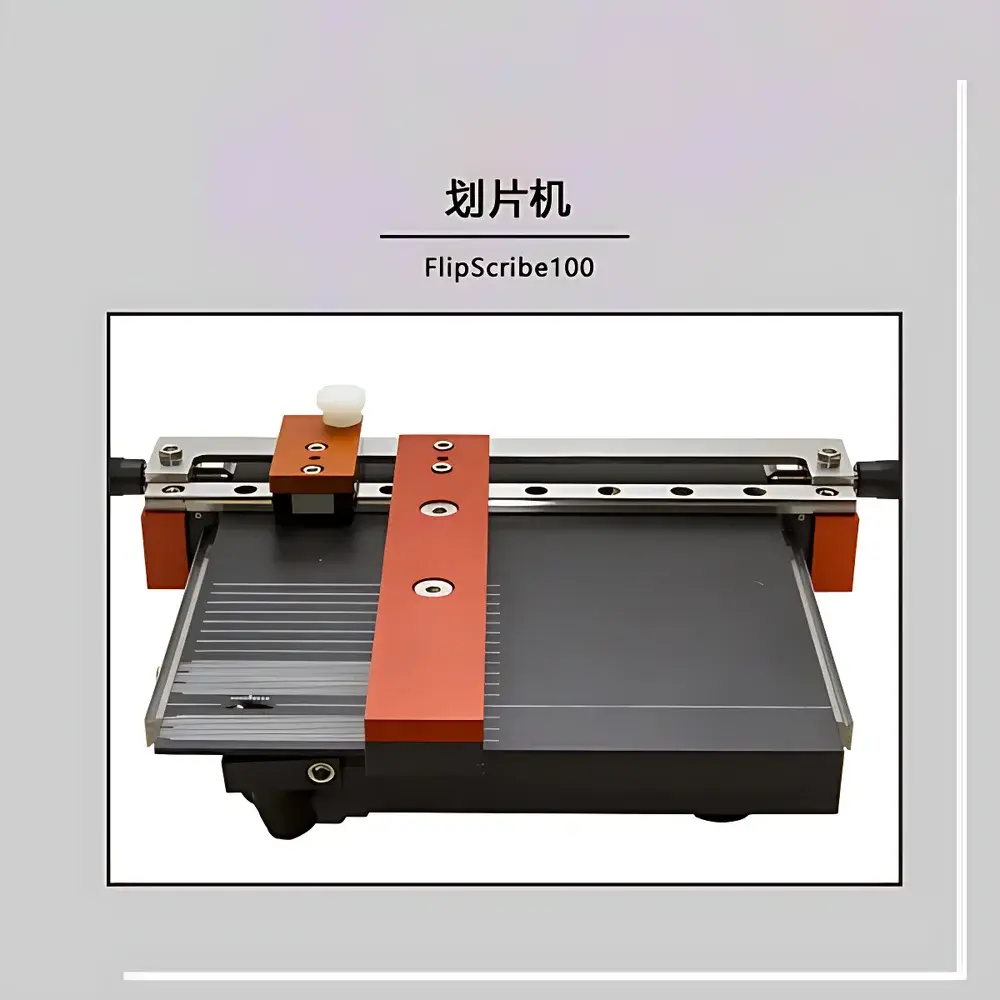
FlipScribe100 Manual Scribe Tool for Semiconductor Wafer Dicing
| Origin | USA |
|---|---|
| Manufacturer Type | Authorized Distributor |
| Origin Category | Imported |
| Model | FlipScribe100 |
| Price Range | USD 0–14,500 (FOB) |
| Max Scribing Speed | 500–600 mm/min |
| Application Scope | R&D Laboratory Environments |
Overview
The FlipScribe100 is a precision-engineered, fully manual mechanical scribing tool designed for controlled line scoring of semiconductor wafers, ceramic substrates, optical glass, and other brittle, non-ductile materials in low-volume research and development environments. Unlike motorized dicing saws that rely on rotating diamond blades and coolant systems, the FlipScribe100 employs a calibrated, hand-guided scribing principle based on controlled Hertzian indentation—where a precisely oriented diamond stylus applies localized compressive stress to initiate subsurface microcracks along a defined path. This method enables deterministic cleavage upon subsequent breaking or laser-assisted separation, preserving surface integrity and eliminating thermal damage, chipping, or debris generation typical of abrasive cutting. Its compact footprint (220 × 180 × 120 mm), zero-power operation, and absence of consumables beyond replaceable diamond cartridges make it ideal for cleanroom-adjacent lab benches, university microfabrication facilities, and prototyping labs where regulatory compliance, process traceability, and rapid iteration are prioritized over high-throughput production.
Key Features
- Precision rear-side scribing: Enables accurate alignment and scoring from the substrate backside—critical for devices with front-side metallization, MEMS structures, or fragile passivation layers that must remain undisturbed.
- Non-invasive front-surface preservation: The scribe line is generated without contact or force application to the functional device layer, ensuring zero risk of scratching, delamination, or particle generation on active surfaces.
- ±200 µm scribing accuracy (achievable under standard lab conditions): Achieved via integrated dual-axis vernier-aligned stage, embedded stainless-steel metric scale (0.1 mm resolution), and repeatable stylus height/angle adjustment mechanism (±0.5° angular tolerance).
- Universal sample accommodation: Accepts irregular geometries, bonded wafer stacks (e.g., Si-on-glass, SOI), diced die arrays, and non-planar substrates up to 150 mm in diameter or 120 × 120 mm square; no vacuum chuck or clamping required—sample stability ensured by gravity and optional low-adhesion silicone pads.
- Modular diamond cartridge system: Pre-calibrated, factory-aligned diamond scribing tips (standard tip radius: 50 µm, Vickers hardness ≥9000 HV) are user-replaceable without recalibration; each cartridge includes traceable lot documentation compliant with ISO 9001 calibration chain requirements.
- Zero-electricity mechanical architecture: No motors, controllers, or firmware—eliminates EMI concerns, reduces validation burden for GLP/GMP-aligned labs, and ensures operational continuity during power fluctuations or brownouts.
Sample Compatibility & Compliance
The FlipScribe100 supports a broad range of rigid, isotropic, and quasi-isotropic substrates including silicon (100, 111), fused silica, sapphire, alumina (96% and 99.6%), lithium niobate, and borosilicate glass (e.g., Pyrex®). It is routinely deployed in academic and industrial labs conducting ASTM F39-22 (Standard Test Method for Scribe-and-Break Strength of Brittle Materials) and JEDEC JESD22-A113 (Mechanical Shock Testing of Semiconductor Devices) pre-conditioning steps. While not a production-grade dicer, its scribe geometry and repeatability meet internal QC thresholds for qualification testing per ISO/IEC 17025-accredited laboratories. Device-level traceability is supported through optional engraved serial-number plates and compatible logbook templates aligned with FDA 21 CFR Part 11 Annex 11 data integrity expectations (manual entry only).
Software & Data Management
The FlipScribe100 operates without embedded electronics or software. All operational parameters—including scribe length (1–100 mm), stylus penetration depth (mechanically indexed via micrometer collar), and lateral offset—are set manually and recorded in laboratory notebooks or LIMS-integrated spreadsheets. For audit readiness, users may employ standardized SOP templates (provided in English and bilingual technical annexes) covering calibration verification, preventive maintenance checks (annual visual inspection of stylus wear and scale readability), and environmental monitoring logs (temperature/humidity ranges per ISO 14644-1 Class 8 ambient recommendations). No cybersecurity protocols apply due to absence of network interfaces or firmware.
Applications
- Rapid prototyping of MEMS sensor dies prior to wafer-level packaging
- Backside scribing of flip-chip bonded assemblies for controlled singulation
- Pre-dicing preparation for laser stealth dicing (LSD) processes in photonics R&D
- Controlled fracture initiation in piezoelectric material characterization studies
- Low-risk scribing of radiation-sensitive or cryogenically stored samples (no EMI or thermal load)
- Educational demonstrations of brittle fracture mechanics and crystallographic cleavage planes
FAQ
Is the FlipScribe100 compliant with ISO 13485 or IATF 16949 quality management systems?
Yes—the tool’s design, supplier documentation, and calibration traceability support integration into QMS frameworks requiring documented control of test equipment per clause 7.1.5. However, end-user responsibility includes establishing internal procedures for periodic verification and record retention.
Can it be used for scribing patterned wafers with topography (e.g., metal lines or oxide steps)?
Yes, provided step heights do not exceed ±5 µm across the scribe path; the adjustable stylus angle allows compensation for mild topographic gradients.
What is the expected lifetime of a diamond cartridge under typical lab usage?
Approximately 2,500 linear meters of scribing at nominal load (verified per ASTM E384 microhardness testing of worn tips); lifetime varies with substrate hardness and operator technique.
Does it require cleanroom certification for Class 1000 (ISO 6) environments?
No formal certification is issued, but all materials (anodized aluminum frame, stainless steel scale, PTFE-coated adjustments) comply with ISO 14644-1 particle shedding limits when operated with standard cleanroom gloves and lint-free wipes.
Is training or certification required for operators?
A two-hour hands-on competency session is recommended; no formal certification is mandated, though internal lab SOPs often include sign-off checklists aligned with CLIA or CAP guidelines for instrument-specific proficiency assessment.