
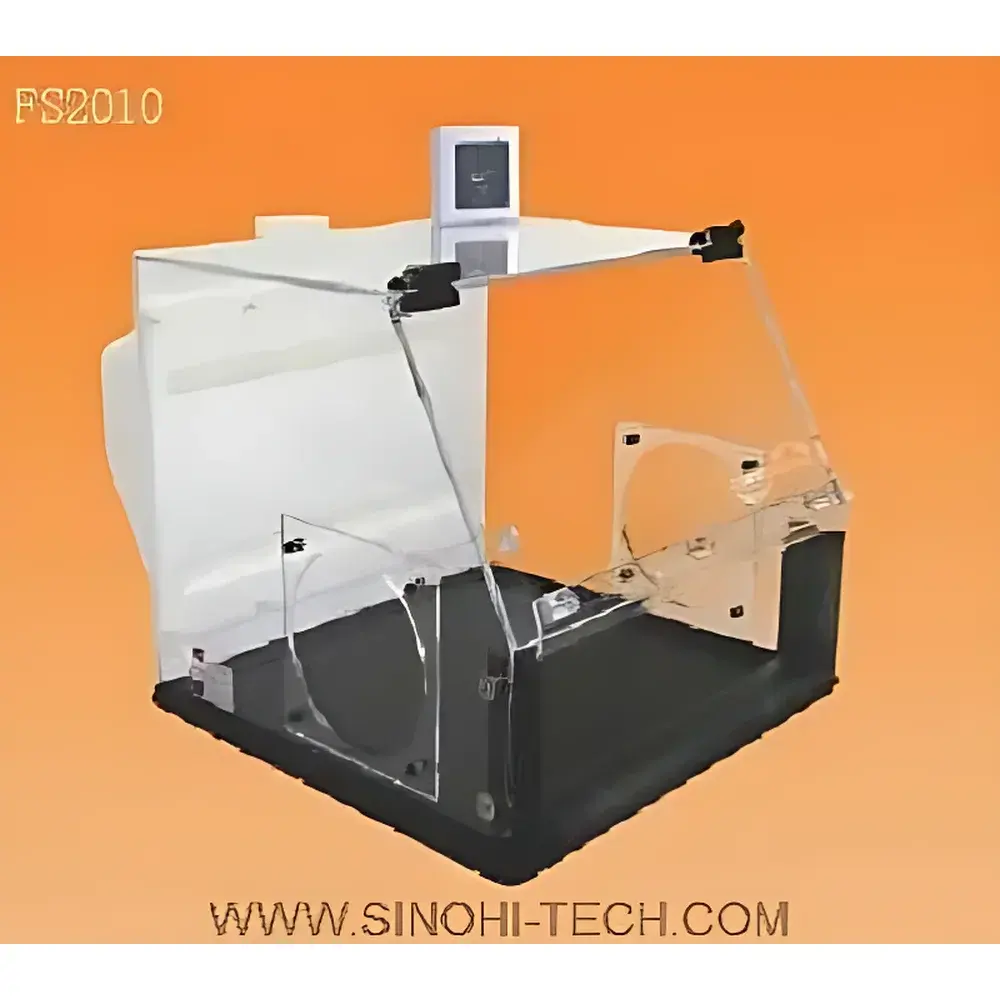
Flow Sciences FS2000 Series Balance Safety Enclosure
| Origin | USA |
|---|---|
| Manufacturer Type | Authorized Distributor |
| Origin Category | Imported |
| Model | FS2010 |
| Pricing | Available Upon Request |
Overview
The Flow Sciences FS2000 Series Balance Safety Enclosure is an engineered containment solution specifically designed for precision analytical and micro-balance applications where both operator safety and measurement integrity are mission-critical. Unlike general-purpose fume hoods, the FS2000 series employs a low-turbulence, laminar airflow architecture grounded in aerodynamic containment principles—minimizing air velocity fluctuations across the weighing surface to prevent convective disturbances that compromise balance stability, drift, or repeatability. It operates as a negative-pressure, ducted or recirculating (with optional carbon filtration) enclosure, delivering consistent face velocity control while maintaining ISO 14644-1 Class 5 (or better) particle-free conditions at the work zone. The system meets OSHA 1910.1450 and ANSI/AIHA Z9.5 laboratory ventilation standards for chemical handling, and its structural compliance supports GLP/GMP environments where documentation of containment performance and operator exposure risk mitigation is required.
Key Features
- Aerodynamically optimized slot inlet design ensures uniform, non-turbulent airflow across the entire weighing surface—eliminating localized eddies or stagnation zones that induce balance oscillation or sample desiccation.
- Patented airfoil-style side wings guide airflow smoothly from the front sash plane to the rear baffle, preventing recirculation vortices and ensuring >95% capture efficiency for particulates and vapors generated during weighing operations.
- Concave resin composite base with seamless, sloped geometry enables rapid decontamination via wipe-down or full spray-rinse protocols—critical for labs handling potent compounds, cytotoxics, or controlled substances.
- Integrated digital face velocity alarm with audible/visual indicators provides real-time verification that inflow remains within the validated operating range (typically 80–120 fpm; configurable per local safety policy).
- Modular side ports accommodate optional accessories: sealed waste bag adapters for solid residue collection, or pass-through sleeves for glove-box-integrated material transfer—reducing cross-contamination risk during high-purity workflows.
- Structural frame constructed from corrosion-resistant powder-coated steel and chemical-grade acrylic viewing panels rated for continuous exposure to organic solvents, acids, and bases.
Sample Compatibility & Compliance
The FS2000 series accommodates standard benchtop analytical balances (up to 32 cm depth), microbalances, and ultra-microbalances without mechanical interference. Its airflow profile has been validated using ASHRAE 110 tracer gas testing and smoke visualization for containment integrity under dynamic loading conditions—including powder pouring, solvent dispensing, and dry weighing of hygroscopic or volatile materials. Units comply with EN 14175-3 (fume hood performance), meet NFPA 45 fire safety requirements for chemical laboratories, and support audit-ready documentation for FDA 21 CFR Part 11–aligned quality systems when paired with optional data-logging modules.
Software & Data Management
While the FS2010 model operates via analog face velocity monitoring, higher-tier configurations (FS2020+) support optional digital integration through RS-485 or Modbus RTU interfaces. This enables connection to centralized lab ventilation management platforms for time-stamped velocity logging, alarm event history, and automated calibration reminders—all traceable for internal QA audits or regulatory inspections. All units include a factory-certified performance test report documenting initial airflow uniformity, containment leakage rate (<0.05 ppm SF₆), and sash position–velocity correlation curves.
Applications
- Weighing of highly potent active pharmaceutical ingredients (HPAPIs) under ICH Q5C and ISPE baseline guidance.
- Preparation of reference standards and certified reference materials (CRMs) requiring ISO/IEC 17025–compliant environmental controls.
- Handling of nanomaterials, radioactive tracers, or allergenic compounds where airborne mass concentration must remain below occupational exposure limits (OELs).
- Stability-indicating assays involving moisture-sensitive or oxidation-prone compounds—where ambient humidity and air movement directly impact gravimetric accuracy.
- QC/QA labs performing USP <41> balance calibration verification under controlled atmospheric conditions.
FAQ
Is the FS2000 Series compatible with automated balance doors or robotic sample handlers?
Yes—custom mounting brackets and clearance envelopes are available for integration with leading OEM balance automation systems; contact technical support for dimensional interface specifications.
Can the enclosure operate in recirculating mode without external ducting?
Recirculation is supported with optional dual-stage filtration (pre-filter + activated carbon), subject to local EH&S approval and compound-specific breakthrough testing.
What maintenance intervals are recommended for airflow verification?
Face velocity should be verified quarterly per ANSI Z9.5; full ASHRAE 110 containment testing is recommended annually or after relocation/modification.
Does Flow Sciences provide installation validation services?
Yes—certified field engineers offer IQ/OQ documentation packages aligned with GxP requirements, including airflow mapping, sash operation testing, and alarm functional verification.



