
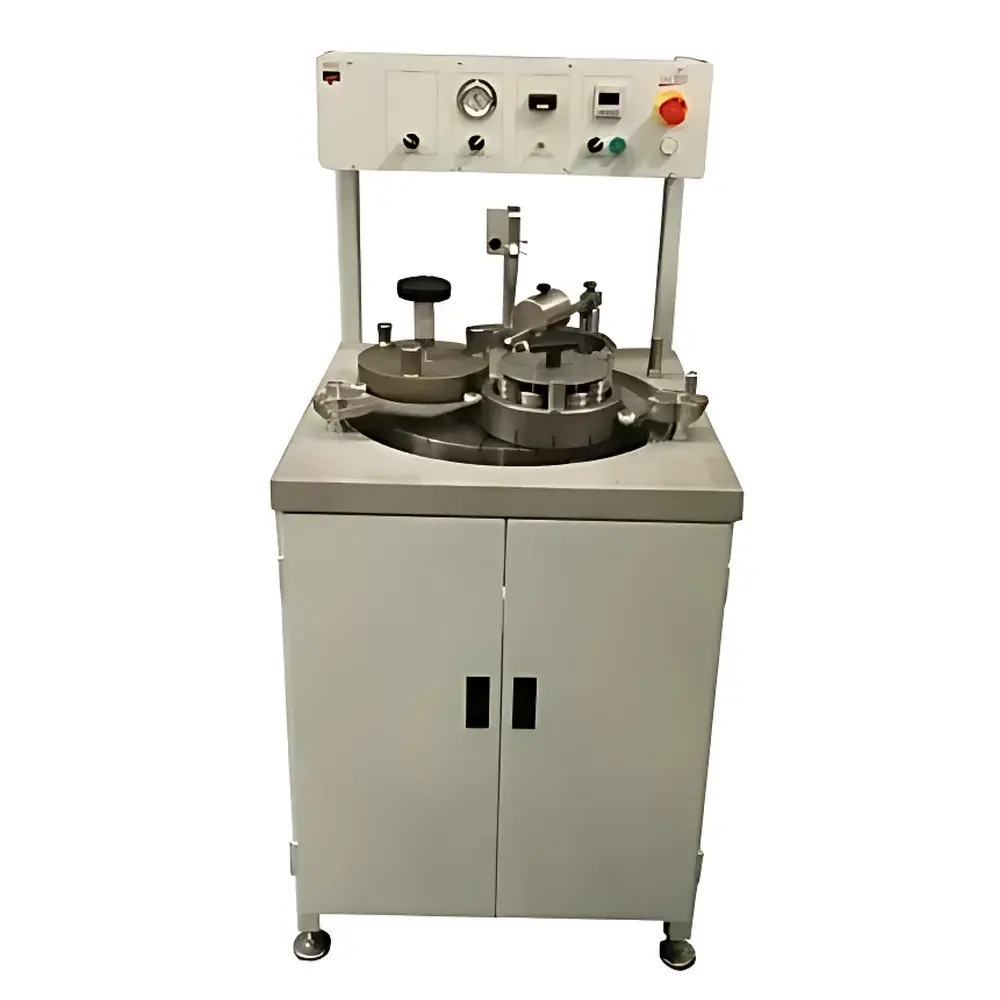
FLOXLAB LM 500 Vertical Single-Platen Precision Lapping Machine
| Brand | FLOXLAB |
|---|---|
| Origin | France |
| Model | LM 500 |
| Platen Diameter | 500 mm |
| Speed Range | 20–75 rpm |
| Timer Range | 0–10 hours |
| Sample Holder Compatibility | 30×45 mm, 60×45 mm (1×1.5 in, 1×3 in) |
| Dimensions (W×D×H) | 700×700×1400 mm |
| Weight | 25 kg |
| Power Supply | 220 V, 50/60 Hz |
Overview
The FLOXLAB LM 500 is a vertically oriented, single-platen precision lapping machine engineered for controlled material removal during the final thickness adjustment stage of petrographic thin section preparation. Designed specifically for geological and petroleum laboratory workflows, it enables reproducible, planar lapping of rock specimens prior to epoxy bonding onto glass slides—ensuring uniform thickness (typically 25–30 µm) required for optical microscopy and polarized light analysis. Its operation relies on rotational lapping mechanics: the specimen, secured in a precision-machined holder, rotates concentrically against a flat, rotating abrasive platen under controlled load and speed. This Couette-type motion—combined with consistent slurry delivery and thermal stability—minimizes edge rounding, warping, or subsurface damage, critical for preserving microstructural integrity in carbonate, siliciclastic, and shale samples.
Key Features
- Stable vertical architecture with rigid cast-iron base and column, minimizing vibration-induced runout during extended lapping cycles.
- Adjustable rotational speed (20–75 rpm) via digitally regulated AC motor, enabling optimization for soft carbonates versus hard igneous or metamorphic lithologies.
- 500 mm diameter lapping platen manufactured from high-grade cast iron with precision-ground surface flatness (< 3 µm TIR), compatible with standard 120–2000 grit silicon carbide or diamond slurries.
- Programmable digital timer (0–10 hours) with auto-shutoff, supporting unattended operation for multi-stage lapping protocols including coarse leveling, intermediate smoothing, and final fine-lapping.
- Dual-format specimen holders accommodating both 30×45 mm and 60×45 mm rock chips—designed to maintain parallelism between specimen face and platen surface within ±0.02°.
- Integrated coolant/slurry distribution system with adjustable flow rate and centralized drainage, reducing thermal drift and improving abrasive efficiency.
Sample Compatibility & Compliance
The LM 500 accommodates standard-sized rock specimens used in petroleum geoscience laboratories, including core plugs, sidewall fragments, and cuttings prepared per ASTM D3289 (Standard Practice for Preparation of Rock Thin Sections). It supports compliance with internal QA/QC procedures aligned with ISO/IEC 17025 requirements for testing laboratories, particularly where traceability of lapping parameters (speed, time, load) is mandated for thin section certification. While the instrument itself does not carry CE or UL certification as a standalone unit, its electrical design conforms to IEC 61000-6-2 (EMC immunity) and IEC 61000-6-4 (EMC emission) standards applicable to laboratory equipment. No modifications are required for use in Class II, Division 2 hazardous locations when operated outside classified zones per NFPA 70 (NEC).
Software & Data Management
The LM 500 operates via an embedded microcontroller interface with no external PC dependency; however, all operational parameters—including start time, elapsed duration, set rpm, and manual override logs—are stored in non-volatile memory with timestamping. Data export is supported via USB-C port to CSV format for integration into LIMS environments (e.g., LabWare, STARLIMS) or Excel-based QC tracking. Audit trails comply with GLP principles, retaining records for ≥7 years unless otherwise specified by client SOPs. Firmware updates are performed offline using signed binary files to ensure integrity and prevent unauthorized configuration changes—consistent with FDA 21 CFR Part 11 expectations for electronic records in regulated petroleum research settings.
Applications
- Precise thickness reduction of drill core samples for routine petrographic analysis in upstream reservoir characterization.
- Preparation of polished thin sections for cathodoluminescence (CL) and electron microprobe (EPMA) sample mounting.
- Controlled lapping of shale matrix blocks prior to focused ion beam (FIB) milling for SEM-based pore network analysis.
- Standardization of sample geometry in inter-laboratory round-robin studies evaluating porosity-permeability relationships.
- Reprocessing of archived thin sections requiring re-lapping due to delamination or uneven thickness.
FAQ
What types of abrasives are compatible with the LM 500?
Standard aqueous slurries of silicon carbide (SiC), aluminum oxide (Al₂O₃), and monocrystalline diamond are validated for use. Slurry concentration and particle size must be selected according to target material hardness and desired removal rate—refer to FLOXLAB Application Note AN-LM500-03.
Can the LM 500 be integrated into automated thin-section production lines?
Yes—the machine features dry-contact relay outputs and Modbus RTU over RS-485 for synchronization with robotic sample handlers and downstream grinding/polishing stations.
Is operator training provided with purchase?
FLOXLAB offers a two-day on-site commissioning and competency verification program covering safety protocols, parameter optimization, maintenance scheduling, and troubleshooting—delivered by certified field application engineers.
Does the LM 500 require compressed air or vacuum systems?
No. It operates solely on standard single-phase AC power and gravity-fed slurry delivery. Optional vacuum-assisted slurry recovery kits are available as accessories.
What is the recommended preventive maintenance interval?
Biannual inspection of platen flatness, bearing preload, and motor coupling alignment is advised. Full service—including recalibration of speed control and timer accuracy—is recommended every 24 months or after 2,000 operating hours, whichever occurs first.




