
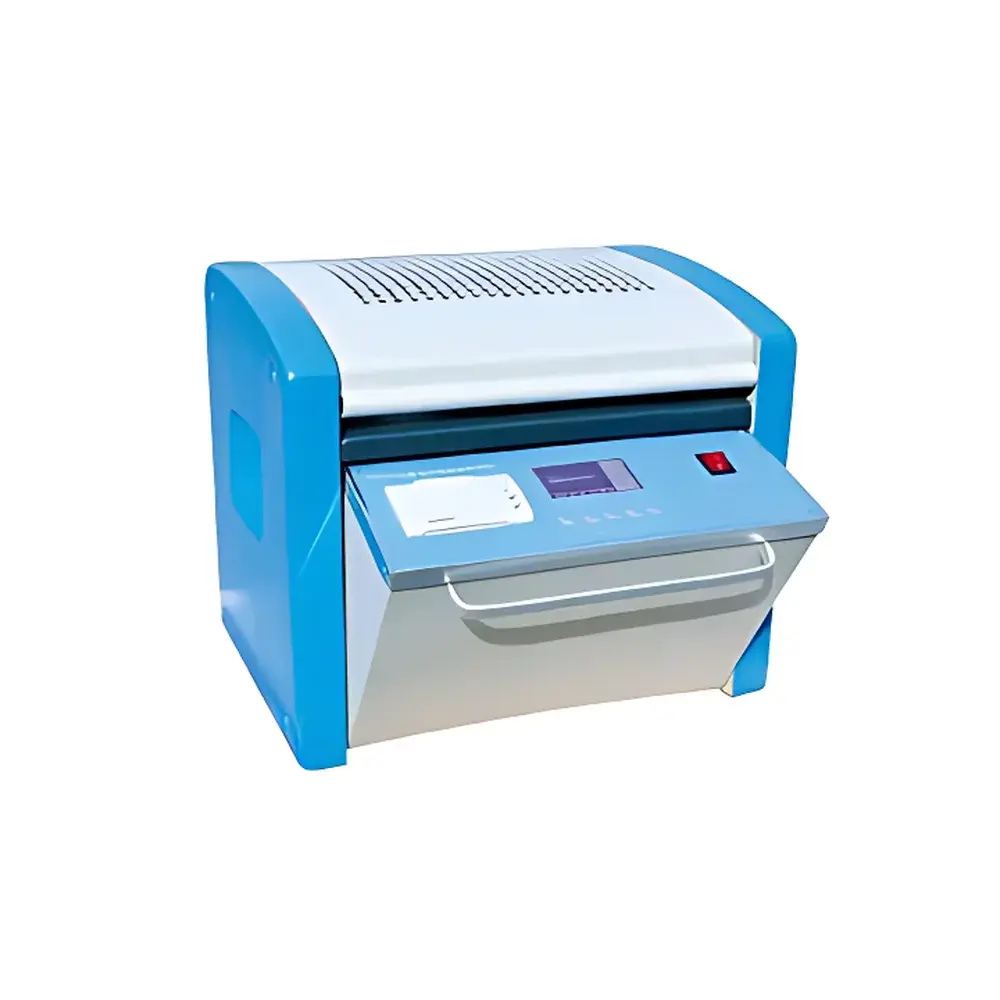
TimePower TP572 Insulating Oil Dielectric Strength Tester (Breakdown Voltage Tester)
| Brand | TimePower |
|---|---|
| Origin | Beijing, China |
| Manufacturer Type | Direct Manufacturer |
| Country of Origin | China |
| Model | TP572 |
| Pricing | Upon Request |
Overview
The TimePower TP572 Insulating Oil Dielectric Strength Tester is a microprocessor-controlled high-voltage test system engineered for precise and repeatable measurement of dielectric breakdown voltage in transformer oils and other insulating liquids. It operates on the principle of controlled AC voltage ramping across a standardized oil gap (per ASTM D877 and IEC 60156 methodologies), where the applied voltage increases linearly until electrical breakdown occurs—marked by a transient current surge exceeding preset thresholds. Designed to meet the stringent requirements of GB/T 507–1986 and DL 429.9–1991, the instrument delivers traceable, GLP-compliant results essential for predictive maintenance of power transmission infrastructure. Its dual-CPU architecture ensures deterministic timing control for voltage ramping, data acquisition, and safety interlock sequencing—critical for minimizing operator variability and ensuring regulatory audit readiness.
Key Features
- Dual-CPU embedded control system enabling synchronized execution of voltage ramping, magnetic stirring, dwell timing, and automatic arc detection
- Programmable AC voltage ramp rates: 2.0 kV/s and 3.0 kV/s (adjustable within 2.0–3.0 kV/s range), compliant with both legacy and modern test protocols
- Integrated dry-type high-voltage transformer module—compact, lightweight (45 kg), and thermally stable for continuous operation under ambient conditions of 5–40 °C and ≤85% RH
- Full automation cycle: auto-stirring (magnetic stir bar), 15-minute静止 (configurable 0–59 min), inter-test interval (3–5 min, adjustable 0–9 min), voltage ramp, breakdown detection, and zero-return
- Comprehensive hardware protection: overvoltage cutoff, overcurrent shutdown, forced auto-zero reset, and grounded chassis interlock with mandatory earth connection verification
- High-resolution LCD interface displaying real-time kV value (0.1 kV resolution), test sequence status, and pass/fail indicators per IEC 60156 pass criteria
- Onboard non-volatile memory storing up to 9 sequential test records—including date/time stamp, breakdown voltage, ramp rate, and operator ID (if configured)
Sample Compatibility & Compliance
The TP572 is validated for use with mineral-based, synthetic, and bio-derived insulating oils used in transformers, circuit breakers, capacitors, and bushings. Sample volume requirement: 350–400 mL per test, filled into a standardized ASTM D877/IEC 60156-compliant test cell (included: one precision-ground brass oil cup with 2.5 mm electrode gap). The instrument supports manual sample introduction and requires no external gas purge or vacuum degassing—making it suitable for field labs and substation environments. Regulatory alignment includes GB/T 507–1986, DL 429.9–1991, ASTM D877 (for routine screening), and IEC 60156 (for type testing and commissioning). While not FDA- or 21 CFR Part 11-certified (as it performs physical—not analytical—measurements), its deterministic firmware logic, tamper-evident test logs, and mandatory grounding protocol satisfy ISO/IEC 17025 clause 7.7 (control of equipment) and internal GLP documentation requirements.
Software & Data Management
Data output is via built-in thermal printer (standard) supporting immediate hard-copy generation of test reports with header fields: test ID, date/time, breakdown voltage (kV), ramp rate (kV/s), number of tests completed, and instrument serial number. All measurements are stored in EEPROM with timestamp and cannot be edited post-execution—ensuring data integrity for QA audits. Optional RS-232 serial interface enables integration with LIMS or SCADA systems for automated report export (ASCII format, CSV-compatible). No proprietary software installation is required; raw data files are human-readable and compatible with Excel or MATLAB for statistical trend analysis (e.g., Weibull distribution modeling of dielectric strength degradation).
Applications
- Routine quality assurance of new insulating oil prior to transformer filling (per IEEE C57.106)
- Condition monitoring of in-service transformer oil during preventive maintenance cycles
- Root-cause analysis of dielectric failure in high-voltage apparatus following fault events
- Verification of oil reclamation efficacy after filtration, dehydration, or degassing treatments
- Training and certification of substation technicians in standardized breakdown testing methodology
FAQ
What safety certifications does the TP572 hold?
The instrument complies with IEC 61010-1:2010 for electrical safety in laboratory equipment and incorporates mandatory protective earth bonding, double-insulated HV circuitry, and interlocked enclosure design.
Can the TP572 test samples other than mineral transformer oil?
Yes—it is compatible with silicone oils, ester-based fluids (natural and synthetic), and polyalphaolefins (PAOs), provided the test cell is cleaned per ASTM D923 between chemically dissimilar fluids.
Is calibration traceable to national standards?
Calibration is performed using NIST-traceable high-voltage dividers and verified annually per ISO/IEC 17025 accredited procedures; certificate includes uncertainty budget at 80 kV (k = 2, U = ±0.8 kV).
What maintenance is required?
Biannual inspection of electrode surface finish (using included standard gauge), cleaning of oil cup with anhydrous ethanol, and verification of stir bar magnetism and HV cable insulation resistance (>100 MΩ at 1 kV DC).



