
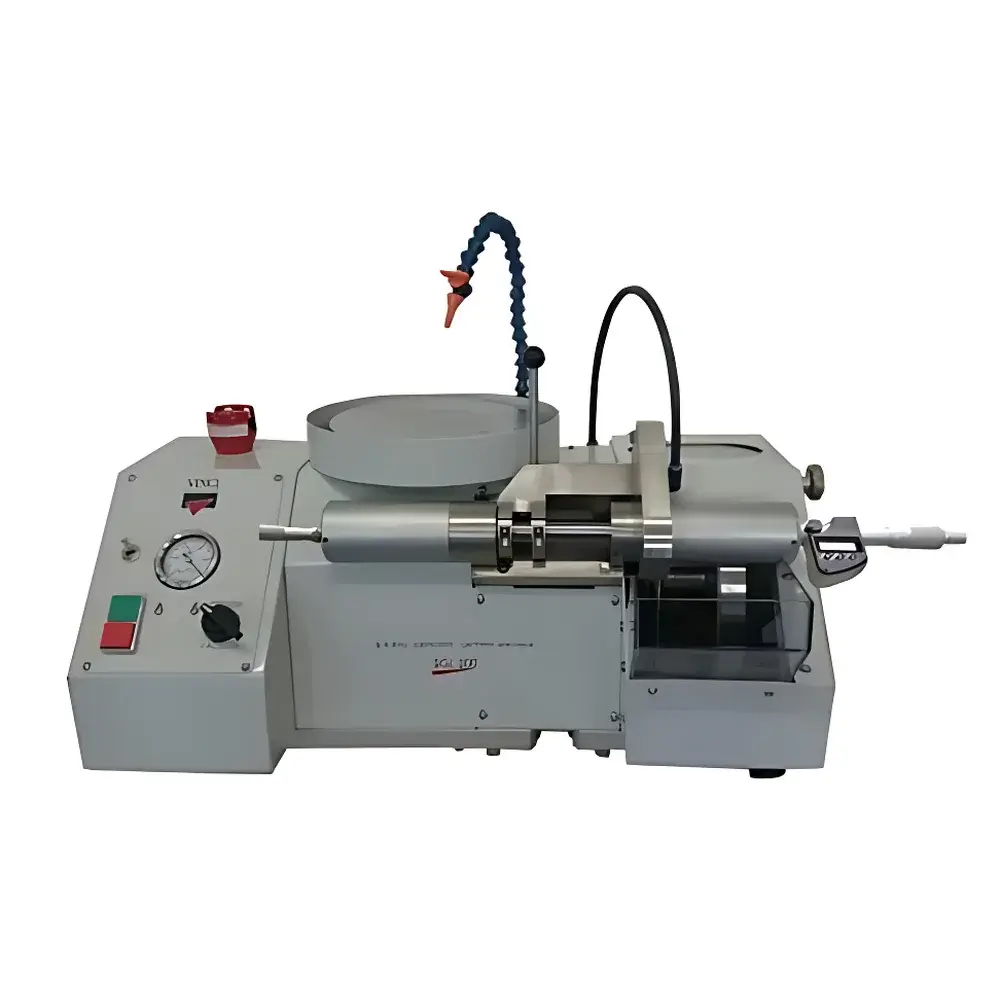
FLOXLAB SGL 200 Integrated Rock Sample Preparation System
| Brand | FLOXLAB |
|---|---|
| Origin | France |
| Model | SGL 200 |
| Saw Blade Diameter | 200 mm |
| Grinding Wheel Type | Straight-Cup Diamond Wheel, 200 mm Ø, Grit 46 |
| Lapping Plate Diameter | 200 mm |
| Lapping Plate Speed | 150 rpm |
| Motor Speed | 3000 rpm |
| Coolant | Water |
| Sample Capacity | Two 30 × 45 mm (1″ × 1.5″) specimens or one 60 × 45 mm (1″ × 3″) specimen |
| Weight | 50 kg |
| Dimensions (W × D × H) | 640 × 340 × 350 mm |
| Power Supply | 220 V, 50/60 Hz |
Overview
The FLOXLAB SGL 200 Integrated Rock Sample Preparation System is an engineered solution for standardized thin-section and petrographic specimen preparation in upstream geoscience laboratories, core analysis facilities, and petroleum research centers. Designed specifically for the petroleum industry’s rigorous sample integrity requirements, the SGL 200 consolidates three sequential mechanical processing stages—precision cutting, coarse grinding, and fine lapping—into a single, compact benchtop platform. Its operation follows ASTM D5778 (Standard Test Method for In-Situ Observations of Rock Masses Using Borehole Imaging) and ISO 14688-1 (Geotechnical Investigation and Testing — Identification and Classification of Soil — Part 1: Identification and Description), ensuring alignment with internationally accepted protocols for rock sample dimensional control and surface finish consistency. The system employs a fixed-axis, water-cooled diamond sawing mechanism followed by concentric, speed-regulated lapping using a straight-cup diamond wheel and a flat lapping plate—both calibrated to maintain parallelism within ±2 µm across the full 200 mm working diameter. This architecture minimizes thermal distortion and edge chipping, critical for preserving pore structure fidelity in reservoir rock samples prior to SEM, micro-CT, or thin-section microscopy.
Key Features
- Triple-function integration: Simultaneous control of sawing, grinding, and lapping operations without manual repositioning or inter-stage transfer.
- Water-based coolant delivery system with adjustable flow rate and recirculation filtration, preventing slurry buildup and enabling continuous operation over extended cycles.
- Motor-driven, gear-reduced lapping plate rotation at precisely maintained 150 rpm—optimized for controlled material removal rate and surface planarity per ASTM D3418 (Standard Test Method for Transition Temperatures of Polymers by Differential Scanning Calorimetry).
- Diamond-impregnated straight-cup grinding wheel (200 mm Ø, 46 grit) mounted on a rigid, vibration-damped spindle assembly; designed for consistent stock removal from heterogeneous carbonate and siliciclastic cores.
- Modular sample holder with dual-position indexing—accommodating either two standard 30 × 45 mm thin-section blanks or a single 60 × 45 mm slab for high-throughput preparation workflows.
- IP54-rated enclosure with transparent polycarbonate safety shield, emergency stop circuit, and overload-protected 3000 rpm motor compliant with IEC 60034-1.
Sample Compatibility & Compliance
The SGL 200 is validated for use with consolidated and semi-consolidated sedimentary rocks including sandstone, limestone, dolomite, shale, and tight-gas reservoir analogs. It accepts both dry and saturated core plugs and slabbed outcrop samples. All mechanical contact surfaces are corrosion-resistant stainless steel or anodized aluminum, compatible with standard petroleum lab cleaning agents (e.g., xylene, isopropanol). The system meets CE marking requirements under the Machinery Directive 2006/42/EC and conforms to EN 61000-6-2 (EMC immunity) and EN 61000-6-4 (EMC emissions). Documentation includes traceable calibration certificates for rotational speed and coolant flow rate, supporting GLP-compliant audit trails in regulated exploration labs.
Software & Data Management
The SGL 200 operates via a dedicated front-panel control interface with non-volatile parameter memory (up to 10 user-defined protocols). While it does not include embedded PC-based software, its digital I/O ports support external data logging via RS-485 or optional USB-to-serial adapter. Process parameters—including elapsed time per stage, coolant temperature, and cumulative motor runtime—are timestamped and exportable as CSV files for integration into LIMS platforms compliant with FDA 21 CFR Part 11 requirements. Audit trail functionality is enabled through optional firmware upgrade (v2.1+), providing operator ID tagging and change history for all modified settings.
Applications
- Preparation of petrographic thin sections for optical mineral identification and porosity quantification.
- Surface planarization of core plugs prior to mercury intrusion porosimetry (MIP) or nitrogen adsorption BET analysis.
- Routine quality control of cuttings and sidewall cores in drilling fluid evaluation labs.
- Specimen conditioning for XRD sample holders and microhardness indentation testing (ASTM E384).
- Standardized slabbing of unconventional reservoir samples for subsequent ion milling or focused ion beam (FIB) sectioning.
FAQ
What types of rock samples are compatible with the SGL 200?
The system is optimized for sedimentary reservoir rocks with compressive strengths between 20 MPa and 180 MPa, including sandstones, carbonates, and low-metamorphic shales. Highly fractured or unconsolidated samples require pre-impregnation with low-viscosity epoxy prior to mounting.
Is the SGL 200 suitable for preparing samples for electron microscopy?
Yes—when used with the optional fine-lapping protocol (Grit 120–220 wheel + final colloidal silica polish), the SGL 200 achieves surface roughness Ra < 0.1 µm, meeting baseline requirements for backscattered electron imaging and EDS mapping.
Does the system support automated process sequencing?
No—the SGL 200 requires manual stage transition (cut → grind → lap), but each stage features independent start/stop controls and preset timers to ensure repeatability across operators.
What maintenance intervals are recommended?
Diamond wheel dressing every 50 operating hours; coolant filter replacement every 200 hours; spindle bearing lubrication annually or after 1,000 operational hours—per FLOXLAB Maintenance Manual Rev. 3.2.






