
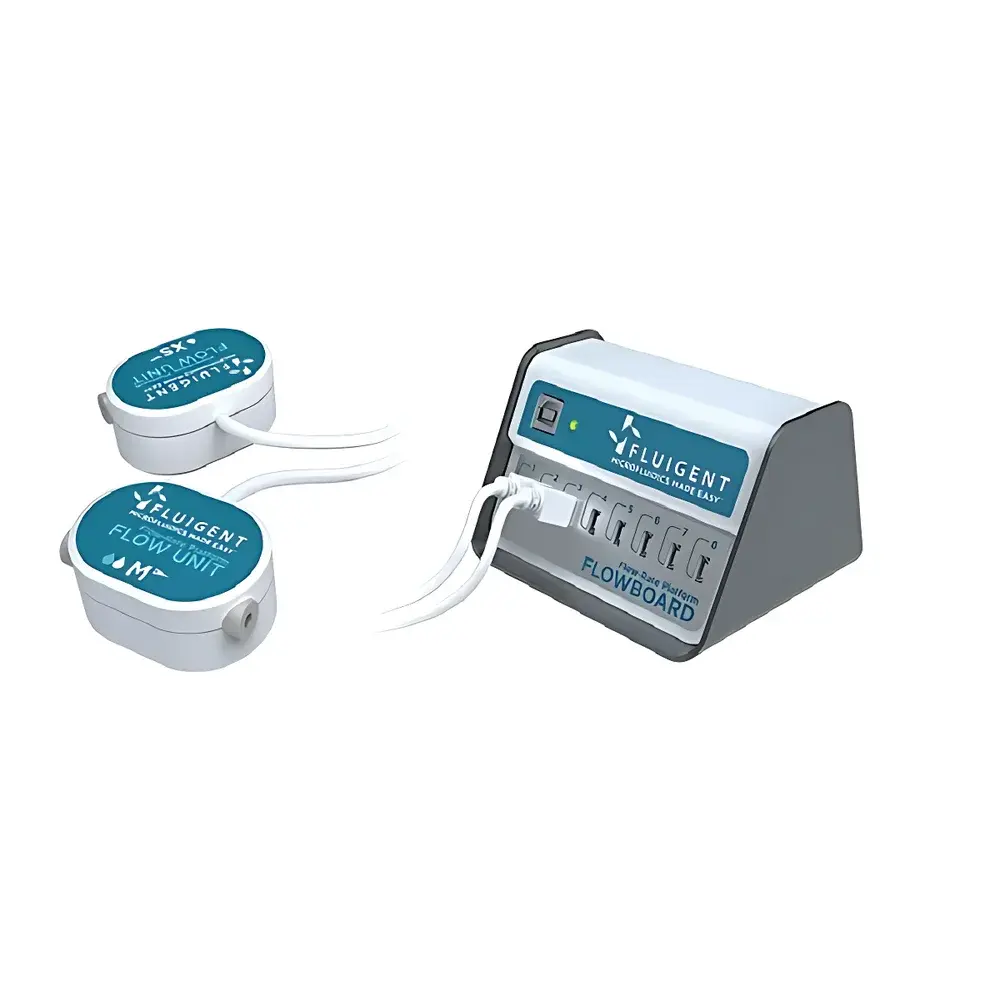
Fluigent FRP Flow Rate Platform – High-Precision Microfluidic Flow Sensor System
| Brand | Fluigent |
|---|---|
| Origin | France |
| Model | FRP Flow Rate Platform (comprising FLOW UNIT sensor + FLOWBOARD controller) |
| Flow Range Options | 7 nL/min to 5 mL/min |
| Sensor Types | XS, S, M, L, XL |
| Communication Interface | USB |
| Max Channels per FLOWBOARD | 8 |
| Software | Fluigent AIO (All-in-One) v3.x |
| Compliance | CE-marked, RoHS-compliant, designed for GLP-compatible lab environments |
| Instrument Category | Microfluidic Chip System |
| Integration | Standalone or embedded in pressure-driven microfluidic control setups |
Overview
The Fluigent FRP Flow Rate Platform is a modular, high-accuracy microfluidic flow monitoring system engineered for quantitative, real-time volumetric flow rate measurement across a broad dynamic range—from ultra-low nanoliter-per-minute regimes to milliliter-scale delivery. At its core lies the FLOW UNIT, a thermally-based mass flow sensor operating on the principle of thermal time-of-flight (TTOF) calorimetry. Each FLOW UNIT integrates a microfabricated silicon chip with two precision platinum resistance temperature detectors (RTDs) positioned symmetrically upstream and downstream of a localized resistive heater. As fluid passes through the microchannel, the heater introduces a controlled thermal pulse; the resulting asymmetry in thermal front propagation—quantified via differential temperature rise between the two RTDs—is directly correlated to volumetric flow velocity under laminar conditions. This physics-based approach eliminates reliance on fluid property calibration for water-like media and ensures high reproducibility (< ±1.5% full scale repeatability) across repeated measurements. The FRP system is not a standalone pump or pressure controller but a metrological-grade sensing layer designed for integration into existing microfluidic infrastructure—including Fluigent’s MFCS™ pressure controllers, third-party syringe pumps, or custom-built pneumatic manifolds.
Key Features
- Five interchangeable sensor modules (XS, S, M, L, XL) covering seven orders of magnitude in flow range: 7 nL/min–5 mL/min, enabling optimal signal-to-noise ratio and minimal uncertainty for each application domain.
- Real-time digital output via USB interface with sub-second response time (t90 < 300 ms), supporting closed-loop feedback integration when paired with compatible actuators.
- FLOWBOARD controller provides synchronized multi-channel acquisition—up to eight FLOW UNIT sensors per board—with timestamped data logging at user-configurable sampling rates (1–100 Hz).
- Temperature-compensated operation (15–40 °C ambient), with built-in thermal drift correction algorithms validated across glycerol/water mixtures (0–80% v/v) and common cell culture media (e.g., DMEM, PBS).
- Rugged stainless-steel wetted path (316L SS) and fluoropolymer-sealed connections ensure chemical compatibility with organic solvents, aqueous buffers, and low-conductivity biological suspensions.
Sample Compatibility & Compliance
The FRP platform is validated for use with Newtonian and weakly non-Newtonian fluids typical in life science workflows, including cell-laden hydrogels (≤ 5 mPa·s), lipid emulsions, and microdroplet carrier oils (e.g., HFE-7500). It is incompatible with particulate-laden suspensions > 5 µm median diameter or highly viscous polymer melts (> 500 mPa·s). All FLOW UNIT sensors are CE-marked and RoHS-compliant. The AIO software supports audit trail generation and electronic signature functionality aligned with FDA 21 CFR Part 11 requirements for regulated environments. Data export formats include CSV, HDF5, and MATLAB-compatible .mat files—facilitating traceability in GLP and early-stage GMP applications.
Software & Data Management
The Fluigent AIO (All-in-One) software v3.x serves as the unified interface for configuration, visualization, and data export. It provides simultaneous real-time graphs for all connected channels, customizable alarm thresholds (e.g., flow deviation > ±5%), and automated report generation with metadata embedding (operator ID, timestamp, sensor serial number, environmental log). Raw sensor data streams are buffered onboard the FLOWBOARD to prevent packet loss during high-frequency acquisition. Exported datasets include calibrated flow values (nL/min), raw ΔT signals (mK), heater power (mW), and internal temperature compensation coefficients—enabling post-hoc reprocessing and uncertainty budgeting per ISO/IEC 17025 guidelines.
Applications
- Droplet generation: Precise quantification of oil/water phase flow ratios in T-junction or flow-focusing geometries to stabilize monodisperse emulsion formation.
- Single-cell analysis: Monitoring perfusion rates in microfluidic trapping arrays to maintain physiological shear stress (< 0.5 Pa) during long-term live-cell imaging.
- Organ-on-a-chip: Validating endothelial barrier integrity via trans-endothelial flow resistance metrics under pulsatile flow profiles mimicking capillary hemodynamics.
- Microscale synthesis: Tracking reagent stoichiometry in segmented-flow reactors where residence time distribution depends critically on absolute flow accuracy.
- Rheological probing: Coupling with particle-tracking velocimetry (PTV) to derive local viscosity maps in viscoelastic biopolymer solutions under controlled extensional strain.
FAQ
Can the FRP system measure flow in gas-phase microchannels?
No. The FLOW UNIT is calibrated exclusively for liquid-phase applications; gas compressibility and thermal conductivity differences invalidate the TTOF model assumptions.
Is sensor recalibration required after changing fluid type?
For water-miscible Newtonian fluids within ±20% density/viscosity deviation from calibration standards (e.g., PBS vs. 10% sucrose), no recalibration is needed. Significant deviations (e.g., ethanol or DMSO) require user-defined fluid property input in AIO software.
What is the minimum recommended inner diameter for tubing interfaced with FLOW UNIT?
Fluigent specifies 100 µm ID fused silica or PEEK tubing for optimal laminar flow development and pressure drop management; larger IDs (>500 µm) may compromise spatial resolution of thermal detection.
Does the FLOWBOARD support Ethernet or analog I/O for industrial PLC integration?
No. Communication is USB 2.0 only. Analog voltage output (0–5 V) is available via optional DAQ module (sold separately); native Ethernet or Modbus support is not implemented.
How is long-term stability verified during continuous operation?
Each FLOW UNIT undergoes 72-hour burn-in testing at rated flow, with drift monitored against NIST-traceable gravimetric standards; typical baseline shift is < 0.3% FS/month under controlled lab conditions.



