Fluigent Raydrop PLGA Micro/Nanoparticle Fabrication System
| Brand | Fluigent |
|---|---|
| Origin | France |
| Manufacturer Type | Authorized Distributor |
| Product Origin | Imported |
| Model | Fluigent-PLGA |
| Chip Type | Raydrop™ |
| Chip Material | Fluorinated Ethylene Propylene (FEP) with Integrated Glass Viewing Window |
| Detection Limit | Sub-micron droplet resolution via high-speed digital microscopy |
| Channel Dimensions | 1–50 µm (standard Raydrop chip configurations) |
| Target Analyte | Poly(lactic-co-glycolic acid) (PLGA) micro/nanoparticles |
| Solvent Compatibility | Ethyl acetate, dichloromethane, acetonitrile, and other low-surface-tension organic solvents |
Overview
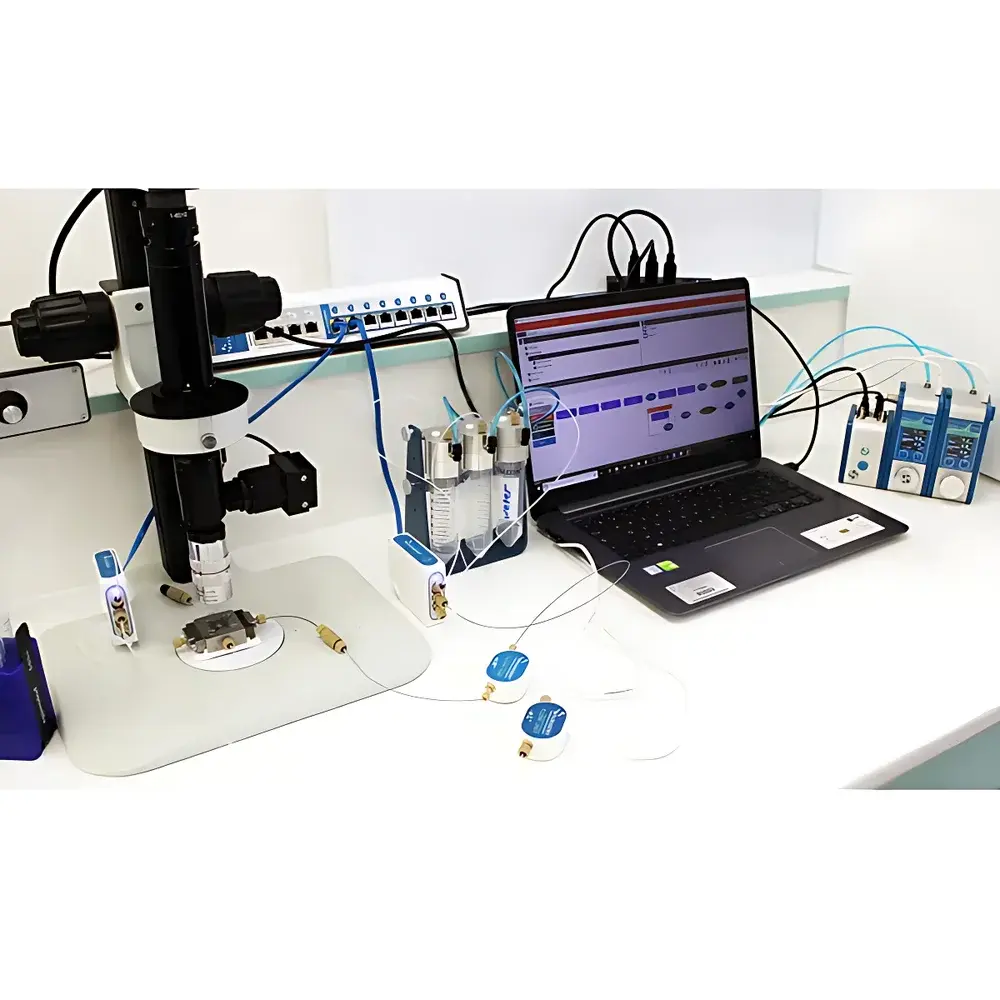
The Fluigent Raydrop PLGA Micro/Nanoparticle Fabrication System is a fully integrated, pressure-driven microfluidic platform engineered for the reproducible, continuous generation of monodisperse poly(lactic-co-glycolic acid) (PLGA) microparticles and nanoparticles. Based on coaxial or flow-focusing droplet microfluidics, the system leverages precise hydrodynamic control to generate uniform aqueous or organic-phase droplets—subsequently solidified into PLGA particles via solvent evaporation or diffusion-based precipitation. Unlike batch emulsification methods, this system eliminates shear-induced aggregation and inter-batch variability, delivering particles with coefficient of variation (CV) < 2% in diameter—critical for controlled drug release kinetics, in vitro release profiling, and regulatory-compliant formulation development. The core architecture centers on the Raydrop™ chip—a thermally stable, optically transparent FEP/glass hybrid device enabling real-time visualization and process validation under laminar flow conditions.
Key Features
- Two independent FLOW-EZ pressure controllers (0–2000 mbar range, ±0.1% FS accuracy) for independent phase flow regulation—enabling precise tuning of droplet size, frequency, and composition.
- Raydrop™ droplet generator chip with customizable channel geometry (standard: 1–50 µm internal dimensions), fabricated from biocompatible, solvent-resistant fluorinated ethylene propylene (FEP) and integrated borosilicate glass viewport.
- Real-time monitoring via high-speed digital microscope (≥1000 fps, 2 µm spatial resolution) synchronized with acquisition software for droplet size distribution analysis pre-solidification.
- Automated two-position 3/2 switching valves for sequential collection of waste stream and particle-laden droplets—supporting multi-step processing (e.g., quenching, washing, stabilization) without manual intervention.
- Integrated flow sensors (±1% reading accuracy) providing closed-loop feedback for long-duration experiments (>24 h) with minimal drift or clogging risk.
- Modular design compatible with third-party collection vessels (e.g., ice-cooled vials, rotating collectors, or inline solvent removal modules).
Sample Compatibility & Compliance
The system is validated for use with PLGA polymers across molecular weights (10–150 kDa) and lactide:glycolide ratios (50:50 to 85:15), dissolved in ethyl acetate, dichloromethane, or acetonitrile at concentrations ranging from 0.5–15% (w/v). Particle diameters are tunable from 150 nm to 50 µm via systematic adjustment of flow rate ratio (aqueous:organic), total flow rate, and interfacial tension modifiers (e.g., PVA, poloxamer 188). All wetted components comply with USP Class VI and ISO 10993-5 cytotoxicity standards. The platform supports GLP-aligned operation through timestamped sensor logs, audit-trail-enabled software, and user-access-controlled parameter locking—facilitating alignment with FDA 21 CFR Part 11 requirements when paired with validated LIMS integration.
Software & Data Management
Operation is managed via Fluigent’s MAESFLO™ software suite (v4.2+), offering intuitive drag-and-drop protocol building, real-time flow visualization, and automated droplet sizing via edge-detection algorithms. Raw video streams and sensor data (pressure, flow, valve position) are time-synchronized and exported in HDF5 or CSV format for downstream statistical analysis (e.g., Dv10/Dv50/Dv90, span, CV%). Software supports IQ/OQ documentation templates aligned with ASTM E2500-13 and ISO/IEC 17025 calibration traceability frameworks. Remote monitoring and alarm-triggered shutdown (e.g., pressure spike >1800 mbar) enhance operational safety during unattended runs.
Applications
- Pharmaceutical development: Scalable synthesis of PLGA microspheres for peptide, protein, and mRNA encapsulation—supporting early-stage formulation screening and IVIVC modeling.
- Tissue engineering: Fabrication of uniform scaffolds or bioactive carrier particles with defined porosity and degradation profiles.
- Diagnostics: Production of calibrated PLGA reference particles for flow cytometry standardization and microfluidic assay validation.
- Academic research: Mechanistic studies of polymer precipitation kinetics, interfacial rheology, and droplet coalescence inhibition under controlled confinement.
- Regulatory submissions: Generation of GMP-relevant process data packages—including process maps, failure mode analysis, and robustness testing reports—for IND/IMPD dossiers.
FAQ
What solvents are compatible with the Raydrop chip?
Ethyl acetate, dichloromethane, chloroform, and acetonitrile are routinely used; compatibility with higher-boiling-point solvents (e.g., DMSO, DMF) requires chip-specific thermal validation.
Can the system produce nanoparticles (<1 µm) with high yield?
Yes—using optimized flow-focusing geometries and low-viscosity PLGA solutions (<2% w/v), sub-200 nm particles have been demonstrated with CV < 3.5% under stabilized laminar conditions.
Is chip cleaning and reuse supported?
Raydrop chips are designed for single-use in GMP environments; however, for research applications, FEP chips may be cleaned with isopropanol/acetone sonication and nitrogen drying—subject to post-cleaning verification of droplet stability and surface wettability.
How is particle solidification integrated into the workflow?
Solidification occurs ex situ: collected droplets are transferred to stirred aqueous phases (e.g., 0.3% PVA) for solvent diffusion, or subjected to rapid rotary evaporation—both protocols are documented in Fluigent’s Application Note AN-PLGA-03.
Does the system support temperature control during droplet generation?
Ambient operation is standard; optional Peltier-cooled chip holders (−10°C to +60°C) and thermostatted reservoirs are available as add-on modules for temperature-sensitive polymer formulations.