
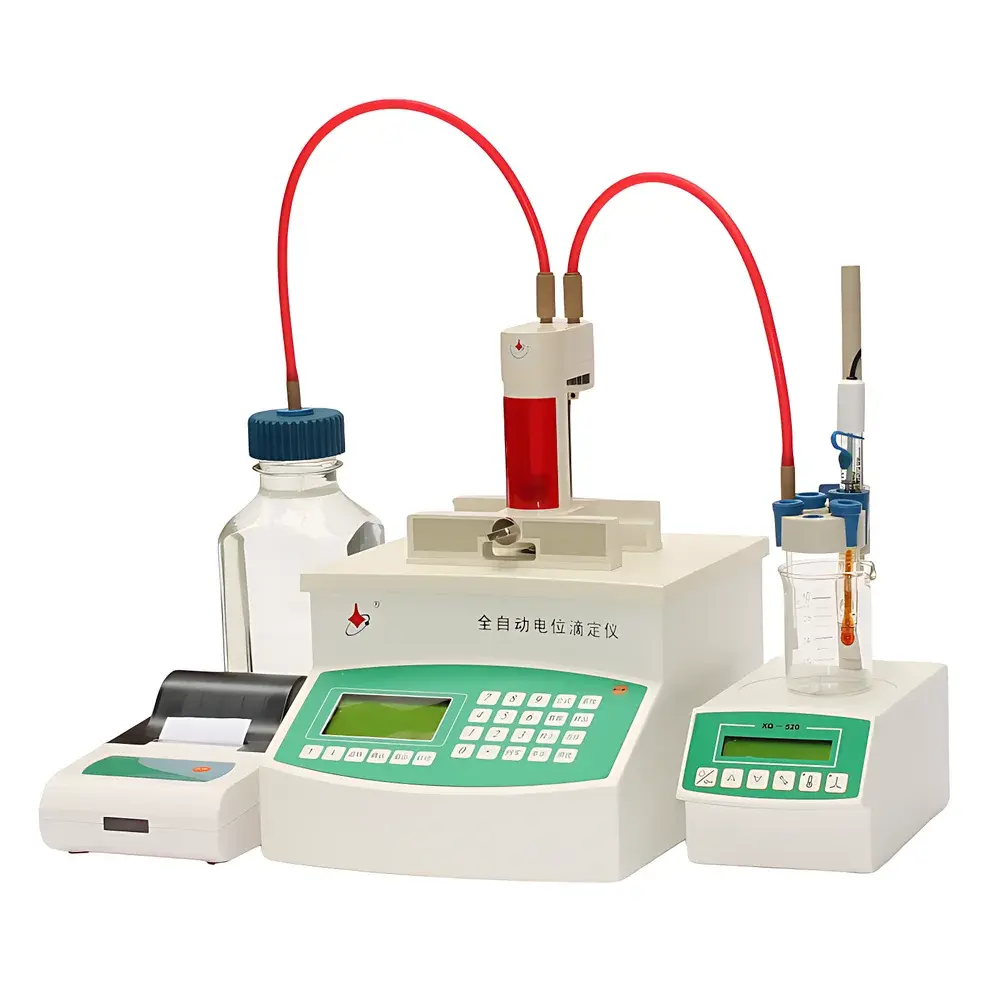
Forerunner ZDJ-3D Automatic Potentiometric Titrator
| Brand | Forerunner |
|---|---|
| Origin | Beijing, China |
| Model | ZDJ-3D |
| Instrument Type | General-Purpose Potentiometric Titrator |
| Application Scope | Universal |
| Potential Measurement Range | 0–2000 mV |
| Meter Accuracy | ±0.1 mV |
| Meter Resolution | 0.1 mV |
| Titration Accuracy | ±0.2 mV or ±0.1% of reading |
| Titration Resolution | 1/100,000 |
| Temperature Control | PID with dynamic compensation, external heating/cooling interface |
| Display | Large backlit Chinese LCD |
| Communication | RS-232 serial interface |
| Software Platform | Windows-based monitoring software |
| Titration System | Piston-driven burette with anti-diffusion titration tip |
| Burette Mounting | Push-in modular design |
Overview
The Forerunner ZDJ-3D Automatic Potentiometric Titrator is a benchtop electrochemical analyzer engineered for precision potentiometric endpoint detection in quantitative chemical analysis. It operates on the fundamental principle of measuring the potential difference between a reference electrode and an indicator electrode as a function of titrant volume, enabling accurate determination of stoichiometric equivalence points in acid-base, redox, precipitation, and complexometric titrations. Designed for routine QC laboratories, academic research facilities, and industrial process control environments, the ZDJ-3D delivers high reproducibility and robust architecture without requiring operator intervention during titration execution. Its modular hardware architecture supports seamless integration into existing analytical workflows, while its compliance-ready design facilitates alignment with documented procedures under GLP and GMP frameworks.
Key Features
- Potential measurement range of 0–2000 mV with meter accuracy better than ±0.1 mV and resolution of 0.1 mV — meeting ASTM E2081 and ISO 8655-4 requirements for electrode calibration verification.
- High-precision piston burette system featuring anti-diffusion titration tips and push-in modular mounting, minimizing dead-volume errors and enabling rapid reconfiguration between titrants.
- Digital titration resolution of 1/100,000 steps ensures sub-microliter dispensing fidelity; combined with endpoint detection algorithms (first/second derivative, fixed potential, or Gran plot), it supports ICH Q2(R2)-aligned method validation.
- Integrated temperature regulation via PID-controlled dynamic compensation, with optional external heating or Peltier cooling interfaces — critical for thermosensitive reactions such as weak acid–weak base titrations per USP <771>.
- Backlit Chinese-language LCD display provides real-time visualization of titration curves, method parameters, raw data, statistical summaries (mean, SD, RSD), and endpoint flags — eliminating dependency on PC for basic operation.
- RS-232 serial communication enables bidirectional data exchange with Windows-based monitoring software, supporting audit trail generation, user access control, and electronic signature capability per FDA 21 CFR Part 11 Annex 11 expectations.
Sample Compatibility & Compliance
The ZDJ-3D accommodates aqueous and non-aqueous matrices across pH 0–14 and ionic strength up to 3 mol/L, compatible with standard single-junction and double-junction reference electrodes (e.g., Ag/AgCl, SCE) and ion-selective indicators (e.g., glass pH, platinum redox, silver halide). It supports ASTM D974 (acid number), ASTM D664 (TAN), ISO 8287 (chloride in water), and pharmacopeial methods including EP 2.2.20 and JP 6.07. All firmware operations log timestamped events, and method files are digitally signed to ensure traceability — satisfying ISO/IEC 17025:2017 clause 7.7 on result reporting integrity.
Software & Data Management
The included Windows application provides method development, sequence programming, real-time curve overlay, and automated report generation (PDF/CSV/XLSX). Raw potential vs. volume datasets are stored with metadata (operator ID, date/time, electrode lot, ambient conditions). Audit trails record all parameter modifications, result deletions, and software updates. Exported data conforms to LIMS-compatible formats and includes checksums for file integrity verification. The software architecture permits configuration lock-down modes for regulated environments where unauthorized changes must be prevented.
Applications
- Determination of total acidity and base number in lubricating oils and biodiesel (ASTM D664, D974)
- Quantification of chloride, bromide, cyanide, and thiocyanate in environmental and pharmaceutical samples
- Standardization of sodium hydroxide, hydrochloric acid, silver nitrate, and EDTA solutions
- Redox titrations involving Ce⁴⁺/Fe²⁺, KMnO₄/oxalate, or iodine/thiosulfate systems
- Weak acid dissociation constant (pKa) profiling via potentiometric titration curves
- Quality control of active pharmaceutical ingredients (APIs) per USP <541> and EP 2.2.20
FAQ
Does the ZDJ-3D support GLP-compliant data handling?
Yes — full audit trail, electronic signatures, and method version control are implemented in accordance with FDA 21 CFR Part 11 and EU Annex 11.
Can the instrument perform multi-step titrations with conditional endpoints?
Yes — programmable sequences allow up to 99 titration steps with conditional logic based on pH, potential, or time thresholds.
Is electrode calibration automated?
Manual two-point calibration is supported; automatic calibration requires optional electrode recognition module (sold separately).
What maintenance intervals are recommended for the piston burette?
Burette seals should be inspected every 6 months or after 10,000 dispensing cycles; replacement kits include certified calibration certificates.
Is remote firmware update capability available?
Firmware updates require local USB connection and authenticated administrator credentials — no over-the-air updates are permitted for security and regulatory compliance.
Related Products





