
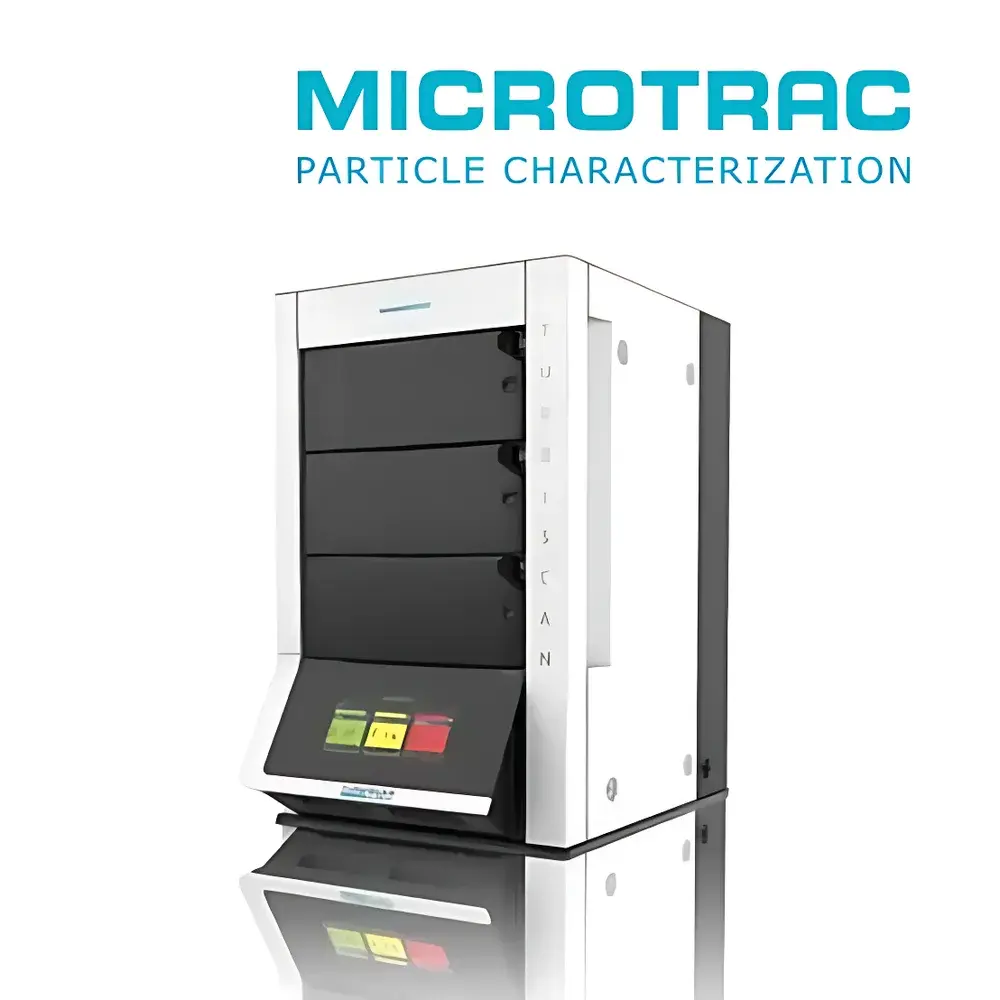
Formulaction TURBISCAN TRI-LAB Static Multiple Light Scattering Analyzer
| Brand | Formulaction |
|---|---|
| Origin | France |
| Model | TURBISCAN TRI-LAB |
| Light Source | 880 nm NIR LED |
| Sample Volume | 1.5–30 mL |
| Temperature Range | 20–60 °C |
| Sample Capacity | 1–3 positions |
| Concentration Range | 0.0001–95% v/v |
| Measurement Principle | Static Multiple Light Scattering (SMLS) |
| Detection Modes | Simultaneous Transmitted (T) and Backscattered (BS) Light |
| Output Metrics | Turbiscan Stability Index (TSI), Migration Rate, Phase Thickness, Kinetic Index, Mean Hydrodynamic Diameter, Dispersion Ratio, Redispersion Efficiency |
Overview
The Formulaction TURBISCAN TRI-LAB is a benchtop static multiple light scattering (SMLS) analyzer engineered for non-invasive, quantitative stability assessment of concentrated colloidal and dispersed systems. Unlike dynamic light scattering (DLS) or centrifugal acceleration methods, SMLS relies on the spatial and temporal analysis of near-infrared (880 nm) light propagation through undiluted, unstirred samples—enabling direct interrogation of real-world formulations across the full opacity spectrum, from transparent solutions to opaque pastes, gels, emulsions, suspensions, foams, and slurries. The instrument scans vertically along the sample height using synchronized dual detection: transmitted (T) and backscattered (BS) light intensities are recorded at high spatial resolution (40 µm step size) over time. Since T and BS signals respond differentially to particle size, concentration, and spatial distribution—governed by Mie theory and photon diffusion models—the system reconstructs vertical concentration gradients, particle migration velocities, phase separation kinetics, and aggregate growth profiles without perturbation, dilution, or calibration standards.
Key Features
- True non-destructive measurement: No sample preparation, dilution, centrifugation, or labeling required—preserves native formulation integrity.
- Triple-sample capability with independent temperature control per position (20–60 °C), enabling parallel accelerated stability studies under controlled thermal conditions.
- High-sensitivity NIR photodiode array (880 nm) optimized for minimal absorption interference in aqueous and organic media, ensuring robust signal-to-noise ratio even at >90% v/v solids loading.
- Automated TSI (Turbiscan Stability Index) calculation: A dimensionless, time-integrated metric derived from normalized variance of BS and T profiles—providing a single quantitative benchmark for comparative stability ranking.
- Real-time LCD display with live kinetic curves: Enables immediate visual feedback on destabilization onset, phase boundary movement, and signal homogeneity evolution.
- Modular hardware architecture compliant with ISO/IEC 17025 laboratory infrastructure requirements—designed for integration into GLP- and GMP-regulated environments.
Sample Compatibility & Compliance
The TURBISCAN TRI-LAB accommodates formulations ranging from low-viscosity Newtonian fluids to highly structured non-Newtonian gels and aerated foams. Its 1.5–30 mL cylindrical glass cell format supports both routine QC screening and R&D-scale formulation development. The system meets analytical traceability requirements for regulatory submissions: raw light intensity data files (ASCII .txt) retain full timestamped metadata, supporting audit trails per FDA 21 CFR Part 11 when paired with validated LIMS or ELN platforms. Method protocols align with ASTM D6573 (Standard Practice for Emulsion Stability Evaluation), ISO 13321 (Light Scattering Particle Size Analysis), and ICH Q5C (Stability Testing of Biotechnological/Biological Products), particularly for assessing physical stability endpoints such as creaming rate, sedimentation velocity, and coalescence onset.
Software & Data Management
The proprietary Turbiscan Lab v4 software provides complete control over acquisition parameters, automated baseline correction, and multi-parameter kinetic modeling. Users define custom stability thresholds (e.g., TSI > 5 = unstable), generate comparative overlay plots across batches or excipient variants, and export time-resolved profiles for statistical process control (SPC) analysis. All datasets include embedded instrument calibration logs, environmental sensor readings (temperature, humidity), and operator ID fields—facilitating full compliance with ALCOA+ principles (Attributable, Legible, Contemporaneous, Original, Accurate, Complete, Consistent, Enduring, Available). Raw data exports support third-party statistical packages (e.g., JMP, Python pandas) for advanced multivariate regression of destabilization drivers.
Applications
- Pharmaceutical: Prediction of suspension redispersibility, emulsion shelf-life, nanoparticle aggregation kinetics in injectables and topical gels.
- Food & Beverage: Quantification of fat globule migration in dairy creams, starch retrogradation in sauces, and air bubble coalescence in plant-based beverages.
- Coatings & Inks: Assessment of pigment settling resistance, rheology-stability coupling in high-solid acrylic dispersions.
- Cosmetics: Evaluation of phase inversion temperature (PIT) behavior in microemulsions, silicone oil droplet migration in antiperspirants.
- Agrochemicals: Screening of suspension concentrate (SC) long-term storage stability and wetting agent efficacy under thermal cycling.
FAQ
How does SMLS differ from dynamic light scattering (DLS)?
SMLS measures spatial heterogeneity and macroscopic migration phenomena in undiluted samples over time; DLS infers hydrodynamic size distributions from Brownian motion in highly diluted, optically clear suspensions.
Can the TURBISCAN TRI-LAB measure particle size in opaque systems?
It reports mean hydrodynamic diameter trends—not absolute size distributions—by modeling BS/T signal ratios against reference calibrants; accuracy depends on refractive index matching and monomodal assumptions.
Is temperature ramping supported?
No—temperature is held constant per test run, but three independently controlled zones allow simultaneous testing at 25 °C, 40 °C, and 60 °C for Arrhenius-based shelf-life projection.
What sample cell types are compatible?
Standard 10 mm pathlength cylindrical glass cells (1.5–30 mL); optional quartz cells available for UV-sensitive or high-pH formulations.
Does the system comply with 21 CFR Part 11?
Hardware and firmware meet technical prerequisites; full Part 11 compliance requires site-specific validation of user access controls, electronic signatures, and audit trail retention policies within the lab’s QMS framework.



